

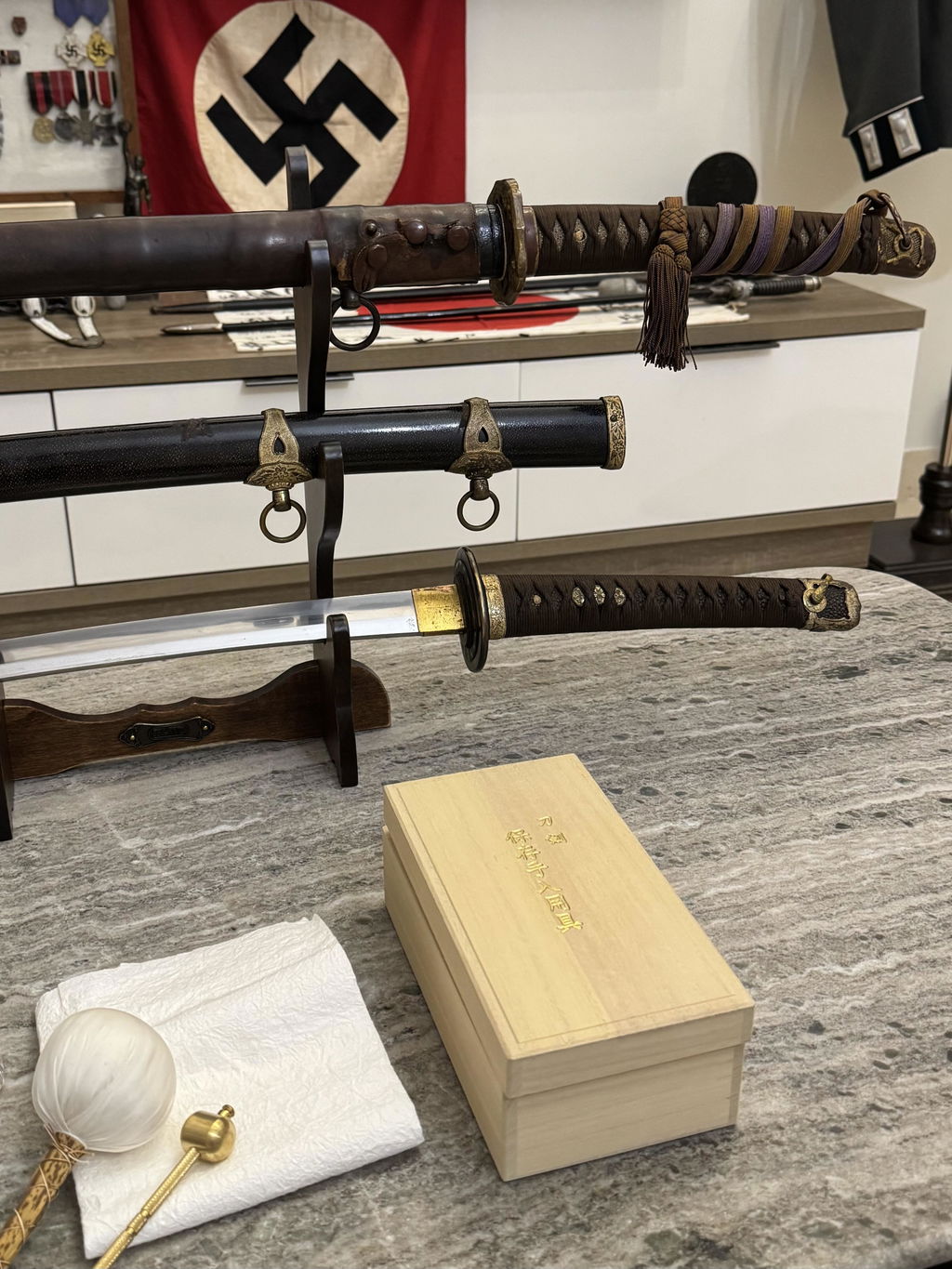
There is a revealing divide in the world of Japanese sword collecting. International collectors — particularly those new to the tradition — are drawn to koshirae: the full mounting with its lacquered scabbard, ornate tsuba, silk-wrapped handle, and decorative fittings. The complete visual package. Japanese collectors with deep experience tend to prefer the opposite: a blade in shirasaya — a plain, unpainted wooden scabbard and handle with no fittings, no lacquer, no ornament of any kind. This difference is not aesthetic accident. It reflects a fundamental insight about what makes a Japanese sword valuable — and understanding it will change how you look at every piece you encounter.
no-ki
What a Shirasaya Is — and Why It Exists
A shirasaya (白鞘) is the simplest possible mounting for a Japanese blade: a plain wooden scabbard (saya) and a plain wooden handle (tsuka), both made from ho-no-ki (magnolia), fitted precisely to the blade, with no fittings, no lacquer, no tsuba, and no decoration of any kind. The scabbard and handle are held together by a small wooden peg (mekugi) through the nakago. That is everything. There is nothing else.
The need for specialised storage is because prolonged koshirae mounting harmed the blade, owing to factors such as the lacquered wood retaining moisture and encouraging corrosion. Magnolia wood, by contrast, is soft, non-abrasive to the blade's surface, and possesses natural moisture-regulating properties — unlacquered wood absorbs small variations in humidity and reduces condensation inside the scabbard. When a significant blade is not being worn or displayed in full koshirae, the shirasaya protects it from the very thing that would damage it: moisture accumulation inside a sealed, lacquered case.
This is the practical origin of the shirasaya. But its significance in the collector's world extends far beyond storage function — and understanding that significance is the subject of this article.
choose the plain wood scabbard
The preference for shirasaya among Japan's most experienced collectors is not aesthetic minimalism. It is a statement about where value lies. In the Japanese sword tradition, the blade is everything. The koshirae — however beautiful, however historically significant — is secondary. A great koshirae on a mediocre blade is still a mediocre blade in decorative packaging. A great blade in a plain shirasaya is still a great blade — and the shirasaya makes that fact immediately visible.
This is why, in Japan's serious dealer and auction networks, a significant blade in shirasaya is a positive signal. It means the blade has been removed from its working mount and placed in storage condition — the condition appropriate for a piece of sufficient quality that its long-term preservation takes precedence over its daily appearance. A sword that has been in shirasaya for decades, with the natural patina that the plain wood develops over time, carries a different kind of visual story than a blade in fresh lacquered koshirae — one that experienced collectors read immediately.
The contrast with the international market is instructive. Overseas collectors, often introduced to Japanese swords through popular culture imagery of the fully mounted katana, associate the complete koshirae with quality and completeness. The shirasaya looks unfinished — as if something is missing. What has not yet been understood is that the koshirae is not what makes a blade significant. When a Japanese dealer or appraiser of fifty years' experience presents a blade in shirasaya, they are not showing you something incomplete. They are showing you the blade itself — stripped of everything secondary — and trusting you to understand what you are looking at.
The Sayagaki — When Plain Wood Becomes a Historical Document
The most compelling reason for an experienced collector to seek a blade in shirasaya is not the wood itself, but what may be written on it. The bare surface of the saya is the natural medium for the sayagaki — the brushed appraisal inscription that transforms the scabbard from a simple storage device into a historical document of the blade it protects.
A well-executed sayagaki functions as a historical label. It provides context and can transform a simple wooden scabbard into a portable archive of the blade it contains. When the hand that wrote the sayagaki belongs to one of the great 20th-century nihonto scholars, that archive can be extraordinarily rich — adding not merely market value but a direct connection to the generation of scholars who defined modern Japanese sword study.
Tokyo National Museum
Satō Kanzan served as director of the Sword Room of the Curatorial Department of the Tokyo National Museum, secretary general of the Society for Preservation of Japanese Art Swords, and deputy director of the Sword Museum. In any single one of these roles, Kanzan would have been among the most authoritative voices in Japanese sword scholarship. Across all of them simultaneously, he was arguably the most influential nihonto scholar of the 20th century.
Kanzan's sayagaki appears on some of the most important swords in private collections — blades he examined, authenticated, and judged worthy of his written opinion. A Kanzan sayagaki is not merely an appraisal — it is a piece of scholarship, applied directly to the blade's storage vessel, by a man whose knowledge of nihonto was institutional as well as personal. His assessments, preserved in the ink on the wood, represent the considered judgment of the head of Japan's most important public sword collection at the period of its greatest scholarly activity.
NBTHK / Sword Museum
Honma Kunzan was a Japanese sword researcher and founder, director, and president of the Society for Preservation of Japanese Art Swords — the NBTHK. In other words, he founded the very institution whose certification system is the primary authentication standard in the modern nihonto market. The NBTHK, the Sword Museum in Tokyo, and the entire scholarly infrastructure that underpins modern nihonto collecting was built, in significant part, by Honma Kunzan's vision and labour.
A Kunzan sayagaki on a shirasaya carries the weight of this foundational authority. He examined thousands of blades across a long career of extraordinary scholarly productivity — and his written opinions, preserved on the wood of the shirasayas he examined, are a direct connection to the man who created the framework within which all subsequent nihonto scholarship and authentication has operated. To own a blade with a Kunzan sayagaki is to own a piece that the founder of the NBTHK held in his hands and judged worthy of his written opinion.
NBTHK
In the living market, the most sought-after name is Tanobe Michihiro, who signs his sayagaki as Tanzan. As a former senior researcher and head of the research department at the NBTHK, his scholarship and authority are recognised worldwide, and a Tanobe sayagaki is treated by collectors as a strong endorsement of a blade. His written comments, particularly when laudatory, can materially affect how a sword is valued and how quickly it sells.
Tanobe's sayagaki carries the authority of the NBTHK research department — the same institutional knowledge base that underpins the panel appraisals on which the certification papers are based — applied as an individual scholarly assessment. A Tanobe sayagaki and NBTHK papers together on a blade are the strongest possible combination of institutional and individual expert endorsement available in the current market.
and you are reading the handwriting of the man who defined modern nihonto scholarship."
The Patina of Years — What the Wood Tells You
There is another dimension to the shirasaya's appeal that has nothing to do with scholarship and everything to do with time. A plain magnolia wood scabbard, used and touched and stored over decades, develops a patina that lacquered koshirae cannot develop — a warmth and depth in the wood's colour, a slight smoothness from years of handling, a quality that the Japanese aesthetic sensibility captures with the word wabi (侘び): the beauty of things that have aged naturally, that carry the marks of time without being diminished by them.
A new shirasaya made for a blade today is pale, almost white. A shirasaya that has been with a blade for fifty years is a warm, honey-toned amber. One that has been with a blade for a century has the colour and texture of old ivory — a material that has absorbed the oils of the hands that have held it, the slight variations in atmosphere, the accumulated trace of time. This patina is not damage. It is evidence — evidence of a blade that has been carefully preserved, carefully handled, and continuously valued across generations of ownership.
When a Japanese dealer of the old school looks at a shirasaya, they read the wood the way a collector reads a nakago. The patina's depth, colour, and character tell a story about how the blade has been kept — a story that a lacquered koshirae cannot tell in the same way, because the lacquer preserves the scabbard's appearance rather than allowing it to record time.
Shirasaya or Koshirae — What Each Signals
- The blade is significant enough to warrant storage condition rather than display condition
- The owner or previous owner understood nihonto deeply enough to prioritise the blade's preservation
- The wood may carry sayagaki — a direct scholarly connection to the blade's history
- The patina of the wood records the blade's ownership history in visible form
- The blade can be examined immediately — nakago accessed, measurements confirmed, polish inspected — without removing decorative fittings
- In Japan's collector market: a positive signal of a serious, significant piece
- The blade is presented for wearing, display, or gift — the complete visual experience
- The koshirae itself may be historically significant — period fittings are a separate collecting category
- Visual impact is immediate and complete for those unfamiliar with the blade tradition
- The lacquered scabbard preserves its own appearance but cannot record time the way shirasaya can
- Sayagaki is impossible — the lacquered surface does not accept ink
- Internationally: the preferred presentation for collectors drawn to the complete visual package
What This Means for International Collectors — A Reframe
The preference for koshirae among international collectors is entirely understandable — and there is nothing wrong with it. A great period koshirae is a significant historical artifact in its own right: the work of multiple specialist craftspeople, reflecting the aesthetic priorities of its time, and providing a visual context for the blade that shirasaya cannot. If a piece's koshirae is historically exceptional, it adds genuine value and significance.
But the insight that Japan's most experienced collectors carry — and that this article exists to share — is that the blade and the koshirae are separate things, to be evaluated separately. A blade in shirasaya with a Kanzan sayagaki and Jūyō Token papers is a vastly more significant acquisition than an equivalent blade in a beautiful koshirae with no papers and no appraisal history. The plain wood makes this immediately apparent to someone who understands the market; it may be invisible to someone who does not.
- When you see a blade in shirasaya in Tozando's collection, read the wood before you read the blade. Check whether sayagaki is present, and if so whose. The inscription on the wood may be the most historically significant thing about the piece.
- A shirasaya with deep, honey-toned patina is not a scabbard in need of replacement — it is a record of careful, continuous ownership over decades or longer. The patina is part of the value.
- If a piece comes with both shirasaya and koshirae, understand that these are separate objects with separate histories. The shirasaya may be much older than the koshirae, or vice versa. Ask our specialists to explain the relationship between them.
- A blade in shirasaya that you cannot fully appreciate visually is often a blade that rewards closer, more informed examination. The absence of decorative distraction means there is nothing between you and the steel itself — and the steel is where the tradition lives.
with the history that plain wood preserves
Tozando's antique collection includes pieces in shirasaya — some carrying sayagaki by the scholars who defined modern nihonto study. When a piece in our collection has significant inscriptions, we describe them in full. Because the writing on the wood is part of what you are acquiring — and understanding it changes what you own.
In Closing — The Eloquence of Plain Wood
The shirasaya is, by every conventional aesthetic measure, the least impressive way to present a Japanese sword. No lacquer, no ornament, no metal fittings, no silk — just plain magnolia wood, shaped to the blade and nothing more. And yet in Japan's deepest collecting culture, it is precisely this plainness that carries the most meaning.
The shirasaya says: this blade does not need decoration to be what it is. It says: whoever has kept this piece understood that the blade itself is the point. It says, sometimes, in the handwriting of Satō Kanzan or Honma Kunzan brushed in sumi ink across the wood: I held this blade, I examined it, and this is what I found.
When you learn to read a shirasaya — its patina, its inscription, its fit, the care evident in its making — you are reading the entire history of a blade's life after the forge. That history is written not in lacquer and gold, but in plain wood and ink. And sometimes, that is the most eloquent writing of all.
Sources: Tokyo Nihonto — "Sayagaki: The Appraisal Inscriptions That Add Value to a Nihonto" (2026); Medieval-Shop Blog — "Japanese Shirasaya: The Silent Scabbard That Protects the History of the Katana" (2025); Military Wiki / Fandom — "Japanese sword mountings"; Tozando Katana Shop product listings — Kanemoto katana with Kanzan sayagaki; Nakajima Rai katana with Kunzan sayagaki. Scholar biographical information: Satō Kanzan role confirmed from Tokyo National Museum records; Honma Kunzan role confirmed as NBTHK founder from publicly available NBTHK history; Tanobe Michihiro role confirmed from NBTHK staff records as cited in multiple specialist sources.
Note: The characterisation of Japanese collector preferences for shirasaya versus koshirae reflects Tozando's direct experience in Japan's nihonto market over nearly four decades, and the consensus described in specialist collecting literature. Individual preferences vary; the generalisation describes a tendency in the market rather than a universal rule.

Leave a comment: