

A collector in the United States paid $8,500 for what was advertised as a "certified Edo-period katana" on a popular online auction site. The NBTHK papers were photocopies. The signature on the tang was fake. The blade itself was a $200 replica with an acid-etched hamon. The seller disappeared. The money was gone. This story is not exceptional — it plays out thousands of times every year, across every continent, at every price point. But the fraud problem in the Japanese sword auction market goes deeper than fake blades and forged NBTHK papers. In Japan itself, cases of falsified and mismatched government registration certificates are being reported to police — including to the Kyoto Kamigyo Police Station, the precinct that covers Tozando's neighbourhood. This article tells the full story, in both markets.
a fraud pattern active inside Japan's own market
In Japan, every nihonto is legally required to carry a Token Toroku-sho (銃砲刀剣類登録証) — a government registration certificate issued by the prefectural Board of Education. This card must stay with the blade at all times. It is the legal identity document of the sword. When a sword is sold, the new owner must notify the Board of Education within 20 days. The system is designed to create a traceable ownership record for every registered blade in the country.
What the system did not fully anticipate is the incentive structure of the auction market. Cases have been reported to Japanese police — including to the Kyoto Kamigyo Police Station, the precinct that covers the Kamigyo district where Tozando's headquarters is located — involving two distinct patterns of registration certificate fraud:
Falsified Toroku-sho: Forged registration certificates, designed to look identical to genuine government-issued documents, attached to blades that have never been legally registered — or whose original registration described a different, less valuable blade. The forgery is often sophisticated enough to pass casual inspection, particularly when a buyer is unfamiliar with the specific paper, printing, and seal characteristics of a genuine Toroku-sho.
Mismatched Toroku-sho: A genuine registration certificate — belonging to a different, often more valuable or more historically significant blade — attached to a lesser or replica sword. The certificate is real; the sword it accompanies is not the one the certificate describes. The measurements, blade type, and registration number will not match the physical blade — but this requires careful physical comparison to detect, which online auction buyers cannot perform.
Both patterns are criminal offences under Japanese law. Both are active in Japan's domestic auction market. And both are invisible to an overseas buyer who cannot physically examine the blade and its documentation together before purchasing.
Why Auction Platforms Are Uniquely Dangerous for Nihonto
Japanese sword fraud exists in all market channels — but it is most concentrated and most difficult to detect in online auction environments. Understanding why requires understanding what genuine nihonto evaluation requires: physical examination of the blade under good lighting, direct inspection of the nakago and its patina, reading the NBTHK papers in their original physical form, comparing the registration certificate measurements to the actual blade, and often holding the sword to assess weight and balance. Every one of these requirements is impossible in an online auction.
-
Photographs can be manipulated — or simply misleading
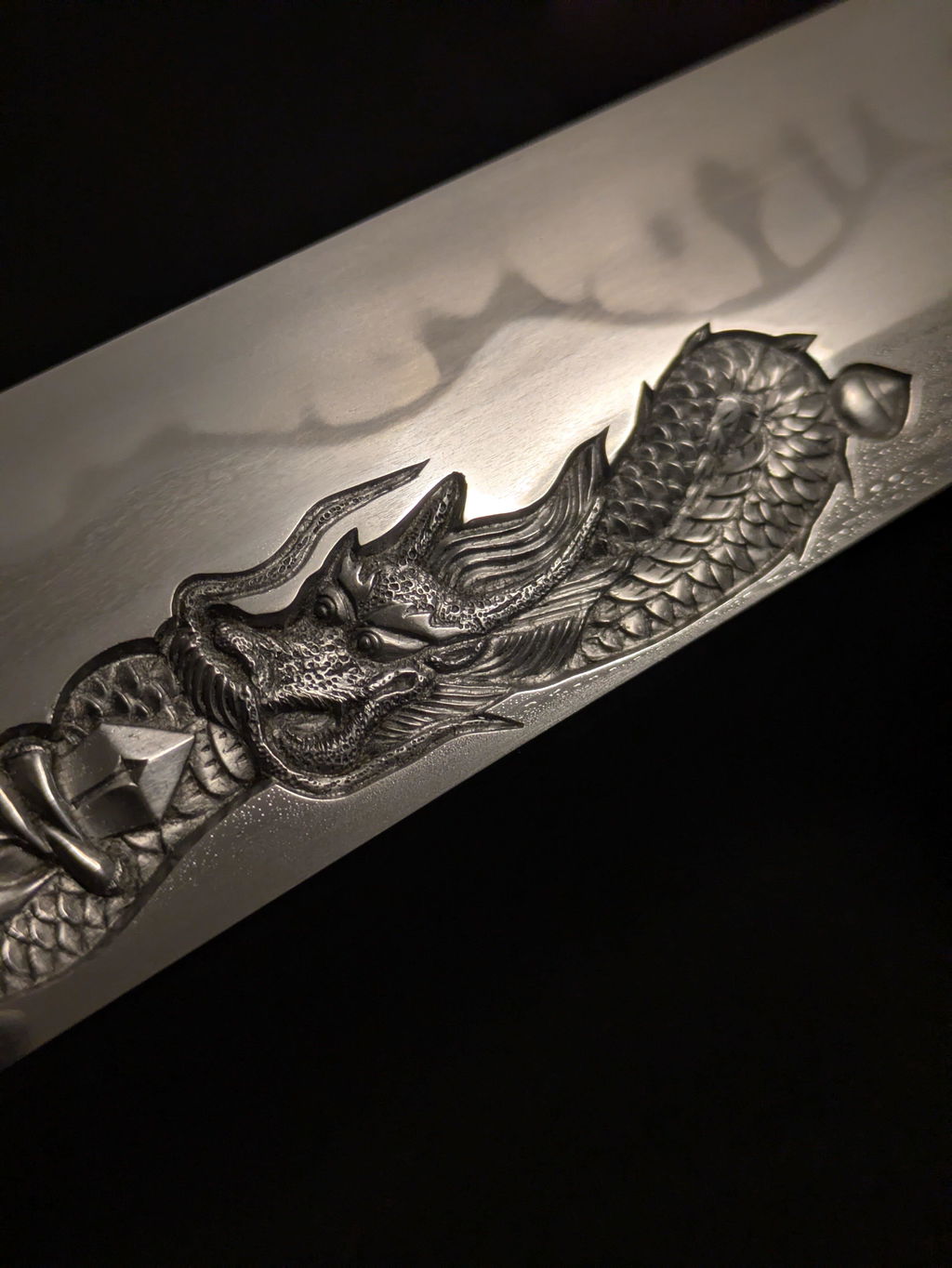
Professional photography, careful lighting, and selective framing can make a mass-produced replica look remarkably similar to an authentic nihonto in photographs. A genuine hamon has three-dimensional depth that photographs cannot capture; an acid-etched fake hamon looks similar in a well-lit photograph. Genuine jihada grain is a subtle feature that emerges clearly only under raking light in person; in a photograph, it is often indistinguishable from smooth, grain-free industrial steel. The physical examination that would immediately reveal the difference is precisely what online bidding prevents.
-
Photocopied NBTHK papers and fabricated documentation
Original NBTHK certificates carry physical security features — embossed seals, specific paper stock, characteristic watermarks — that cannot be convincingly reproduced by photocopying. But in an auction listing photograph, a photocopy looks identical to an original. Sellers who display "NBTHK papers" in their listing photographs are not necessarily displaying original physical documents. A photocopy of a genuine NBTHK paper accompanying a fake blade is one of the most common fraud patterns in the online auction market. The only way to verify NBTHK papers is to hold the physical originals — which is impossible before an auction closes.
-
Mismatched registration certificates — the Japan-specific risk
As described above, a genuine Japanese government registration certificate can be detached from the blade it belongs to and attached to a different blade. To a buyer who does not read Japanese and cannot cross-reference the certificate's measurements against the physical blade, a genuine Toroku-sho — even one that describes a different sword — appears to be legitimate documentation. This fraud pattern is particularly insidious because the document itself is real; only the pairing is false.
-
Seller anonymity and cross-border accountability gaps
Many fraudulent sellers operate under carefully constructed personas — Western-seeming usernames, English-language listings written to avoid obvious red flags, and addresses in the US, UK, or Canada that are actually mail forwarding services for operations based in China or elsewhere. When money changes hands and the fraud is discovered, the seller has disappeared. Cross-border fraud recovery through online auction platforms is, in practice, nearly impossible — the platforms' buyer protection systems are not designed for high-value specialist items, and the jurisdictional complexity of international fraud claims makes legal recourse extremely difficult for most buyers.
-
Time pressure eliminates due diligence
Auction mechanics create artificial urgency. Bidding closes at a specific time, competitive pressure drives emotional decision-making, and the opportunity to ask detailed questions and wait for thorough answers is structurally limited. The due diligence that a thoughtful purchase from a specialist dealer allows — multiple rounds of questions, time to consult other collectors, the option to request additional photographs or measurements — is compressed or eliminated by the auction format. This time pressure is not an accident; it is the mechanism by which rushed decisions replace careful ones.
The listing appeared on a major online auction platform. The title: "Authentic Edo-period katana — NBTHK certified — rare find." The photographs showed a blade with an attractive hamon, a sword in what appeared to be period koshirae, and — critically — photographs of what looked like NBTHK Hozon papers, a Japanese registration certificate, and an English-language certificate of authenticity from an organisation the buyer had not heard of but assumed was legitimate.
The seller had a Western username and listed from a UK address. Their feedback score was positive — built on transactions for other items. The listing ran for seven days. The buyer researched online, found nothing obviously suspicious, and bid. At $8,500, they won. They paid via bank transfer as the seller requested — "to avoid platform fees."
When the sword arrived, the NBTHK papers were photocopies. The registration certificate measurements did not match the blade. The "organisation" that had issued the English certificate did not exist. The blade itself was a Chinese-made replica with an acid-etched surface line where a hamon should have been. The steel was stainless. The seller's account was gone. The UK address was a mail forwarding service. Recovery: zero.
This is not an unusual case. It is a template — a pattern that repeats across platforms, price points, and buyer demographics. The details change; the outcome rarely does.
The sword is not what either of them describes."
Where the Risk Is Highest — and Where It Is Lower
Not all auction and online sale environments carry equal risk. Understanding the spectrum helps collectors make more informed decisions about where to seek pieces.
No specialist expertise in the listing or vetting process. Seller identity verification is minimal. Returns and fraud recovery are extremely difficult for high-value specialist items. The platform's structure rewards volume and speed, not specialist knowledge. This is where the majority of sword fraud occurs. Avoid for any genuine nihonto purchase regardless of how convincing the listing appears.
A significant proportion of genuine nihonto in Japan changes hands through Yahoo! Auctions — but so do fakes, blades with mismatched registration certificates, and pieces with undisclosed structural issues. Genuine pieces do exist here, but evaluating them requires Japanese-language fluency, deep knowledge of what to examine, and ideally the ability to arrange in-person inspection before bidding. Registration certificate fraud — including the patterns reported to Kyoto police — is most commonly encountered on domestic Japanese auction platforms.
Established major auction houses with specialist Japanese art or arms departments employ curators who examine pieces before listing. This reduces (but does not eliminate) the risk of obvious fakes. Caveats: specialist expertise varies significantly between departments; the auction house's liability for attribution errors is typically limited in their terms; and pre-sale inspection opportunities, while sometimes available, are not always practical for international bidders.
A specialist dealer who has physically examined every piece in their inventory, carries original NBTHK papers, can explain the provenance of each piece, and stands behind what they sell is the most reliable purchasing channel available. This is not because dealers are inherently more trustworthy than auction houses — it is because the specialist dealer model creates direct accountability that the auction model does not. The dealer's reputation is at stake with every sale.
How to Protect Yourself — If You Do Buy at Auction
The safest advice is not to purchase genuine nihonto through online auction platforms — particularly general marketplaces. But for collectors who do choose to engage with auction channels, the following protections reduce (without eliminating) the risk:
- Never pay by bank transfer or cryptocurrency to a seller you do not know. These payment methods offer no buyer protection and no recourse. If a seller requests them, walk away. Use a credit card or a payment platform with buyer protection — and understand that even these have limits for specialist items.
- Require original physical NBTHK papers to be shipped with the sword — not photocopies. A seller who cannot guarantee this is either not in possession of originals or is concealing something. Make the presence of original physical papers a condition of purchase before bidding.
- Verify the Toroku-sho measurements against the blade description. The blade length and curvature recorded on the registration certificate must match the blade being sold. Ask the seller to confirm these measurements explicitly. A legitimate seller will have no difficulty providing this; a fraudulent one will stall or deflect.
- Research the seller's history specifically for nihonto sales. Positive feedback on sales of electronics, clothing, or other items means nothing for specialist sword sales. Look for feedback specifically on sword transactions, and contact previous sword buyers if possible.
- Ask for the NBTHK certificate number and cross-reference it where possible. For Jūyō Token and above, NBTHK records can be verified. For Hozon and Tokubetsu Hozon, a legitimate dealer can provide the number before you bid.
- For any significant purchase from a Japanese domestic auction, consider engaging a Japanese-speaking proxy bidding service that can physically inspect the piece before bidding on your behalf. This adds cost but provides a layer of due diligence that remote bidding cannot.
- If the price seems too good for the claimed attribution, it is. There are no bargain Kamakura-period katana with Jūyō papers at $3,000. The gap between claimed value and asking price is the clearest single indicator of fraud in the auction market.
original papers, verifiable provenance
Every sword in Tozando's collection has been physically examined by our specialists, carries original NBTHK certification where applicable, and comes with a Toroku-sho whose measurements we can verify against the blade before shipping. No auction pressure, no anonymity, no photocopied papers. A specialist dealer you can call, email, and verify — since 1989.
In Closing — The Auction Is Not the Problem. The Information Gap Is.
Auctions are not inherently illegitimate. The great auction houses have facilitated the movement of some of the finest nihonto in the world from collection to collection. The problem is not the auction format itself — it is the combination of that format with the specific characteristics of the nihonto market: the expertise required to evaluate authenticity, the ease with which documentation can be forged or mismatched, and the near-zero accountability for fraud once money has changed hands across international borders.
The collector who understands these risks, applies the protections described above, and limits their auction engagement to channels with genuine specialist oversight can participate in the auction market with reasonable caution. The collector who does not — who bids on a beautifully photographed "certified Edo-period katana" on a general marketplace because the price looks right and the papers look real — is, in the most likely scenario, not buying a Japanese sword. They are paying for a very convincing photograph of one.
Know what you are looking at. Know what documents you are seeing. And know that the best protection against auction fraud is the knowledge to recognise it before you bid — not the hope of recovering your money after you have paid.
Sources: Tozando Katana Shop — "Don't Be Fooled: How to Buy an Authentic Japanese Sword" (2026), "Buyer Beware: Japanese Sword Auction Failure Examples" (2025); Tokyo Nihonto — "Is It Safe to Buy Authentic Nihonto Online from Japan?" (2025); Nihonto Kanji Pages (JSSUS) — "Japanese Sword Laws"; Tozando direct knowledge of cases reported to Kyoto Kamigyo Police Station regarding falsified and mismatched Token Toroku-sho.
Note: The case study in this article is a composite drawn from multiple documented fraud patterns and is representative of a widely reported scenario rather than a single specific incident. The "80%" figure for fake listings is an industry estimate. The zero recovery rate reflects the general experience of buyers defrauded through online auction platforms for specialist items, not an officially tracked statistic. Cases involving falsified Toroku-sho reported to Kyoto Kamigyo Police Station are referenced based on Tozando's direct knowledge as a dealer operating in that jurisdiction.

Leave a comment: