A supreme blade conveying the true essence of the contemporary master "Kunihisa." Its reverse date, Heisei 30, tsuchinoe-inu year, "yama-warau" (spring of 2018), sets into the signature the image of spring, when the rich nature of Shinshū bursts into bud — a hira-zukuri wakizashi in which a modern master's design sense shines. It shows the fresh, moist luster that only the newly forged steel of a modern sword possesses, and preserves exactly, in ideal condition, the flesh (niku) of the blade and the crisp carving — a bō-hi paired with a soe-bi on the front (omote) and a bō-hi on the back (ura) — just as the maker intended, letting you experience the smith's design beauty directly.
The jigane is a superbly worked itame, finely and tightly packed, clothed in clear, fine ji-nie for a moist, lucid ground. The hamon is a broad suguha with a shallow notare, mixed with ko-gunome. As a brand-new work, fresh from the forge, it is in perfect, as-made condition, with no flaw or rust of any kind.
A hira-zukuri (flat-sided, ridgeless) wakizashi with crisp carving on both faces — a bō-hi (straight groove) with a soe-bi (accompanying narrow groove) on the omote, and a single bō-hi on the ura. At a nagasa of 40.6 cm (about 1 shaku 3 sun 4 bu) with 0.5 cm of sori and a single peg-hole (mekugi-ana), it holds the maker's intended shape and proportions in their ideal state.
Ishida Kunihisa (real name Ishida Tomohisa, born 1977) is a swordsmith of high renown. In 1995 he entered the school of Kawachi Kunihira, a holder of Nara Prefecture Intangible Cultural Property status, and in 2002 opened the "Kunihisa Tantō-ba" forge in Gunma. Rather than merely following tradition, he is celebrated for a high forging technique that studies a range of methods and old works and reconstructs them for the modern age — so versatile that he can make anything to order.
His encounter with the Japanese sword. The spark came at his grandfather's funeral, when he was seventeen: "Seeing the makura-gatana (pillow-sword) placed on the coffin, I became interested in Japanese swords. Then a television feature on swordsmiths moved me, and I resolved to become one." Around the same time, learning that the smith Kawachi Kunihira of Nara would take part in an NBTHK-sponsored competition held in Tokyo, he was introduced through an acquaintance of his father and became Kunihira's pupil at eighteen. After hard training, in 2001 he received approval from the Agency for Cultural Affairs to make art swords, and the following year became independent, opening the Kunihisa Tantō-ba in his home city of Tomioka.
Selected record:
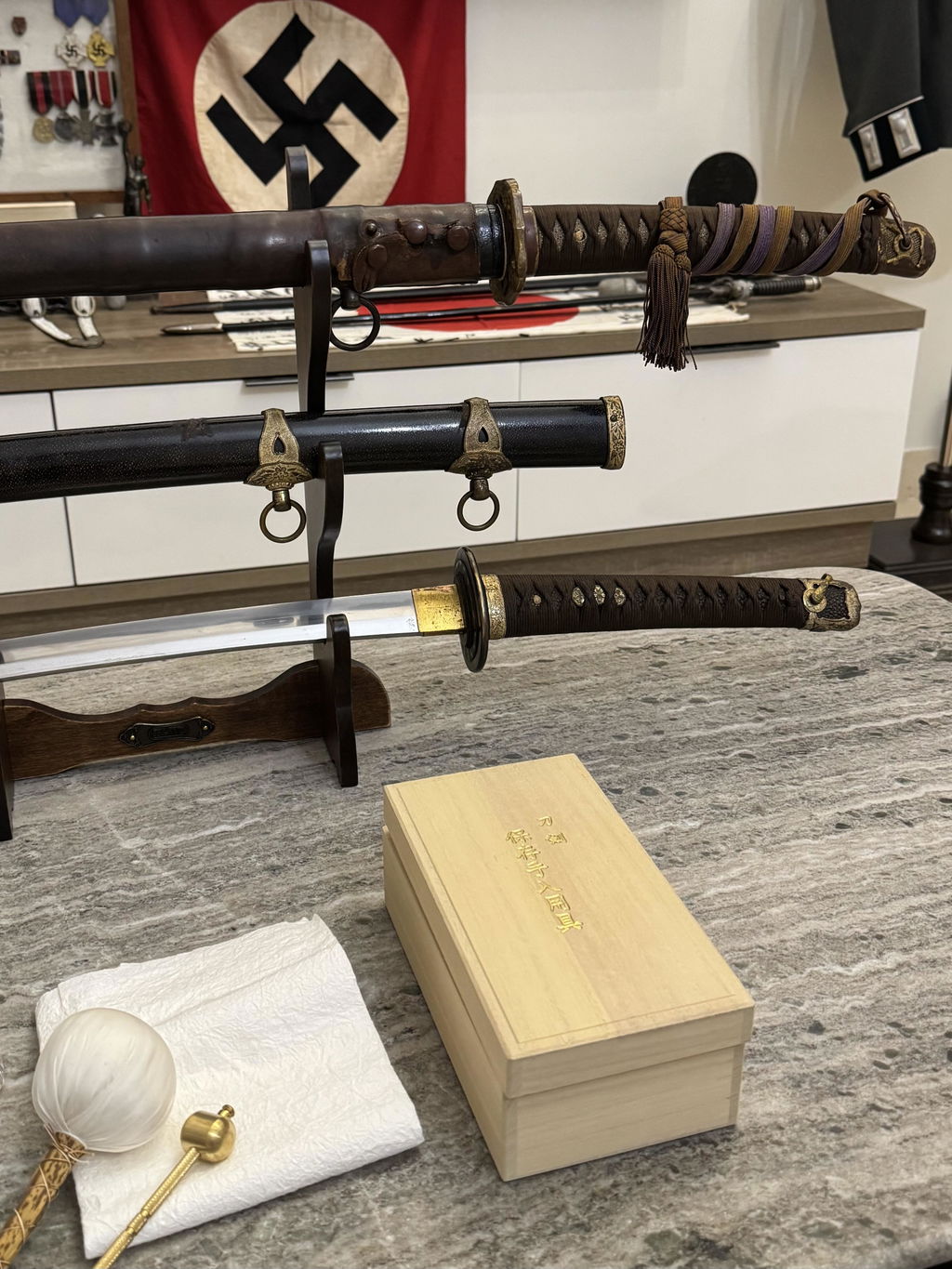
The blade is preserved in a plain wood shirasaya (resting scabbard) with a gold habaki.
A pristine, freshly made hira-zukuri wakizashi by the contemporary master Ishida Kunihisa — its well-forged itame ground and bright suguha temper held in the maker's ideal form, with a bō-hi-and-soe-bi carving on the front and a bō-hi on the back, and its reverse inscribed with the poetry of a Shinshū spring. A first-rank modern work to appreciate and treasure exactly as it left the forge.


¥290,000 ¥320,000

¥250,000 ¥270,000


Every blade reflects generations of knowledge, discipline, and precision passed down through traditional Japanese swordmaking. From the forging of steel to the final finishing touches, each piece is shaped with patience, mastery, and deep respect for heritage.

From carefully selected materials to the refined finishing of every surface, each sword is crafted and presented with uncompromising attention to detail. Our commitment to authenticity ensures every piece reflects true tradition, lasting quality, and enduring cultural value.

Designed with balance, simplicity, and purpose, our blades embody the harmony between refined form and skilled craftsmanship. Each sword represents a thoughtful union of strength, elegance, and the timeless discipline of Japanese artisans.