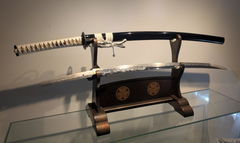
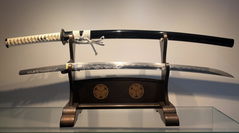
Antique Japanese Wakizashi Sword - Mumei, Shinto Era (36.6 cm)
¥200,000 ¥240,000

Nippon Genshosha is a collective of three licensed Japanese swordsmiths — Tomoki Kuromoto, Kosuke Yamazoe, and Tomoyuki Miyagi — who forge together from a workshop in Kyotango, on the northern coast of Kyoto. Founded in Tokyo in 2017 and established as a company in 2019, the group has become one of the most visible names among the youngest generation of smiths, making swords that honour centuries of tradition while speaking to the present. A katana commissioned through Tozando is forged to order by the smith of your choice.
Tomoki Kuromoto (黒本知輝), the group's representative, was born in Osaka City on 2 April 1986. He knew he wanted to become a swordsmith from childhood, drawn by a deep fascination with the blade itself. In his work he pursues what he calls the beauty of function: "Bold and precise — I pursue the beauty of functionality, to make a sword beautiful from an artistic point of view."
Kosuke Yamazoe (山副公輔), born in Suita City, Osaka, on 6 January 1990, was first drawn to sword-making through Japanese period dramas. His approach is one of constant refinement: "I give the very best I have at the time, and I update it each time I make a sword."
Tomoyuki Miyagi (宮城朋幸), born in Koto, Tokyo, on 19 March 1990, grew up watching period dramas with his parents and had resolved to work with Japanese swords by the time he reached junior high school. He is drawn above all to a blade's presence — "a fierce, sharp appearance, and the pattern of the steel."
Nippon Genshosha was formed in Tokyo in 2017 and incorporated in 2019, before moving its forge to Kyotango in northern Kyoto, where it lit its furnace in 2022. The group sees the Japanese sword in three ways at once: as a soul — a spiritual symbol of life; as art — a refined, sharply tempered form; and as a protective object that wards off misfortune and carries a wish for the safety of those we love. Alongside their swords they work tamahagane steel into other crafted objects, give live forging demonstrations, and are committed to training the next generation of swordsmiths.
The collective's work has reached audiences far beyond the sword world. They have given forging demonstrations both in Japan and abroad, including an eight-day demonstration in the Republic of Buryatia, Russia, and have forged a sword used in a performance of the Noh play Kokaji. Their resin-encased display sword ARATASHI (新し) debuted at the Mitsukoshi gallery in Nagoya, and the group has held solo exhibitions in Tokyo and Kyoto. In 2025 Nippon Genshosha was featured in National Geographic, and their work was shown in the Kyoto Zone of the Kansai Pavilion at the Osaka–Kansai Expo 2025.
"I hope you enjoy the charm of swords, past and future." — Tomoki Kuromoto
"A Japanese sword can be owned by anyone, without a licence. I hope you find the katana that is perfect for you, and experience owning one." — Kosuke Yamazoe
"Japanese swords are not only weapons; they have long been treasured as spiritual symbols." — Tomoyuki Miyagi
Group: Nippon Genshosha (日本玄承社) — founded 2017, based in Kyotango, Kyoto.
Members: Tomoki Kuromoto (黒本知輝, b. 2 April 1986, Osaka City), Kosuke Yamazoe (山副公輔, b. 6 January 1990, Suita City), Tomoyuki Miyagi (宮城朋幸, b. 19 March 1990, Tokyo).
¥200,000 ¥240,000

¥400,000 ¥430,000

¥270,000 ¥290,000

¥300,000 ¥330,000


Every blade reflects generations of knowledge, discipline, and precision passed down through traditional Japanese swordmaking. From the forging of steel to the final finishing touches, each piece is shaped with patience, mastery, and deep respect for heritage.

From carefully selected materials to the refined finishing of every surface, each sword is crafted and presented with uncompromising attention to detail. Our commitment to authenticity ensures every piece reflects true tradition, lasting quality, and enduring cultural value.

Designed with balance, simplicity, and purpose, our blades embody the harmony between refined form and skilled craftsmanship. Each sword represents a thoughtful union of strength, elegance, and the timeless discipline of Japanese artisans.