

A Japanese sword is not manufactured. It is created — through a sequence of processes that takes months from start to finish, involves the hands of multiple specialist craftspeople, and has not fundamentally changed in over a thousand years. Understanding how a nihonto is made is not merely technical knowledge — it is the foundation for understanding why an authentic Japanese sword is unlike anything else produced in the history of edged weapons. This guide takes you through every step, from the iron sand collected on riverbanks to the finished blade in its mountings.
The Complete Process at a Glance
Japanese sword production is not a single craft — it is a sequence of highly specialised crafts, each performed by a different category of artisan. The swordsmith (tōshō) forges the blade; the polisher (tōgishi) reveals its character; the engraver (hori-shi), scabbard maker (saya-shi), handle wrapper (tsuka-maki-shi), and metal fitter (kinko) complete the mounting. A finished sword in full koshirae represents months of collaboration between specialists who have each trained for a decade or more in their individual discipline.
| Stage | Japanese term | Craftsperson | Time required | What happens |
|---|---|---|---|---|
| 1. Steel making | Tatara-fukitatara | Tatara masters (NBTHK) | 3–4 days per operation | Iron sand smelted with charcoal to produce tamahagane |
| 2. Charcoal preparation | Sumiwari | Smith / apprentice | Ongoing preparation | Pine charcoal split to precise sizes for different stages |
| 3. Steel selection | Tamahagane yobishume | Master smith | Hours | Pieces selected and sorted by carbon content from fracture faces |
| 4. Forging | Kitae | Master smith + apprentice | Several days | Steel folded, hammered, composite construction assembled |
| 5. Shaping | Sunobe / hizukuri | Master smith | 1–2 days | Blade shape, geometry, and profile established |
| 6. Clay coating & quenching | Tsuchioki / yaki-ire | Master smith | Hours (critical) | Clay applied; blade heated and quenched; hamon and curvature formed |
| 7. Rough shaping | Kaji-oshi | Master smith | 1–2 days | Filing and rough polish to reveal blade profile |
| 8. Signature | Mei-kiri | Master smith | Hours | Smith inscribes name and date on the tang |
| 9. Polishing | Togi | Master polisher (tōgishi) | 1–3 weeks | Progressive stone polishing reveals hamon, jihada, full blade character |
| 10. Mounting | Koshirae-shi | Multiple specialists | Weeks to months | Scabbard, handle, guard, fittings assembled by specialist craftspeople |
Everything begins with satetsu — iron sand collected from riverbeds, particularly in the Chūgoku mountains of western Japan. This iron-rich sand, combined with charcoal, is the raw material for tamahagane (玉鋼, "jewel steel") — the material from which every authentic Japanese sword is made.
The smelting takes place in a tatara — a clay furnace approximately 1.1 metres tall, 3 metres long, and 1.1 metres wide, constructed fresh for each operation. A tatara operation consumes approximately 9.1 tonnes of iron sand and 11 tonnes of charcoal over three to four continuous days of smelting, with workers and bellows operators taking shifts around the clock. At the end of the process, the tatara masters break open the clay furnace to extract the kera — a bloom of steel of approximately 2.3 tonnes, from which less than one tonne of usable tamahagane can be selected.
The tatara process was nearly lost in the Taishō period as Western steelmaking technology displaced it. In 1977, the NBTHK restored traditional tatara operations in Yokota, Shimane Prefecture — the last operating tatara smelter in the world. Today, tamahagane is produced only three or four times a year, in winter, and is sold exclusively to licensed master swordsmiths. The NBTHK oversees the entire supply chain, ensuring that the steel available to contemporary smiths meets the traditional standards the tradition demands.
Before forging can begin, two essential preparatory tasks must be completed. The first is sumiwari — the splitting of charcoal into precisely controlled sizes. The best charcoal comes from pine; chestnut is also used. To make one sword, approximately 12–15 kg of charcoal is consumed across all stages. The size of the charcoal controls the forging temperature: pieces of about 2–3 cm are used during the forging (kitae) process, while smaller pieces of 1–1.5 cm are required for the critical quenching stage. There was an old saying that an apprentice had to spend three years just to learn sumiwari correctly — it is that consequential.
The second preparatory task is steel selection. The pieces of tamahagane are carefully examined by the master smith — reading the fracture faces of each piece, which reveal the steel's carbon content through their crystalline structure. High-carbon pieces (hard, fine-grained fracture) are set aside for the blade's outer shell (kawagane); lower-carbon pieces (tougher, more granular fracture) are designated for the inner core (shingane). This selection, performed entirely by eye and hand, is the first act of artistic judgment in the making of a sword.
The tamahagane is heated in the forge to approximately 1,200°C — a yellow-orange heat — and then hammered on the anvil. The hammering begins the process of expelling impurities: slag, oxides, and non-metallic inclusions are driven out with each blow. The steel is then folded — pressed flat, cut partway through, and folded back on itself — before being hammered out again to its original length. This folding and hammering cycle is the origin of what is commonly called "folding the steel."
Typical folding counts are 10–16 times, producing 1,024 to 65,536 layers. More than about 20 folds would begin to reduce the carbon content to the point where the steel loses its ability to harden effectively — so the claim of "a million folds" sometimes seen in marketing is metallurgically impossible for any functional blade steel. The correct folding count is a deliberate, controlled decision by the master smith, not simply "as many times as possible."
The composite construction is assembled at this stage. The hard outer steel (kawagane) is formed into a U-shaped channel; the softer inner steel (shingane) is inserted into it. The two metals are then forge-welded together by heating and hammering — the outer skin wrapping entirely around the inner core. This combination gives the blade both the hardness needed for a cutting edge and the toughness needed to absorb impact without fracturing.
After the composite billet has been assembled, the smith draws it out into a long flat bar (sunobe) — the rough precursor of the finished blade. The sunobe is then shaped into the blade's basic form through hizukuri — a process of precise localised heating and hammering that establishes the blade's profile, curvature, cross-section, and all its geometric features.
At this stage, all the distinctive architectural elements of the sword are established: the shinogi (ridge line), hi (fuller groove, if any), kissaki (tip form), nakago (tang shape), and the overall length and curvature. The smith also deliberately introduces a slight reverse curvature at this point — a controlled anticipation of the curvature that will emerge naturally during the quenching process, so that the final shape lands as intended.
Once shaping is complete, the smith uses files and planes to refine the surface — establishing the final geometry before the critical quenching stage. A rough polish at this point reveals the blade's profile clearly for the first time.
anticipating, preparing, and guiding a material that has its own nature."
Yaki-ire (焼き入れ) is the moment of highest risk and highest consequence in the entire process — the point at which months of work are confirmed or destroyed in seconds. The master smith works alone. Apprentices are not permitted to observe this stage. The recipe and application method of the clay mixture is the smith's most closely guarded professional secret.
A clay mixture (tsuchi) — combining clay, charcoal powder, and ground whetstone in proportions known only to the smith — is applied to the blade. A thick coat covers the spine and sides; a thin coat or no coat is left near the edge. This differential clay application is the primary design act of hamon creation: the shape of the clay boundary determines the shape of the temper line that will emerge.
The coated blade is heated to approximately 800°C (1,472°F) in the charcoal forge — a precise temperature judged by the colour of the glowing steel in a darkened room. At the right temperature, the blade is plunged edge-first into a water trough. The edge — uninsulated by the thin clay layer — quenches almost instantly, transforming to hard martensite. The spine — insulated by thick clay — cools slowly, transforming to softer pearlite. The differential expansion and contraction of these two structures produces the hamon and — simultaneously — the characteristic curvature of the blade.
If the temperature is too high, the blade cracks. If too low, the hardening is incomplete. If the quenching angle is wrong, the curvature is wrong. The smith has one chance. This is why yaki-ire is the moment that defines a master: it is irreversible, and it cannot be rushed, repeated, or corrected by any subsequent process.
After quenching, the blade undergoes a brief tempering step: heating the entire blade evenly to around 400°F (204°C) to reduce the edge hardness from its peak martensite state to a more suitable 58–60 HRC on the Rockwell scale. This makes the edge more durable in use without significantly reducing its cutting ability.
The smith then performs kaji-oshi — a rough polish using files and whetstones that refines the blade's geometry, establishes the final shape of the kissaki and shinogi, and prepares the surface for the professional polisher. At this stage, the hamon becomes visible for the first time as the rough scale is removed.
The final act of the swordsmith is mei-kiri — inscribing the signature on the tang. The smith's name is engraved on the front (omote) side of the nakago; the date is typically on the back (ura). This signature is the most legally and historically consequential act in the entire process — it is the smith's formal claim of authorship, and it will be examined by NBTHK appraisers to determine attribution for as long as the blade survives. This is why the mei-kiri is the last thing the smith does before releasing the blade to the polisher.
Polishing is not finishing — it is revelation. The polisher's task is to uncover what the swordsmith has created: to make the hamon visible, to bring out the jihada, to reveal the geometry of the blade in its full clarity. A great polisher does not impose on the blade; they serve it.
The process moves through a sequence of progressively finer natural whetstones — from coarse stones that establish the blade's geometry, through intermediate stones that refine the surface, to the finest stones that create the blade's characteristic finish. The sequence is: rough polish (shitaji togi) to remove the coarse scale from forging; intermediate polish to establish the blade's geometry; fine polish to begin revealing the hamon; and nugui (finger-stone work) to bring out the full depth and activity of the hamon and jihada. A complete professional polish by a master polisher takes one to three weeks for a single blade and represents an investment comparable to the forging itself.
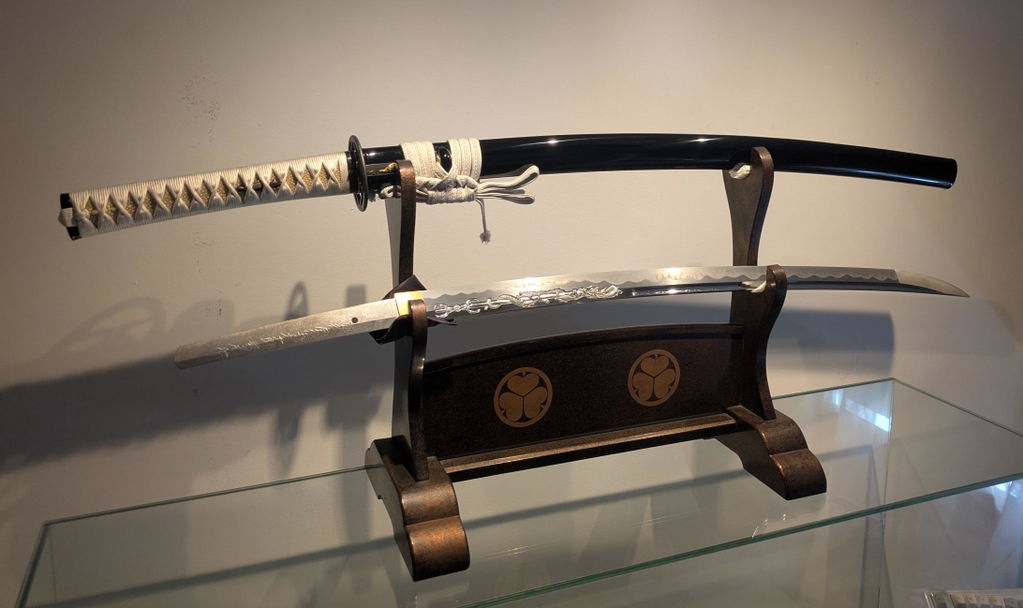
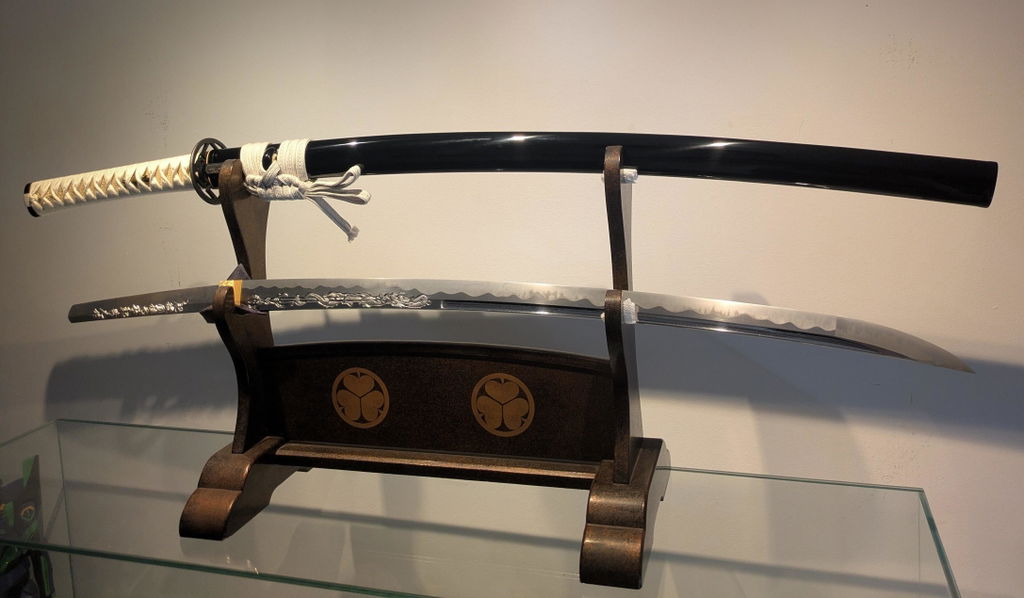
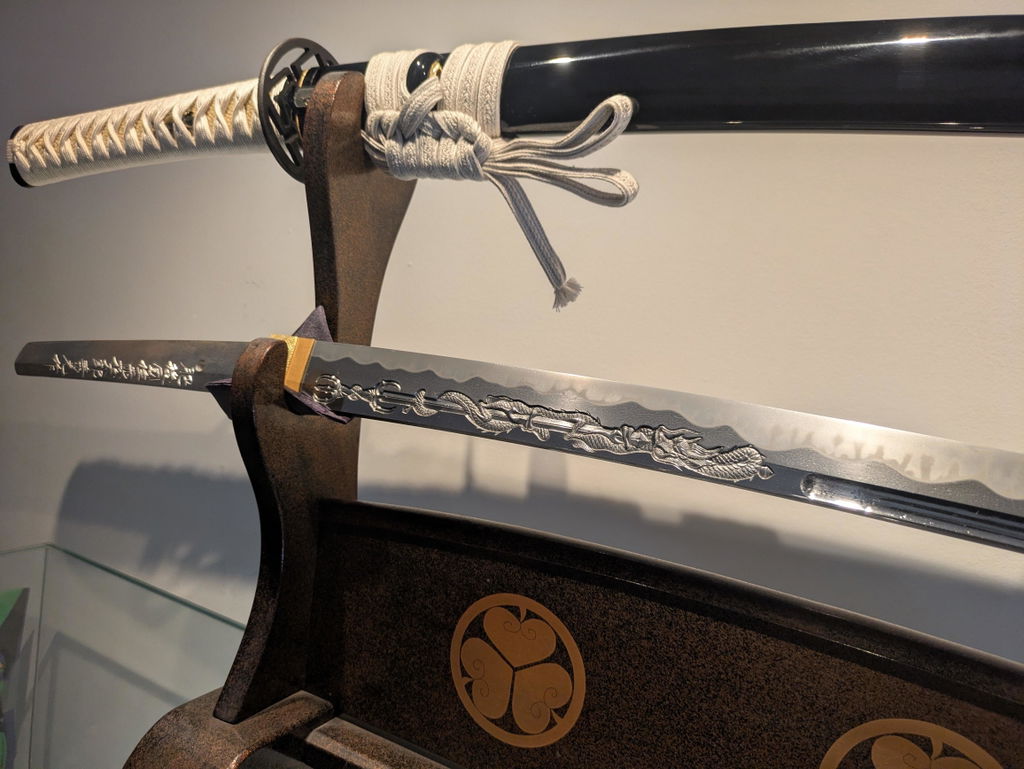
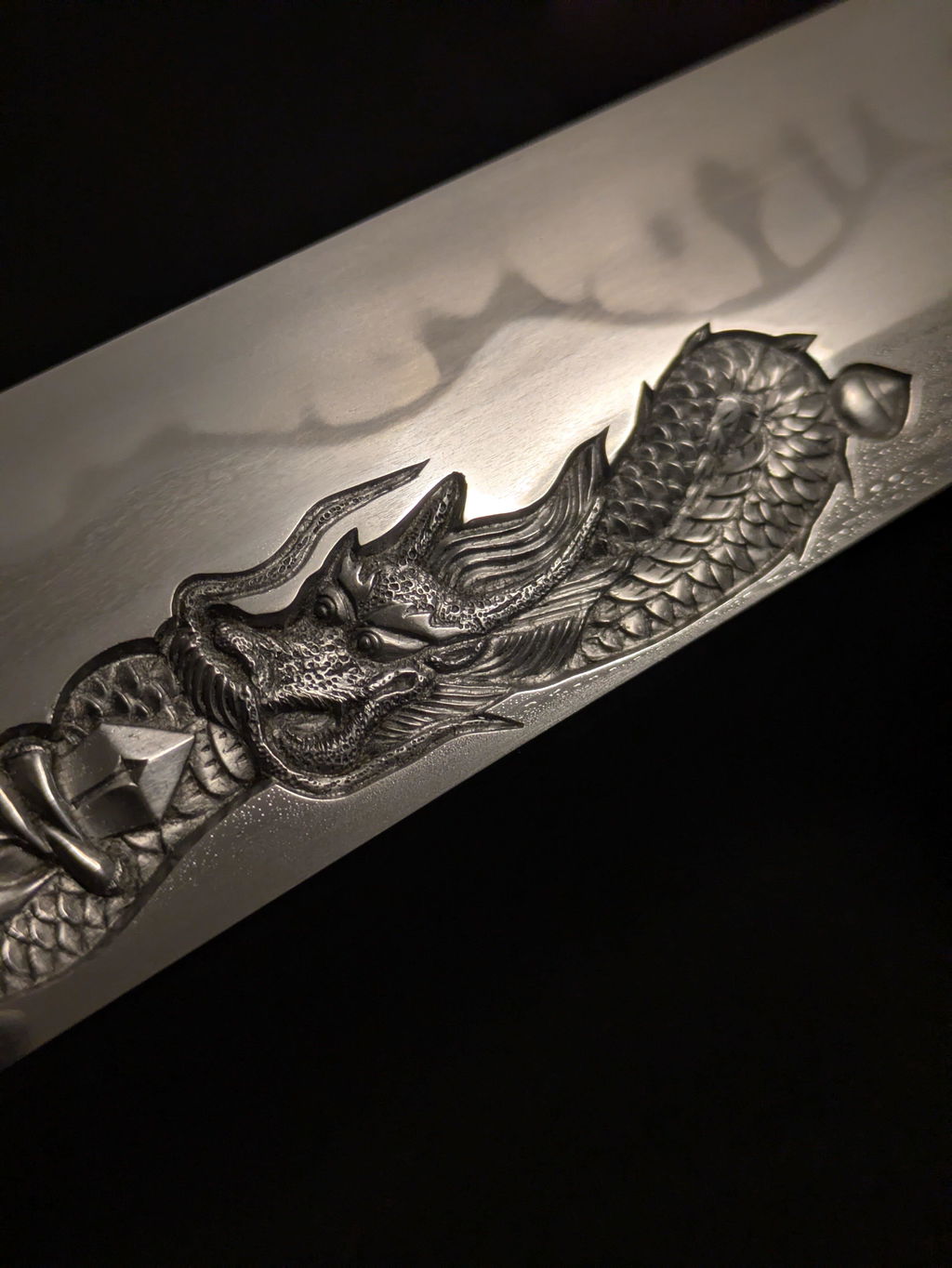
The finished blade shows two distinct surface finishes: the ji (the flat of the blade above the hamon) is worked to a misty, reflective grey that reveals the jihada clearly; the ha (the hardened edge area, including the hamon itself) is worked to a brighter, more mirror-like finish that makes the nie and nioi crystals sparkle. This contrast — dark and bright, mist and light — is one of the most distinctive and beautiful visual effects in all of Japanese art.
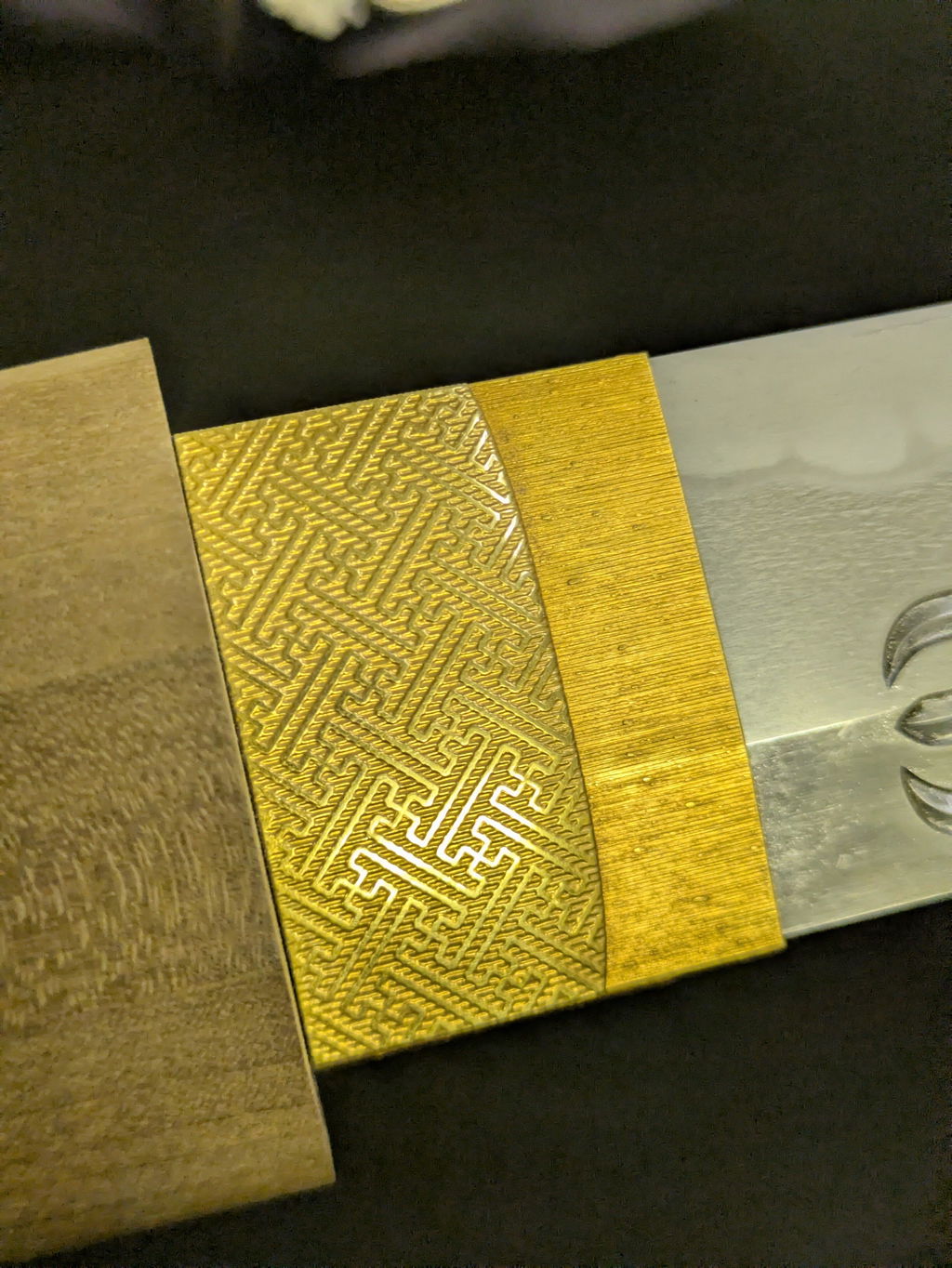
The final stage — creating the mounting (koshirae) — involves a completely different set of specialist craftspeople, each of whom has trained for years in their specific discipline. The saya (scabbard) is carved from ho-no-ki (magnolia wood) to fit the blade precisely — the interior shaped to the blade's exact cross-section so that it holds the blade securely without metal-to-metal contact. The exterior is lacquered by specialist lacquer artists.
The tsuba (guard) is created by a metal artist — in the finest pieces, a craftsperson who has spent a lifetime developing techniques in iron, copper, brass, and gold inlay. The fuchi and kashira (handle collar and pommel cap), the menuki (handle ornaments), and the kozuka (utility knife handle) are all produced by specialist metal artists. The handle (tsuka) is wrapped in samegawa (ray skin) — providing grip and moisture absorption — and then bound in traditional silk or cotton cord in one of several traditional patterns.
A full set of commissioned high-quality koshirae by specialist craftspeople can take months and add a significant cost to the final piece. For antique swords, the original period koshirae — if it survives — is itself a historically significant artifact. For modern commissioned work, the choice of craftspeople and fittings is one of the most important and personal decisions the commissioning collector makes.
What This Means — Reading a Blade Through Its Making
Understanding the making process changes how you look at every sword. Each visual feature of an authentic nihonto is a direct record of a specific stage in the process:
- The jihada — the grain pattern visible in the blade's body — is the record of the folding and forging stage. The specific pattern (itame, mokume, masame, ayasugi) reflects the school's folding technique and is one of the primary attribution tools used by NBTHK appraisers.
- The hamon — the temper line — is the record of the clay application and quenching. Its shape reflects the smith's tsuchioki design; its character (nie vs. nioi; the presence of kinsuji, sunagashi, ashi) reflects the steel composition and quenching technique.
- The curvature (sori) — is the physical record of the differential transformation rates during quenching, shaped by the clay thickness and the blade's geometry before quenching.
- The polish — determines whether all of the above is visible. A great polish by a master tōgishi is not an aesthetic improvement on the blade; it is the act of making the blade fully legible — revealing everything the smith placed in it.
- The nakago and mei — the unpolished tang and its signature — are the blade's identity document. The specific patina, the file marks, and the signature style are all records of the time and hands that made the blade.
- Mass-produced replica blades show none of these features authentically. An acid-etched hamon has no depth; a ground jihada has no grain; a mechanically curved blade has no relationship between its curvature and its quenching. The process is the authenticity.
of the hands that made it
Every sword in the Tozando collection was made through the complete traditional process described in this article — tamahagane steel, differential clay hardening, master polishing, specialist mounting. Antique and modern, NBTHK certified, shipped from Kyoto to collectors in over 30 countries.
In Closing — Why the Process Cannot Be Shortened
Every attempt to accelerate, simplify, or substitute in the Japanese sword-making process produces a recognisably inferior result. Modern alloy steels are more consistent than tamahagane — but they lack its specific response to differential clay hardening. Power hammers are faster than hand forging — but they cannot replicate the specific directional grain that hand folding produces. Chemical etching creates a visible line on the steel — but it has no depth, no nie, no life.
The Japanese sword tradition has not preserved its methods out of nostalgia. It has preserved them because, for the specific object it produces — a blade with this combination of hardness, toughness, visual character, and cultural weight — the traditional methods are simply the best methods. A thousand years of refinement by the most technically sophisticated metalworking culture in the pre-industrial world produced an optimum that modern technology has still not improved upon.
That is what you hold when you hold an authentic nihonto — not a historical curiosity, but the finest expression of a technology that has never been bettered for its specific purpose. If you feel drawn to own a blade shaped by this tradition, you can explore our collection of antique Japanese swords — each one sourced and examined in Japan, carrying within it the centuries of craftsmanship described above.
Sources: Metropolitan Museum of Art — "The Japanese Blade: Technology and Manufacture" (2003); Wikipedia — "Japanese swordsmithing"; SamuraiSword.com — "Japanese Sword Making Process"; Touken World — "The Making of Japanese Swords"; MartialArtSwords.com — "The 7-Step Process to Creating a Traditional Japanese Sword"; Japan National Tourism Organization — "How Traditional Samurai Swords Are Made"; JapaneseOniMasks.com — "Traditional Katana Forging Techniques Explained"; Samurai Swords Store — "How Are Samurai Swords Made?"; Tozando Katana Shop — "Why Are Japanese Swords Said to Be the Best in the World at Cutting?"
Note: The process described here reflects the traditional nihonto-making method used by licensed Japanese swordsmiths. Specific techniques vary between smiths and schools; the process described is representative of the standard approach. Time estimates are approximate.

Leave a comment: