

A Japanese sword arriving at your home in Los Angeles, London, or Sydney has travelled from one of the most carefully controlled collecting environments in the world into conditions it was never designed for. Western homes — centrally heated in winter, air-conditioned in summer, built from materials with very different thermal and moisture characteristics than traditional Japanese construction — present a unique set of challenges for nihonto preservation. The good news is that with the right setup, any Western home can keep a Japanese sword in excellent condition indefinitely. This guide tells you exactly how.
The Western Home — Why It Creates Unique Challenges
Japanese swords were designed to be stored and maintained in a Japanese environment — one with specific seasonal humidity patterns and traditional building materials that naturally moderate moisture. A typical Western home presents three challenges that Japanese homes do not:
Central heating. In North America, the UK, northern Europe, and Australia in winter, central heating systems dramatically reduce indoor humidity — often to 20–30% relative humidity (RH) during cold months. At these levels, the organic components of a sword — the wooden saya (scabbard), the tsuka (handle) wrapping, the ray skin beneath it — dry out, crack, and shrink. Fittings can loosen. The lacquer on the saya can check and peel. This is one of the most common causes of damage to swords owned by Western collectors, and one of the least recognised.
Air conditioning. In warmer climates — southern USA, Australia, the Middle East, Southeast Asia — air conditioning reduces temperature but can drive humidity to extremes in either direction depending on the system type. Moving a sword between an air-conditioned interior and a humid exterior creates sudden temperature and humidity differentials that cause condensation to form inside the saya against the blade surface. This condensation risk is specific and underreported.
Seasonal swings. In continental climates — much of the US Midwest and Northeast, central Europe, Canada — the difference between summer humidity (sometimes 70–80% RH) and winter heating-season humidity (20–30% RH) can exceed 50 percentage points. A sword stored without humidity management will experience these swings in full, cycling between the rust risk of excessive humidity and the cracking risk of excessive dryness.
Your Climate — What It Means for Your Sword
Before choosing a display and storage solution, identify which climate pattern applies to your location. Each presents different primary risks and requires a different approach:
The biggest threat is months of low-humidity central heating. Add a room humidifier or use Boveda 55% packs in your storage/display area throughout winter. In summer, indoor humidity often rises — monitor with a hygrometer and use silica gel or a dehumidifier if it exceeds 65%. Oil the blade every 3 months year-round; check more frequently in winter.
Humidity is generally manageable but rarely ideal. Winter heating reduces humidity indoors; damp summers push it up. Salt air in coastal locations accelerates steel oxidation even at moderate humidity. Use two-way humidity packs (Boveda 55%), keep the sword away from exterior walls and windows, and oil every 3 months. A sealed storage case is particularly beneficial near the coast.
Outdoor humidity regularly exceeds 70–80%. Air conditioning creates a large temperature and humidity differential between inside and outside. Never bring a cold sword directly from AC into outdoor humidity. Keep display areas at consistent AC temperature; use a dehumidifier or silica gel packs to maintain 45–55% RH indoors. Oil every 3 months minimum.
The dryest environment for a sword outside a desert. Wooden components crack, wrappings dry, and fittings loosen without active moisture management. A room humidifier or sealed storage with Boveda 55% packs is essential — not optional. Check humidity daily in summer. The good news: rust is a lower risk than in humid climates. Oil every 6 months is usually sufficient if humidity is managed.
Display Options for Western Interiors
A Japanese sword is a striking object — it deserves to be seen. The following display formats work well in Western home interiors, from apartments to houses, and can be adapted to rooms of any size and style.
-
1Tabletop sword stand — the most versatile starting point $20 – $150 depending on material and tier count
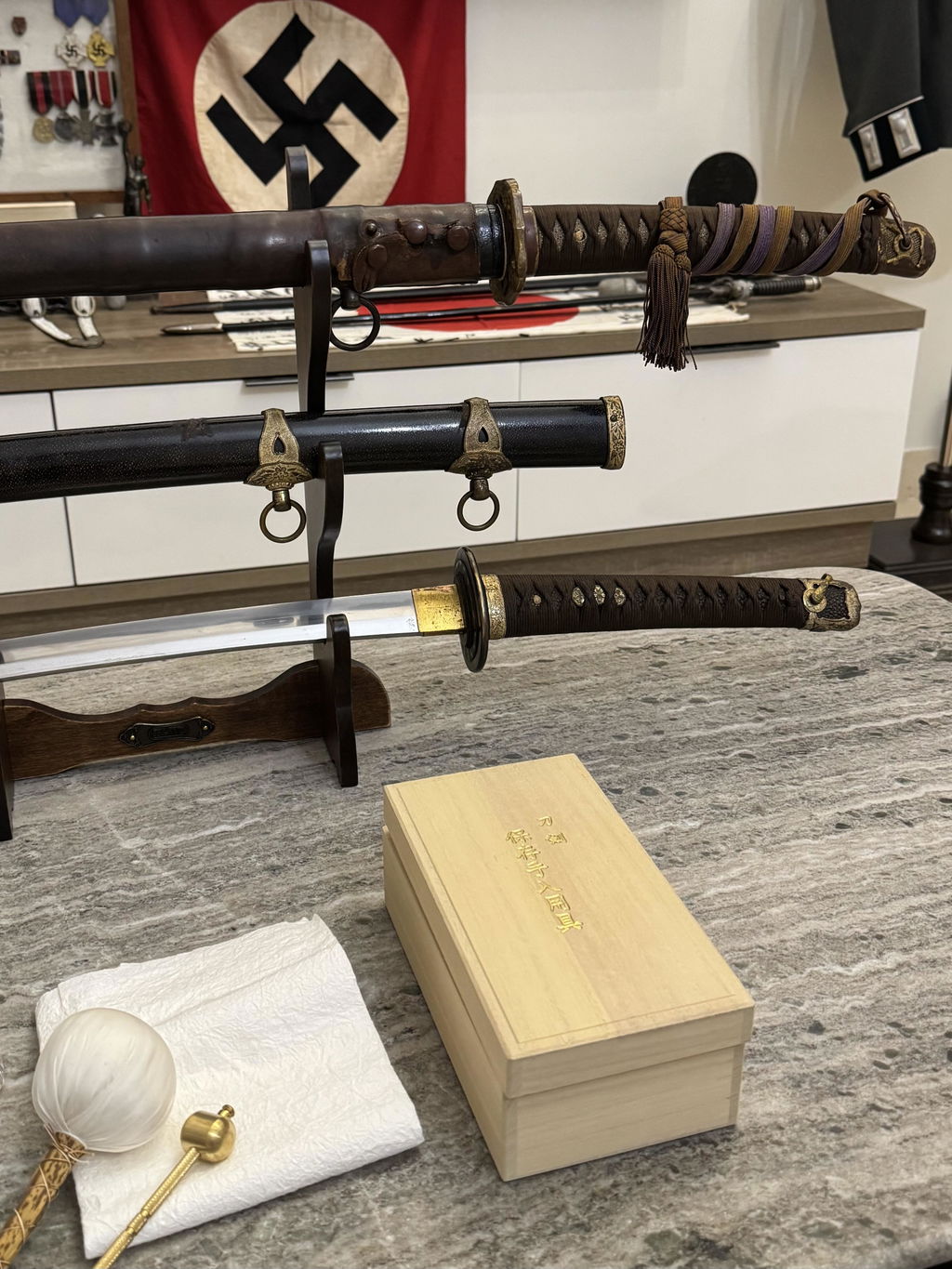
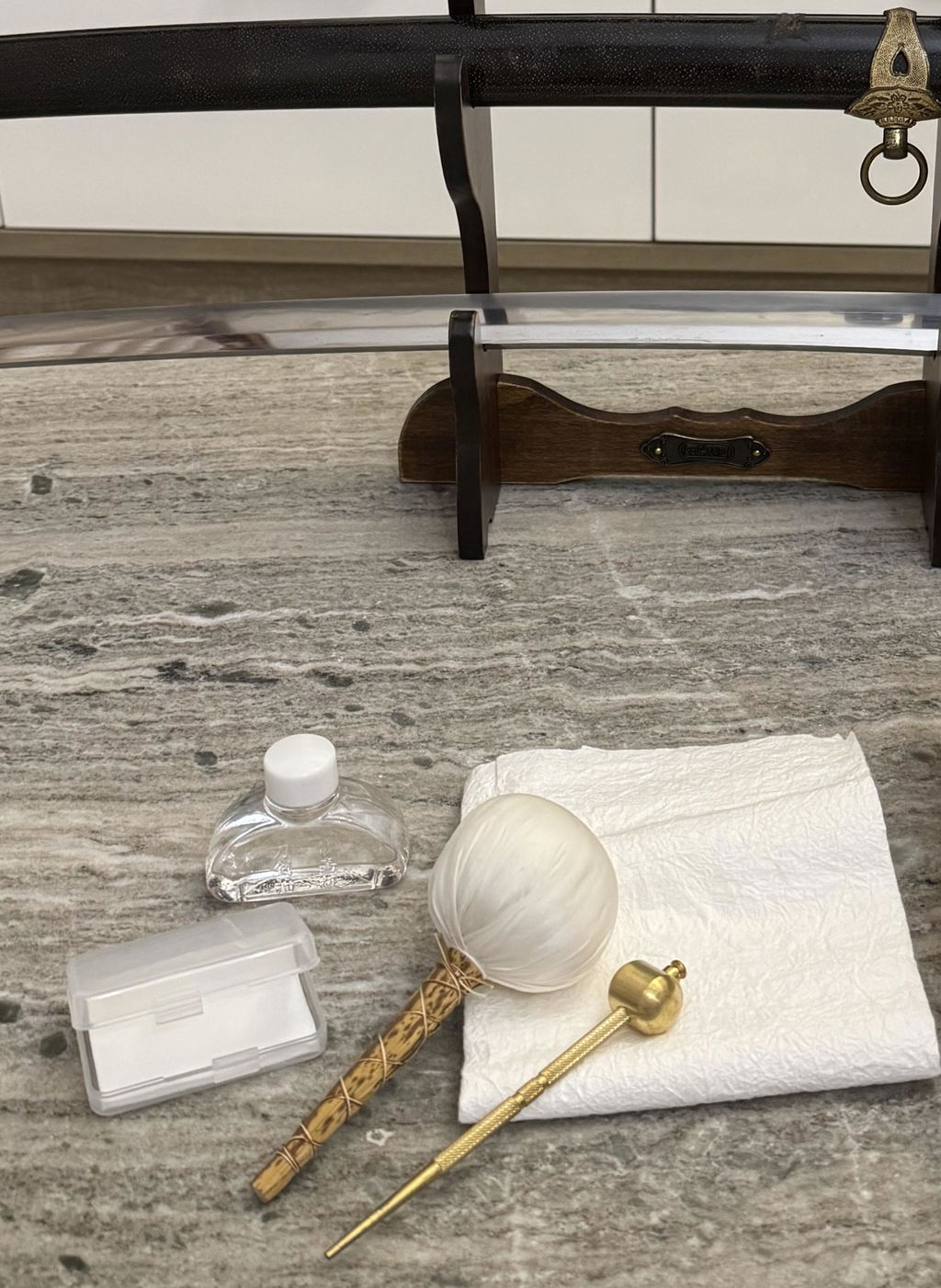
A freestanding wooden sword stand requires no installation, suits any surface — a bookshelf, sideboard, mantelpiece, or dedicated display cabinet — and can be moved freely. Single-tier stands display one sword; two-tier stands are ideal for a daishō pair (katana above, wakizashi below); three-tier stands accommodate a full set. In a Western living room or study, a quality lacquered Japanese stand makes a clean visual statement without requiring any modification to the room.
What to check before buying: all contact points (the curved notches where the sword rests) must be padded with soft material — felt, leather, or silk. Bare wood or metal notches will damage the saya lacquer over time. Avoid inexpensive stands from non-specialist retailers that use unpadded wooden supports. Budget $50–$100 for a stand that will not damage the sword it holds.
The correct orientation on any horizontal stand is edge upward, with the tsuka (handle) to the left. This is the traditional "peace position" — the sword at rest, not ready to draw. It also prevents uneven pressure on the interior of the saya.
-
2Horizontal wall mount — space-efficient and dramatic $50 – $300
Mounting a sword horizontally on the wall brings it to eye level, frees up surface space, and creates a striking focal point in any room. In a study lined with bookshelves, above a fireplace mantel, or on the long wall of a hallway, a horizontal wall mount presents the sword as the art object it is — clearly intentional, respectfully displayed. Multi-tier horizontal racks allow multiple swords to be displayed in a gallery format.
Installation is the critical step. A full nihonto in koshirae weighs 1.5–2 kg. Always anchor into wall studs — not into drywall alone. In the UK and Europe, masonry walls require appropriate masonry anchors rated for the weight. Use a stud finder or a masonry drill as appropriate. Two points of contact into solid structure is the minimum; three is preferable for a heavy sword. Mount at a height where you can comfortably handle the sword with both hands — typically 140–160 cm from floor to the sword's midpoint.
Edge upward is the correct orientation. All contact points must be padded. Keep the mount at least 30 cm from any window to avoid sunlight and exterior wall thermal effects.
-
3Vertical wall mount — maximum impact, minimum footprint $30 – $200
A vertical wall mount takes up only 10–15 cm of horizontal space and 100–120 cm of height — ideal for narrow wall sections between windows, beside doorways, or in tight spaces between furniture. In a Western interior, a single sword displayed vertically on a dark wall makes an exceptionally strong visual statement: the long curve of the blade, the grain of the saya, the detail of the fittings — all visible at once, in a format that reads immediately as art rather than weapon.
The correct orientation for vertical display is kissaki (tip) upward, edge facing left when viewed from the front. The installation requirements are the same as for horizontal mounts — stud or masonry anchoring is essential. Vertical mounts are slightly less convenient for regular maintenance (requiring one-handed removal from above) but are perfectly suited to display-only pieces that are inspected and maintained monthly on a stand.
-
4Display case — protection, presentation, and humidity control in one $150 – $1,500+
For Western collectors in challenging climates — humid subtropical, coastal, or with large seasonal swings — a sealed display case with active humidity management is the most practical and most protective option. It keeps the sword continuously visible, protects from dust and accidental handling, and allows precise humidity control. For families with children or pets, a lockable case also provides meaningful security.
The critical requirement: a sealed case without humidity management is worse than no case at all. A sealed glass case without humidity control traps moisture in humid climates (rust risk) and traps dry air in heated rooms (cracking risk). Always specify humidity management when selecting a case. Options include: Boveda or equivalent passive packs changed every 2–3 months ($10–$20 each), or an active electronic humidity controller with a built-in dehumidifier or humidifier ($200–$500 additional).
UV protection is equally important. Standard glass transmits the UV wavelengths that degrade lacquer, silk, and the visual character of the blade. Confirm the UV specification of any case before purchasing — "UV-resistant" and "UV-filtering" are different claims. For a significant antique, a case with museum-grade UV glass ($500–$1,500+) is worth the investment.
-
5Long-term storage — shirasaya and paulownia box $50 – $200
For swords not currently on display, the professional storage standard is a shirasaya (plain wooden storage scabbard made from ho-no-ki magnolia wood) inside a kiri-bako (paulownia wood box) with humidity control packs. The shirasaya creates a stable micro-environment around the blade; the paulownia wood naturally moderates humidity inside the closed box. A Boveda 55% pack inside the closed box maintains the target humidity with minimal monitoring — even in a centrally heated Western home.
This combination is the recommended storage format for any sword not on regular display, and is particularly well-suited to Western climates because it creates an isolated, self-regulating environment that is insulated from the larger room's humidity fluctuations. Store the box horizontally in a climate-stable interior room — a wardrobe shelf, a dedicated storage cabinet, or a climate-controlled room — not in a basement, attic, or garage.
The sword that is correctly displayed is correctly cared for — they are the same practice."
Where to Display — Room by Room in a Western Home
Location within your home matters as much as the choice of stand or mount. Some rooms are naturally better than others:
| Room | Suitability | Key considerations |
|---|---|---|
| Study / home office | Excellent ✓ | Typically stable temperature; minimal moisture sources; interior walls available; seriousness of the space suits the object. The ideal display environment in most Western homes. |
| Living room | Very good ✓ | Works well on an interior wall away from windows. Avoid positions near fireplaces (heat and ash) and exterior walls. Monitor humidity if the room has large windows or is used for cooking. |
| Bedroom | Acceptable △ | Human respiration raises overnight humidity slightly. Keep away from exterior walls. Ensure the display is secure — a sword that can be knocked from its stand is a safety hazard. Mount at sufficient height to avoid accidental contact. |
| Hallway / corridor | Acceptable △ | Often good temperature stability but susceptible to drafts from doors. Check for direct sunlight at different times of day. A vertical wall mount works particularly well in a narrow hallway. |
| Kitchen | Avoid ✕ | Cooking generates moisture, grease particles, and temperature spikes. Completely unsuitable for any nihonto display regardless of position. |
| Basement | Avoid ✕ | Chronically high humidity in most Western climates; poor temperature stability; risk of water intrusion. Even with a dehumidifier, basements are not suitable for significant pieces. |
| Attic / loft | Avoid ✕ | Extreme temperature and humidity swings between seasons. Not suitable regardless of climate. |
| Garage | Avoid ✕ | Temperature follows outdoor extremes; chemical vapours from vehicles and tools; dust. Completely unsuitable. |
Practical Humidity Management — Tools and Methods
Managing humidity in a Western home does not require specialist equipment. The following tools, used correctly, maintain ideal conditions in any climate:
The digital hygrometer — your most important tool
A digital hygrometer (thermohygrometer) costs $10–$20 and displays the current temperature and relative humidity of the room. Place one near your display or storage area and check it regularly. This single tool tells you whether your conditions are within the safe range (45–60% RH) and gives you early warning of dangerous extremes. Without a hygrometer, you are managing your sword blind.
Two-way humidity packs (Boveda or equivalent)
Boveda packs and similar two-way humidity control products maintain a specific target RH — absorbing excess moisture when humidity is high and releasing moisture when humidity is low. Available in a 55% RH target (ideal for sword storage). Place packs inside your storage box or display case and replace every 2–3 months. A single Boveda 60g pack costs approximately $3–$5 and protects a sealed box effectively for its full service life. This is the most cost-effective humidity solution available for enclosed storage.
Room humidifier (for cold-climate winters)
If you live in a cold-climate country and store your sword in a room that is centrally heated through winter, a small ultrasonic humidifier ($30–$80) running near your display area during the heating season maintains room humidity above the critical 40% threshold. Set the target to 50% and use distilled water to prevent mineral deposits. This is particularly important in North American and northern European climates where winter indoor humidity regularly drops to 20–30%.
Dehumidifier or silica gel (for humid climates)
In humid subtropical climates — southern USA, coastal Australia, parts of southern Europe in summer — a small dehumidifier or silica gel packs in your storage area prevent humidity from exceeding 65%. Silica gel is rechargeable (dried in an oven) and cost-effective for enclosed storage; a small electric dehumidifier ($40–$80) is more convenient for a display room. Replace or recharge silica gel when its indicator shows saturation.
Security and Insurance
A Japanese sword collection represents a significant financial investment. In a Western home, practical security and appropriate insurance are non-negotiable:
- Use a lockable display case for any piece in an accessible location — particularly important in homes with children, regular visitors, or in jurisdictions with specific storage requirements for edged weapons.
- Photograph your collection in detail — blade, tang, papers, and fittings — and store images in a secure cloud location. This documentation is essential for insurance claims and police reports.
- List nihonto on your contents insurance separately. Standard policies typically have a per-item cap far below the value of a significant piece. Ask specifically about scheduling individual high-value items as "specified items" or "valuables."
- Store NBTHK papers separately from the swords — ideally in a fireproof safe or safe-deposit box. Papers are irreplaceable proof of authentication; their loss in a fire or theft complicates everything that follows.
- Know your local legal requirements. Sword ownership and storage laws vary significantly between countries and jurisdictions. In the UK, swords with blades over 50 cm are subject to specific transport rules. In Australia, requirements vary by state. In the USA, regulations vary by state and city. Confirm the rules for your jurisdiction before displaying any sword.
The Display Setup Checklist — Before You Finalise
- Digital hygrometer placed in or near the display area — reading confirmed between 45–60% RH.
- Display position is on an interior wall, at least 30 cm from exterior walls and windows.
- No direct sunlight reaches the display at any time of day — checked at different hours.
- No UV-emitting light aimed directly at the sword. If using a spotlight, confirm it is UV-filtered LED.
- Humidity management in place for your climate: humidifier packs for dry/heated rooms, dehumidifier or desiccant for humid climates.
- All stand or mount contact points padded with soft material — no bare wood or metal against the saya.
- Wall mounts anchored into studs or masonry — not drywall anchors alone.
- Display case (if used) includes active or passive humidity management — not sealed without control.
- Sword oriented edge upward on horizontal stand or mount; kissaki up / edge left on vertical mount.
- NBTHK papers stored separately in a secure, fireproof location.
- Local legal requirements for sword ownership and storage confirmed.
- Oiling schedule set — next maintenance date recorded (every 3 months for most climates).
The Most Common Western Collector Mistakes
- Storing in a centrally heated room through winter without humidity management. The single most common cause of organic component damage in European and North American sword collections. A room humidifier or Boveda packs cost less than $30 and prevent it entirely.
- Using a sealed display case without humidity control. Creates an unmanaged sealed environment that amplifies whatever the ambient conditions are — humid climates become rustier inside the case; dry heated rooms become desiccating. Always include humidity management in any case.
- Positioning against an exterior wall. Cold-climate condensation forms at the thermal boundary between interior and exterior. Interior wall only, 30 cm minimum from exterior surface.
- Mounting into drywall without stud anchoring. Drywall anchors eventually fail under sustained weight. Always anchor into studs or masonry.
- Displaying in direct sunlight. UV light is cumulative and irreversible. Even one hour of daily sunlight over months causes visible lacquer and silk degradation.
- Moving a cold sword directly into a warm, humid room. Condensation forms inside the saya against the blade surface. Acclimatise gradually — keep the sword in an insulated bag for 30–60 minutes before opening in a different temperature environment.
- Neglecting the maintenance schedule because the sword looks fine. Rust begins invisibly. The 3–6 month oiling interval prevents what cannot yet be seen.
shipped directly from Kyoto
Tozando supplies quality sword stands, shirasaya, paulownia storage boxes, and complete maintenance kits to collectors in over 30 countries. Have questions about the right setup for your home or climate? Our specialists are here to help in English.
In Summary
Displaying a Japanese sword in a Western home is not difficult — but it requires understanding which specific challenges your climate and home type present, and addressing them before they cause damage. The collector who installs a hygrometer, adds humidity packs to their storage setup, mounts into solid wall structure, and keeps the sword away from sunlight and exterior walls has done the essential work. Everything after that is maintenance — and the 10-minute oiling routine every few months is one of the most satisfying rituals that sword ownership offers.
The sword that is correctly displayed is correctly cared for. In your home, in your climate, that is entirely achievable.
Sources: Tokyo Nihonto — "Nihonto Care: Clean, Oil and Store Your Katana," "How to Display Your Katana: Stands, Cases, and Dojo Setup at Home"; Tozando Katana Shop — "The Perfect Guide to Displaying Your Japanese Sword," "Katana Care 101," "Shirasaya: Essential Storage"; TrueKatana — "Katana Wall Mount," "Katana Stands and Sword Display Racks"; Keisuke Nakamura / katana-case-shi.com; PacificArmory — "How to Display Your Katana the Right Way."
Note: Humidity and temperature figures reflect general best practice. Local conditions vary; monitor your specific environment with a hygrometer. Legal requirements for sword display and ownership vary by country and jurisdiction — always confirm requirements for your location.

Leave a comment: