

A collector in Melbourne paid $8,000 for an authentic nihonto, stored it for six months in a display case from a local home goods store, and discovered that the lacquered saya had developed cracks from humidity fluctuations. The blade itself had begun to show faint surface rust. Both were entirely preventable. Japanese swords were designed and cared for in Japan — a country with specific seasonal humidity patterns and a millennium of accumulated knowledge about how to protect these objects. When a sword travels to another climate, that knowledge must travel with it. This guide provides everything an international collector needs to know.
Why Japanese Swords Are Uniquely Vulnerable
A Japanese sword is made of tamahagane — traditional high-carbon steel produced in a tatara furnace from iron sand and charcoal. This steel is exceptional in its hardness and cutting ability. It is not exceptional in its resistance to rust. Tamahagane is more reactive than most modern steels — it rusts faster, and rust, once established, can damage the polished surface in ways that are expensive or impossible to fully reverse.
The vulnerability does not stop with the blade. The other components of a nihonto — the wooden saya (scabbard), the tsuka (handle) wrapped in samegawa (ray skin) and ito (silk or cotton cord), the lacquer finish on the saya — are all organic materials that respond to humidity changes. Too dry, and wrappings crack and fittings loosen. Too humid, and rust accelerates, lacquer blisters, and mould can establish in the wooden components.
In Japan, this balance is managed by centuries of accumulated craft knowledge and by a climate that, while humid, is relatively consistent in its seasonal patterns. Outside Japan, collectors face a much wider range of conditions — and without the right knowledge, even a carefully purchased, properly certified blade can deteriorate within months.
The Humidity Problem — Understanding the Risk
Target relative humidity: 40–60%. This is the most important single number in nihonto care. Below 40%, the organic components of the sword — tsuka wrapping, samegawa, wooden fittings — dry, shrink, and crack. Above 65%, rust risk accelerates sharply and mould can develop in wooden components. The ideal sweet spot is 45–55%, with stability being as important as the exact figure.
Different climates around the world present different challenges for sword storage — and understanding your specific climate risk is the first step toward managing it correctly.
Southeast Asia, coastal Australia, Florida, Gulf Coast USA, parts of southern Europe. Humidity regularly exceeds 70–80%. Without active dehumidification, rust can begin within weeks of missed oiling. Air conditioning reduces humidity but creates sharp temperature differentials — a condensation risk when moving swords between spaces. Oil every 3 months minimum; consider sealed humidity-controlled storage.
American Southwest, Middle East, inland Australia, northern China. Humidity can drop below 20–30% in summer or in centrally heated interiors in winter. At these levels, tsuka wrapping dries and cracks, wooden fittings shrink and loosen, and the saya can warp. Add a humidifier to the storage environment and use Boveda or similar two-way humidity packs in sealed storage. Oil the blade on schedule regardless of visible rust risk.
Central Europe, northern USA, Canada, northern China, Korea. Hot humid summers and cold dry winters create large seasonal humidity swings. Central heating in winter drops indoor humidity to 20–30%. Summers in a basement can push it above 70%. Monitor humidity year-round and adjust management accordingly — dehumidify in summer, add moisture in winter. This climate type is most commonly mismanaged because neither extreme seems consistently threatening.
UK, New Zealand, coastal Western Europe, coastal Canada. Moderate humidity overall, but salt content in coastal air dramatically accelerates steel oxidation. Even 50% humidity in a salt-air environment presents a greater rust risk than 60% inland. Oil more frequently — every 3 months — and store away from windows and exterior walls where salt particulates accumulate. A sealed storage cabinet is particularly beneficial in coastal locations.
The Core Care Routine — Step by Step
A complete nihonto maintenance session takes 10–20 minutes and requires a small kit of traditional tools. The routine should be performed every 3–6 months under normal conditions, more frequently in high-humidity environments or immediately after any handling.
-
1
Prepare your environment and remove jewellery Work on a clean, stable surface covered with a soft cloth. Remove your watch and any rings or bracelets before handling the blade — metal jewellery can scratch the polish in an instant. Wash your hands, or wear clean cotton gloves. Never touch the blade surface with bare skin; the oils and acids in your skin etch the steel within hours.
-
2
Remove the blade from the saya Hold the saya from below with the left hand, edge upward, and draw the tsuka with the right hand. Draw slowly and steadily — never force a blade that feels stuck. A stuck blade usually indicates humidity has caused the wood to swell slightly. If resistance is felt, gently rotate the saya to free it. Never pull against significant resistance; damage to the blade or saya can result.
-
3
Remove old oil with nuguigami Using a soft nuguigami (cleaning paper) or a clean, lint-free cloth, wipe the old oil from the blade surface in long, smooth strokes from machi (blade base) to kissaki (tip). Wipe in the direction of the spine — never across the edge. The old oil contains accumulated dust, atmospheric particles, and oxidation products that must be removed before fresh oil is applied.
-
4
Apply uchiko powder (optional but recommended) Uchiko is a fine whetstone powder in a silk ball. Lightly tap it along both sides of the blade to apply a thin layer of powder, then wipe clean with fresh nuguigami. This removes residual oil and micro-particles that the first wipe may have missed, leaving the surface completely clean. Do not press hard — uchiko is mildly abrasive and excessive pressure can affect the polish over time. For valuable antiques, some specialists recommend omitting uchiko to protect the original polish.
-
5
Apply fresh chōji oil Apply a few drops of chōji oil (clove oil — available from Japanese sword suppliers) to a clean soft cloth or dedicated oil applicator. Apply a thin, even coat to both sides of the blade, working from base to tip. Less is more — you are protecting the surface, not lubricating it. A thin coat that is barely visible is correct. Excess oil attracts dust and can pool in the habaki (blade collar), causing corrosion at that junction.
-
6
Inspect the habaki and nakago annually Once a year, remove the tsuka (handle) to inspect the nakago (tang). Use a mekugi-nuki (peg remover) to push out the mekugi (bamboo peg) and slide the tsuka free. Inspect the tang for any signs of rust or unusual oxidation. Check the habaki fitting for corrosion at its inner surface. Re-seat everything carefully before re-inserting the mekugi. If rust is found on the tang, consult a professional — do not attempt to remove it yourself.
-
7
Return the blade and store correctly Return the oiled blade to its saya, edge upward, with a smooth, controlled motion. Store horizontally on a katana-kake (sword stand) with the edge upward, or in its shirasaya in a tōken-bako (sword storage box) with humidity control. Do not store the sword vertically — oil will migrate toward the tip and the distribution of the coat becomes uneven.
The damage from skipping it can take years — and thousands of dollars — to repair."
Storage Solutions for International Collectors
The right storage solution depends on your climate, your collection size, and your budget. The following options are arranged from basic to professional-grade.
| Option | Approx. cost | Humidity control | Best for | Notes |
|---|---|---|---|---|
| Shirasaya + silica gel packets | $30–$60 total | Passive — absorbs excess moisture | Temperate climates; short-term storage | Replace silica gel every 3–6 months. Monitor with a hygrometer. Not sufficient alone in high-humidity climates. |
| Paulownia wood box (kiri-bako) + Boveda packs | $50–$150 | Two-way — absorbs and releases | Most climates; 1–3 sword collection | Paulownia naturally regulates humidity. Boveda packs maintain a specific target RH. Replace packs every 2–3 months. The standard solution for most serious collectors. |
| Sealed display case + humidity packs | $150–$500 | Sealed environment with packs | Display collections; humid climates | A glass case without humidity management does more harm than good. Must include Boveda or equivalent packs. Keep out of direct sunlight — UV destroys lacquer and hamon visibility. |
| Climate-controlled sword cabinet | $300–$1,500+ | Active electronic control | Serious collections; extreme climates | Maintains target RH automatically. The professional standard for significant collections. Built-in dehumidifier/humidifier. Some models include UV-filtering glass. Lockable for security. |
| Dedicated climate-controlled room | Variable | Full room control | Large collections; museum-standard care | A dedicated storage room with a standalone dehumidifier/humidifier, digital thermohygrometer, and blackout curtains is the approach used by serious Japanese collectors and institutions. |
Displaying Your Sword — Doing It Right
Display and storage are not mutually exclusive — but displayed swords require more active monitoring than stored ones, because display cases are typically less humidity-controlled than storage boxes.
Orientation
The traditional and correct orientation for a katana on a horizontal stand is edge upward. This reflects how the sword was carried, prevents uneven pressure on the saya interior, and correctly aligns the directional elements of the koshirae. For vertical wall mounts, the kissaki (tip) points upward and the edge faces left when viewed from the front. Never store or display a sword in a vertical orientation with the tip pointing down — oil accumulates unevenly, and the mounting components can loosen over time.
Light and UV
Direct sunlight is the enemy of every organic component of a Japanese sword. UV light fades and cracks lacquer on the saya, deteriorates the silk or cotton ito wrapping, and can affect the surface character of the blade itself. Even indirect strong light is damaging over years. Display cases should be positioned away from windows, or fitted with UV-filtering glass. Check the UV rating of any display case before purchase.
Stand contact points
Ensure that all contact points on your sword stand — the notches or padded supports where the blade and saya rest — are cushioned with soft material. Hard wooden or metal contact points can damage the lacquer or the blade surface over time. Most quality Japanese sword stands come with appropriate padding; check inexpensive stands carefully.
The Maintenance Kit — What You Need
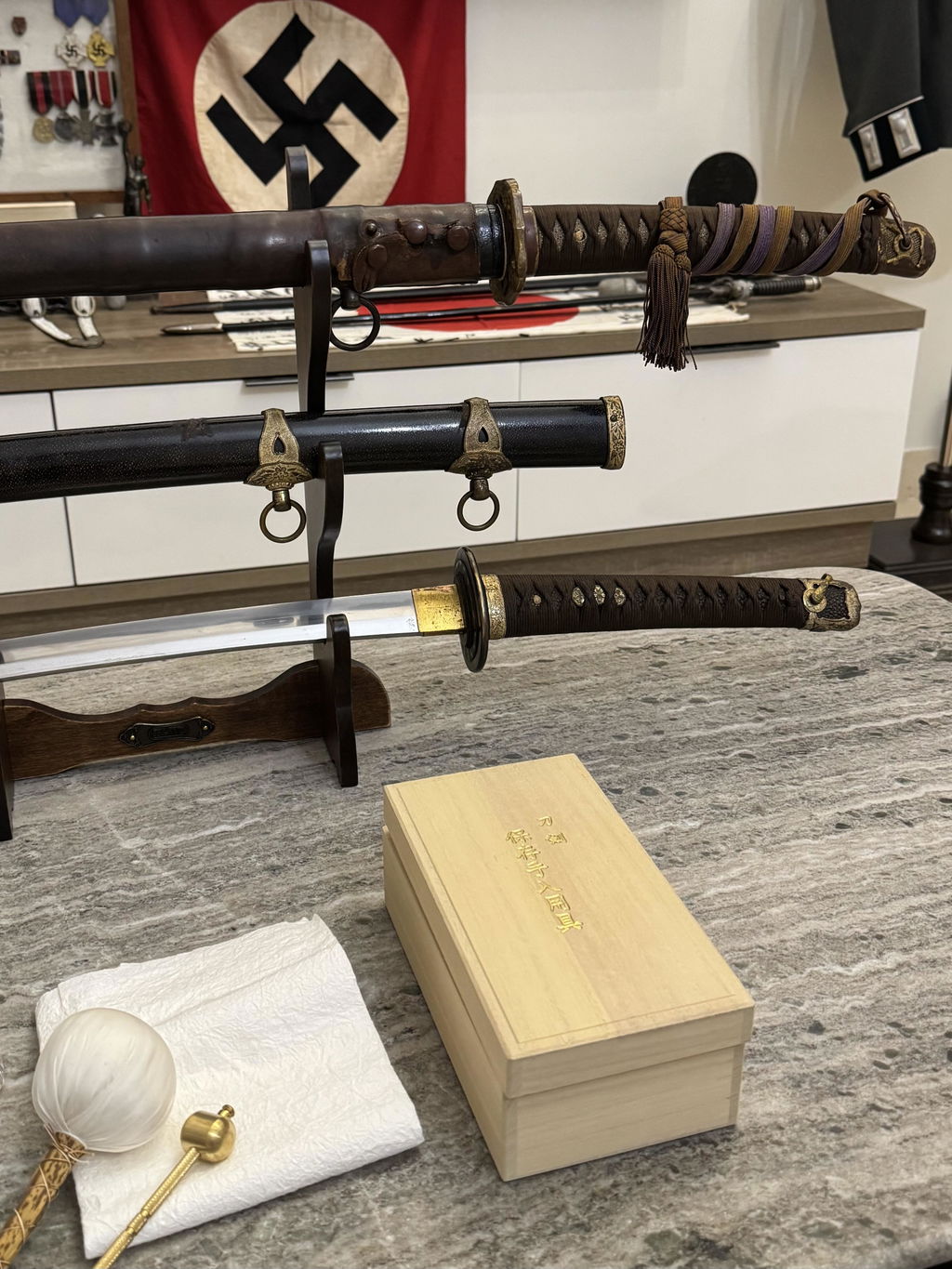
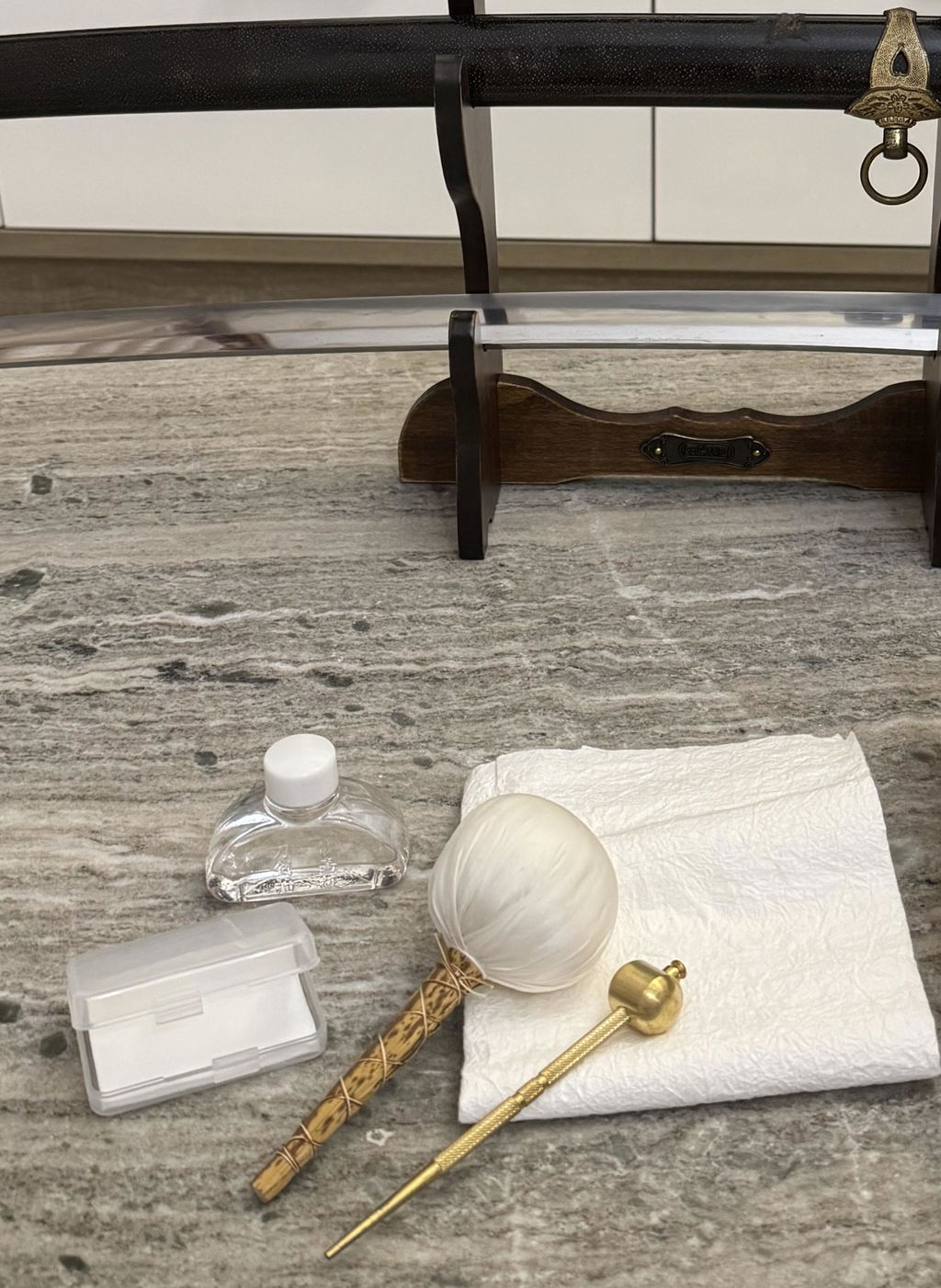
A complete maintenance kit is inexpensive, compact, and lasts for years. A basic kit costs $30–$60 and contains everything needed to maintain a collection indefinitely. The following items are the essentials:
| Item | Japanese name | Purpose | Notes |
|---|---|---|---|
| Cleaning paper / soft cloth | Nuguigami | Remove old oil from the blade | Use lint-free paper or a clean, soft cotton cloth. Disposable Japanese cleaning paper is available from sword suppliers. |
| Uchiko powder ball | Uchiko | Remove residual oil and micro-particles | Fine whetstone powder in a silk ball. Tap lightly — excessive pressure over time can affect polish. Omit on very valuable antiques if advised by your dealer. |
| Clove oil (chōji oil) | Chōji abura | Protect blade from rust and oxidation | Traditional blend of clove oil and mineral oil. The clove component adds mild antimicrobial and rust-inhibiting properties. Substitute: food-grade mineral oil. Never use WD-40, motor oil, or cooking oil. |
| Oil applicator | Abura-nuguishi | Apply oil evenly to blade surface | A dedicated soft cloth or cotton pad for oil application. Keep separate from cleaning cloths to avoid contamination. |
| Peg remover | Mekugi-nuki | Remove the bamboo peg to detach handle | A small brass hammer used for the annual tang inspection. Push the peg from the ura (back) side. |
| Digital hygrometer | — | Monitor humidity in storage area | Not a traditional item but essential for international collectors. A $10–$20 digital hygrometer placed in or near your storage area tells you whether conditions are within the safe range. |
| Humidity packs (Boveda or similar) | — | Maintain target relative humidity | Two-way humidity control packs that both absorb and release moisture. Available in specific RH targets (55% recommended for sword storage). Replace every 2–3 months. |
What Never to Do
- Never touch the blade with bare hands. Skin oils and acids etch the surface within hours in any climate. Always use clean cloths or gloves when handling the blade.
- Never apply oil inside the saya. Oiling the interior of the scabbard damages the wood and causes the blade to stick — the opposite of its intended effect. The oil goes on the blade only.
- Never store near heat sources, exterior walls, or in basements or attics. All of these locations experience humidity and temperature fluctuations that are harmful to swords. A climate-stable interior room is always the correct choice.
- Never store the sword in an unventilated airtight container without humidity control. Trapped moisture promotes mould in wooden components. A breathable container with humidity packs is better than a sealed case without them.
- Never attempt to remove rust yourself on a valuable nihonto. Even light rust should be reported to a professional polisher. Incorrect rust removal — including the use of abrasives or chemical treatments — can permanently damage the polish and reduce the blade's value and authenticity.
- Never bring a cold sword directly into a warm, humid room. Allow the sword to acclimatise gradually to prevent condensation inside the saya. Keep it in an insulated bag for 30–60 minutes before opening in a different temperature environment.
- Never display in direct sunlight or under UV-emitting light sources. UV destroys lacquer, silk, and cotton components irreversibly. This damage is cumulative and invisible until it is too late.
- Never ignore the maintenance schedule because the sword looks fine. Rust begins invisibly at a microscopic level before it becomes visible. The 3–6 month oiling schedule prevents what cannot yet be seen, not what is already apparent.
Special Care for Newly Arrived Swords
A sword that has just been shipped internationally deserves particular attention in its first months in your care. Newly polished blades and freshly forged swords are especially vulnerable to rust in the first six months — the blade surface has not yet developed the stable oxide layer that provides some natural protection in older pieces.
- Inspect the blade immediately on arrival — check for any rust, damage, or humidity issues that may have occurred in transit.
- Oil the blade within 24 hours of arrival, regardless of when it was last oiled before shipping.
- For the first six months, oil every month rather than every 3–6 months.
- Allow the sword to acclimatise to your home environment before placing it in a sealed display case — one to two weeks in the open air of a humidity-controlled room is ideal.
- Check the habaki and nakago after the first month to verify that no condensation damage occurred during shipping.
- Set up your hygrometer and humidity management before the sword arrives — not after.
When to Seek Professional Care
Home maintenance handles the routine — but some situations require a specialist. Knowing when to escalate is as important as knowing how to oil.
Contact a professional polisher (tōgishi) if: visible rust appears and cannot be removed with gentle oil application; the hamon appears to be losing definition or brightness; any scratches or nicks appear on the blade surface; or the overall condition of the polish seems to be deteriorating over time. A professional polish restores the blade to its full visual and physical condition — and for an NBTHK-certified piece, maintaining polish quality is essential to maintaining the certification's validity.
Contact a saya specialist if: the scabbard has cracked, warped, or no longer fits the blade correctly; the blade sticks when being drawn; or the lacquer has blistered, chipped, or cracked significantly. A poorly fitting saya can cause physical damage to the blade surface.
Contact a tsuka specialist if: the handle wrap has loosened, torn, or developed mould; the mekugi (bamboo peg) has cracked and no longer holds the handle securely; or the samegawa (ray skin) shows significant deterioration. A loose handle is a safety issue as well as a preservation issue.
your nihonto — from Kyoto
Tozando supplies complete maintenance kits, shirasaya, and specialist storage materials to collectors worldwide. Questions about caring for a specific piece? Our specialists provide guidance in English on every aspect of nihonto maintenance — before and after your purchase.
In Summary — The Collector's Maintenance Principles
Japanese sword care is not complicated. It is consistent. The collectors who maintain their pieces in excellent condition over decades are not those who do extraordinary things — they are those who do ordinary things regularly: oil on schedule, store at correct humidity, keep records of maintenance, and call a professional when something exceeds their expertise.
A well-maintained nihonto is not merely a better-looking object. It is a better investment, a more authentic historical artifact, and a more meaningful possession. The blade you pass on to the next generation should be in the same condition — or better — than the blade you received. That is what it means to steward a Japanese sword.
The sword has survived centuries. With the right care, it will survive your climate too.
Sources: Tokyo Nihonto — "Nihonto Care: Clean, Oil and Store Your Katana," "Mastering Japanese Sword Care," "How to Display Your Katana"; Tozando Katana Shop — "Shirasaya: Essential Storage for Your Japanese Sword's Preservation," "Katana Care 101," "How to Preserve Your Sword"; TrueKatana — "How to Care for a Katana: The Complete Maintenance Guide"; Samurai Museum Shop — "A Guide to Sword Maintenance" (Paul Martin); Tokyo Travel Assist — "A Foreigner's Guide to Japanese Swords."
Note: Care recommendations in this article reflect general best practices. Specific blades — particularly those with recent professional polishing, original period koshirae, or unusual construction — may require different maintenance approaches. Consult your dealer or a specialist for guidance specific to your piece.

Leave a comment: