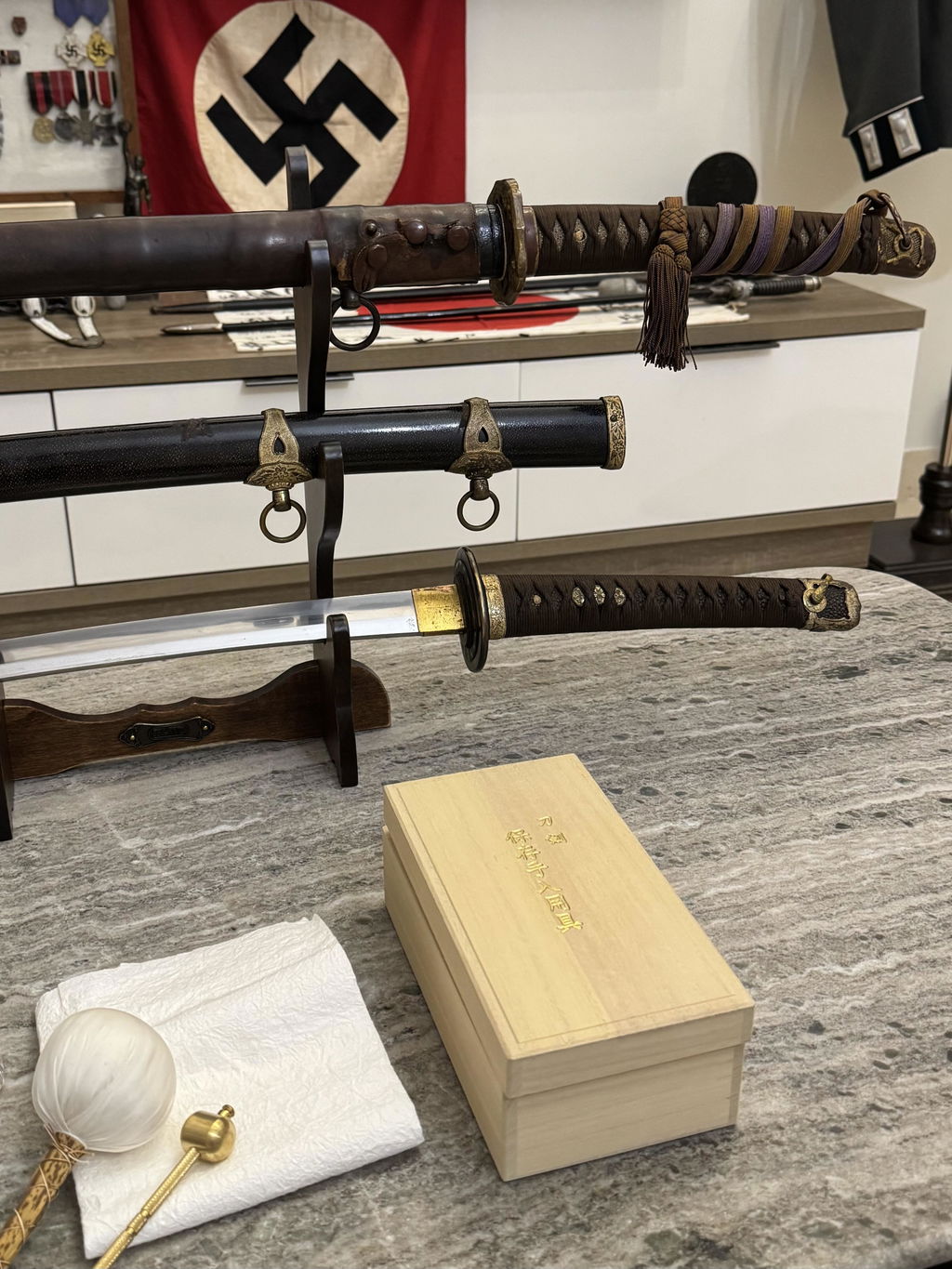
An elegant and unusually powerful original-length (ubu) ko-wakizashi, signed Kanetoki (兼辰) of Mino and dating to around the mid-Edo period. Broad, dynamic, and beautifully preserved, it is the kind of blade that has been prized by generations of collectors for its bold, commanding beauty — a sword with real history and romance, kept in a plain wood shirasaya bearing a flowing sayagaki (scabbard inscription) in its praise.
Freshly polished and in superb, essentially flawless condition, this is an exceptionally sound (kenzen) and impressive blade by the mid-Edo master smith Kanetoki. The jigane is a finely worked konuka-hada ("rice-bran skin") — the dense, tightly forged grain characteristic of Mino — beautifully standing and full of the organic, deeply satisfying expression of a true Japanese sword; moist throughout and free of any unwanted roughness, it shows Kanetoki's high forging skill to the full. The hamon is a broad-tempered gunome-midare of round-topped gunome linked in rhythmic succession. It is nie-hon'i (nie-based), with a bright, clear habuchi; fine nie sparkle along the edge with a dreamy, softly luminous quality — like morning mist.
This is a broad hira-zukuri (flat-sided, ridgeless) ko-wakizashi of a scale that might well be called a "large tanto" (ō-tanto). Its defining feature is an exceptionally wide body (mihaba) far broader than a typical wakizashi, which — combined with the clean, elegant line only hira-zukuri can give — produces a powerful, dynamic impression. The kasane (thickness) is generous and well preserved, giving the blade outstanding balance and a satisfying heft in the hand. At a nagasa of 31.8 cm (about 1 shaku 0.5 sun) with 0.4 cm of sori, it has genuine presence.
The tang (nakago) bears the signature Kanetoki (兼辰). Kanetoki was a Mino (Seki) line of smiths active from the early Muromachi period down into the Shintō era of the Edo period — a distinguished hereditary house of swordsmiths, also known as retained smiths of the Uesugi family. Kanetoki blades are particularly esteemed for their skill and beauty, and this work is regarded as a piece from around the middle Edo period.
The blade is preserved in a plain wood shirasaya (resting scabbard) carrying an elegant, flowing sayagaki — an ink inscription praising the sword's origins and beauty. The very presence of this writing speaks to how highly former owners prized and treasured this piece, and it adds a further measure of dignity and provenance to the blade.
A freshly polished, ubu, signed mid-Edo ko-wakizashi by Kanetoki of Mino — its beautifully forged konuka-hada and bright, nie-based gunome-midare housed in a shirasaya with an appreciative sayagaki. A bold, wide-bodied blade full of presence, ready to appreciate exactly as it is.

Every blade reflects generations of knowledge, discipline, and precision passed down through traditional Japanese swordmaking. From the forging of steel to the final finishing touches, each piece is shaped with patience, mastery, and deep respect for heritage.

From carefully selected materials to the refined finishing of every surface, each sword is crafted and presented with uncompromising attention to detail. Our commitment to authenticity ensures every piece reflects true tradition, lasting quality, and enduring cultural value.

Designed with balance, simplicity, and purpose, our blades embody the harmony between refined form and skilled craftsmanship. Each sword represents a thoughtful union of strength, elegance, and the timeless discipline of Japanese artisans.