This is a signed kaiken — a small tantō of the kind traditionally carried for personal defense — and a genuine work of the Gassan school, dated to the early Meiji period. The tang is signed on the front (omote) Gassan …ichi (月山□一) — the middle character is worn on the registration papers, but on the blade itself it reads clearly as Sadakazu (貞一). The reverse carries an early Meiji-era date (明治…年二…), placing the blade in the 1870s–1880s.
Read as Gassan Sadakazu, the signature is that of the greatest Gassan master of the Meiji period — the first-generation Sadakazu (1836–1918), Imperial Household swordsmith and Teishitsu Gigeiin (Imperial Court Artist), celebrated for his blade engraving and for reviving the school's ayasugi grain. As this blade is offered without modern shinsa papers, we present the signature as it reads rather than as an attribution; formal authentication is left to the buyer and the certifying bodies. What is beyond question is that this is a genuine, early-Meiji-dated Gassan-school kaiken, engraved on both faces.
The Gassan tradition is one of the oldest in Japan, tracing back some eight centuries to the smiths who worked at the foot of the sacred Mt. Gassan in Dewa province. The school is famous above all for ayasugi-hada, a distinctive wave-like grain, but its Meiji-era smiths — trained across the five classical traditions — also worked in other styles. Nearly lost by the late Muromachi period, the Gassan line was revived in the 19th century by Gassan Sadayoshi and carried to new heights by his heir, the first-generation Sadakazu, whose work stands at the summit of Meiji-era swordmaking, prized for its superb blade engraving.
The blade is made in kanmuri-otoshi-zukuri — an elegant, archaic form in which the back (mune) is bevelled away toward the point — giving this little kaiken a refined, purposeful silhouette. Both faces are engraved (horimono): the omote bears a graceful flowering plum branch (ume), with further carving on the reverse — the kind of refined blade engraving for which the Gassan smiths, and Sadakazu above all, were renowned.
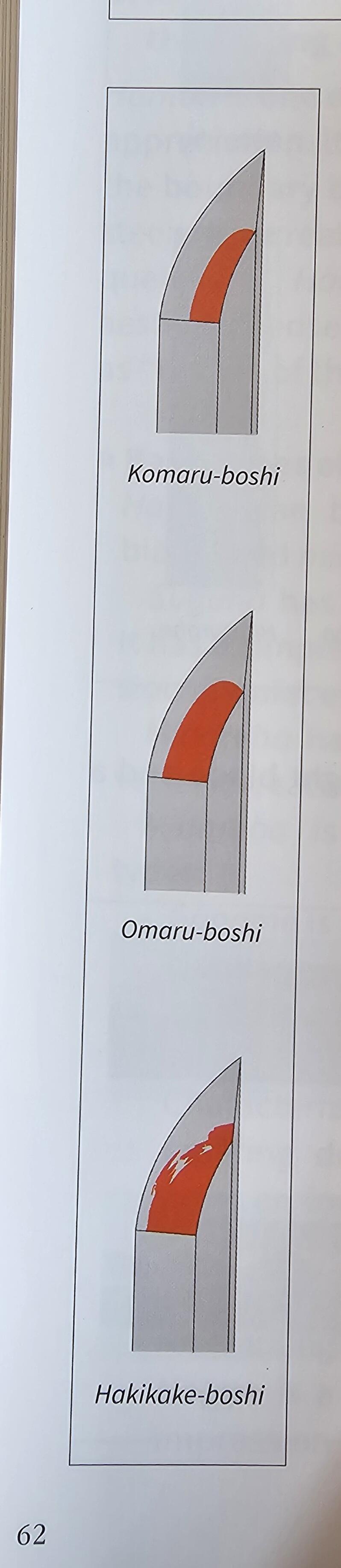
The jigane is a well-forged itame (wood-grain) surface, and the hamon is a spirited midare (irregular temper) that culminates in a bold, deeply turned-back bōshi at the point — a dramatic, powerful finish that gives this small blade real presence. The steel and temper are fundamentally healthy (kenzen). In candor, the polish is old and a little clouded, so the blade does not presently show to its full advantage — a fresh, professional polish would bring out the grain and the vigor of the hamon far more vividly. It is offered honestly in its current state, with that potential intact.
The blade is housed in a plain wood shirasaya, the traditional resting mount that protects the steel between viewings.
An early-Meiji-dated, signed Gassan-school kaiken in the elegant kanmuri-otoshi form, engraved on both faces and finished with a bold, dramatic bōshi — signed in a manner that reads as the great Sadakazu. Sound in health beneath an old polish, it offers the collector both a genuine Gassan blade and the rewarding pursuit of fresh polish and formal attribution.

Every blade reflects generations of knowledge, discipline, and precision passed down through traditional Japanese swordmaking. From the forging of steel to the final finishing touches, each piece is shaped with patience, mastery, and deep respect for heritage.

From carefully selected materials to the refined finishing of every surface, each sword is crafted and presented with uncompromising attention to detail. Our commitment to authenticity ensures every piece reflects true tradition, lasting quality, and enduring cultural value.

Designed with balance, simplicity, and purpose, our blades embody the harmony between refined form and skilled craftsmanship. Each sword represents a thoughtful union of strength, elegance, and the timeless discipline of Japanese artisans.