Antique Japanese Wakizashi Sword - Mumei, Shinto Era (36.6 cm)
¥200,000 ¥240,000

This blade has been acquired. Discover other exceptional swords currently available in our collection.


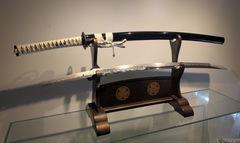
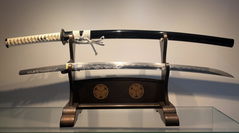
A most compelling and robust blade judged to be the work of Yoshimitsu, a master representative of Tosa province in the late Muromachi period. This is a hira-zukuri yoroidōshi (armor-piercing dagger) thought to have been forged around the Bunmei era of the late Muromachi period. Accompanied by a finely preserved period mounting, it unites the overwhelming strength of a practical fighting blade with a stirring historical value.
The blade is very well polished and well preserved — remarkably sound and, for an old sword (kotō), essentially free of flaws overall. The one regret is a very small edge nick (ha-kobore) about 6 cm up from the ha-machi; this speaks to the blade's long history and in no way diminishes the fine appreciation value or the soundness of the piece as a whole. The jigane is an itame partly mixed with mokume, well forged so that the layers of the forging stand out clearly. The hamon is a suguha with a tight nioiguchi, turning back broadly at the point (bōshi). The tang (nakago) is firmly cut with the two-character signature Yoshimitsu. The mounting is a de-menuki-style aikuchi with a shadow-maki-e (kage-maki-e) lacquered scabbard; a distinctive fitting detail, in which one side of a peg-hole is left unpierced, preserves the character of the period to this day.
The greatest feature of this piece is its astonishing thickness — a kasane of some 9 mm that overturns the ordinary idea of a tanto — in a commanding yoroidōshi form. The trim, ridgeless hira-zukuri body, together with a mune that draws a steep, deep line, radiates an extreme, purposeful beauty honed for one thing only: to pierce an opponent's armor and its gaps. The solid heft and taut tension felt the moment it is taken in hand convey directly the spirit of the samurai who threw himself, body and soul, into battle. This is precisely the refined mass and balance of a chūmon-uchi — a blade commissioned from a master smith by a warrior with a special purpose in mind.
Yoshimitsu was a master smith active in Tosa province (present-day Kōchi) around the Bunmei era (later 15th century) of the late Muromachi period. Tosa Yoshimitsu left many fine, highly practical blades, showing particular skill in carefully made works such as the yoroidōshi prized by samurai for self-defense and real combat. In an age awash with mass-produced blades, a chūmon-uchi like this — with an extra-thick kasane and excellent ground and edge — is exceedingly precious, and is very highly regarded in the appreciation and collecting of swords today.
The blade is accompanied by a well-preserved de-menuki aikuchi koshirae with a shadow-maki-e scabbard and a fitted kozuka. The hilt is a lavish full ray-skin wrap (sō-same-maki) — a mark of high-grade mountings — set with a splendid large central nodule (oyatsubu) as an accent. Boldly three-dimensional de-menuki in the form of an ox lend a refined design touch within the martial austerity. The saya is finished in a deep, flavorful marbled kage-maki-e of intermingled red and green, harmonizing beautifully with the menuki for an air of exceptional elegance. A kozuka is securely housed in the side of the scabbard, conveying the refinement of the samurai of the age and the high completeness of the ensemble as a set of tools.
An extremely powerful yoroidōshi by Yoshimitsu, entrusted with a samurai's life in the turbulent years on the eve of the Sengoku age. With its overwhelming thickness, clear ground and edge, and a high-toned aikuchi koshirae full of period feeling, it is an ultimate piece through which one can fully savor the essence of a practical fighting blade and the breath of history.
¥200,000 ¥240,000

¥400,000 ¥430,000

¥390,000 ¥410,000

¥270,000 ¥290,000

¥300,000 ¥330,000


Every blade reflects generations of knowledge, discipline, and precision passed down through traditional Japanese swordmaking. From the forging of steel to the final finishing touches, each piece is shaped with patience, mastery, and deep respect for heritage.

From carefully selected materials to the refined finishing of every surface, each sword is crafted and presented with uncompromising attention to detail. Our commitment to authenticity ensures every piece reflects true tradition, lasting quality, and enduring cultural value.

Designed with balance, simplicity, and purpose, our blades embody the harmony between refined form and skilled craftsmanship. Each sword represents a thoughtful union of strength, elegance, and the timeless discipline of Japanese artisans.