Antique Japanese Katana Sword - Mumei, Shinshinto Era - NBTHK Hozon Token(73.2 cm)
¥1,100,000 ¥1,150,000

We are pleased to offer a katana attributed to Reisen Sadamori (冷泉貞盛), a solitary and highly individual swordsmith who worked in Chikuzen Province (present-day Fukuoka) during the Nanbokuchō period (mid-14th century). At a time when the brilliant, flamboyant work of the neighbouring Samonji (左文字) school was the height of fashion in Chikuzen, Sadamori went his own way, faithfully carrying on the calm, classical suguha of the older Kongōbyōe (金剛兵衛) tradition. The result is a blade of great dignity and restraint. This sword has been certified by the NBTHK (Nihon Bijutsu Tōken Hozon Kyōkai) as a Jūyō Tōken (Important Sword), No. 565, and it carries a sayagaki by Honma Kunzan — one of the towering figures of 20th-century sword scholarship — as well as being published and illustrated in his own reference work Kantō Hibishō, Zoku (『鑑刀日々抄 続』, p.495).
Reisen Sadamori is a scarce and somewhat enigmatic name in the study of Chikuzen swords. He is understood to have worked within, or very close to, the Kongōbyōe lineage — one of the oldest sword-making traditions in Kyūshū, tracing its roots back to the Kamakura period. Where his contemporaries in the Samonji school pursued vivid, showy hamon full of nie activity, Sadamori committed himself to a serene suguha (straight temper line) executed with the utmost quality. Surviving works bearing his attribution are few, which makes any authenticated example — particularly one elevated to Jūyō Tōken status — a genuinely uncommon opportunity for the serious collector of Nanbokuchō Kyūshū work.
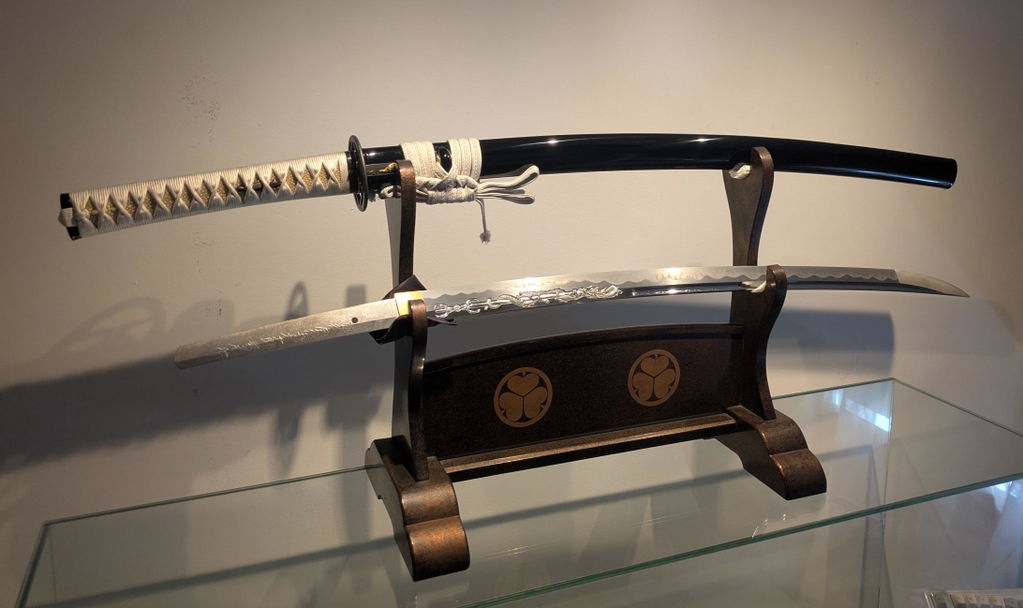
The jigane is a flowing itame mixed with mokume, standing somewhat proud (hadadachi) so that the grain reads clearly, with running chikei threading through it and a bright scattering of ji-nie across the surface. The hamon is a dignified, narrow suguha (hoso-suguha / suguha-chō) in fine ko-nie, worked with abundant ashi and yō so that, for all its restraint, the temper is alive with quiet activity. Toward the upper half of the blade the temper shows nijūba-gokoro (a doubling of the habuchi) together with passages of yubashiri, touches that lift the whole and reveal the hand of a true master. As a Jūyō Tōken the blade is in excellent, healthy condition with the workmanship fully visible; it is a sword to be studied slowly and closely.
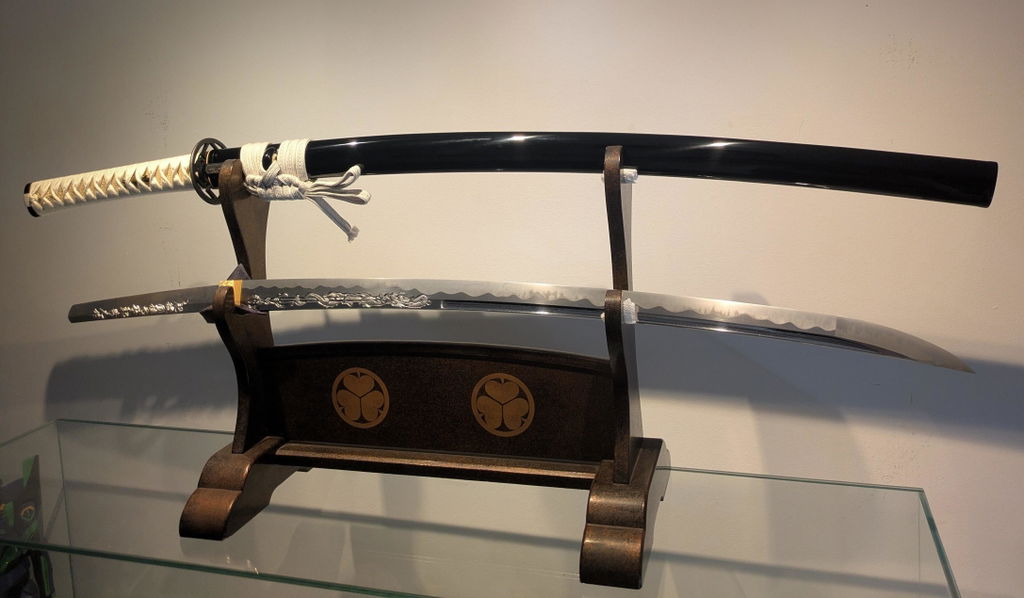
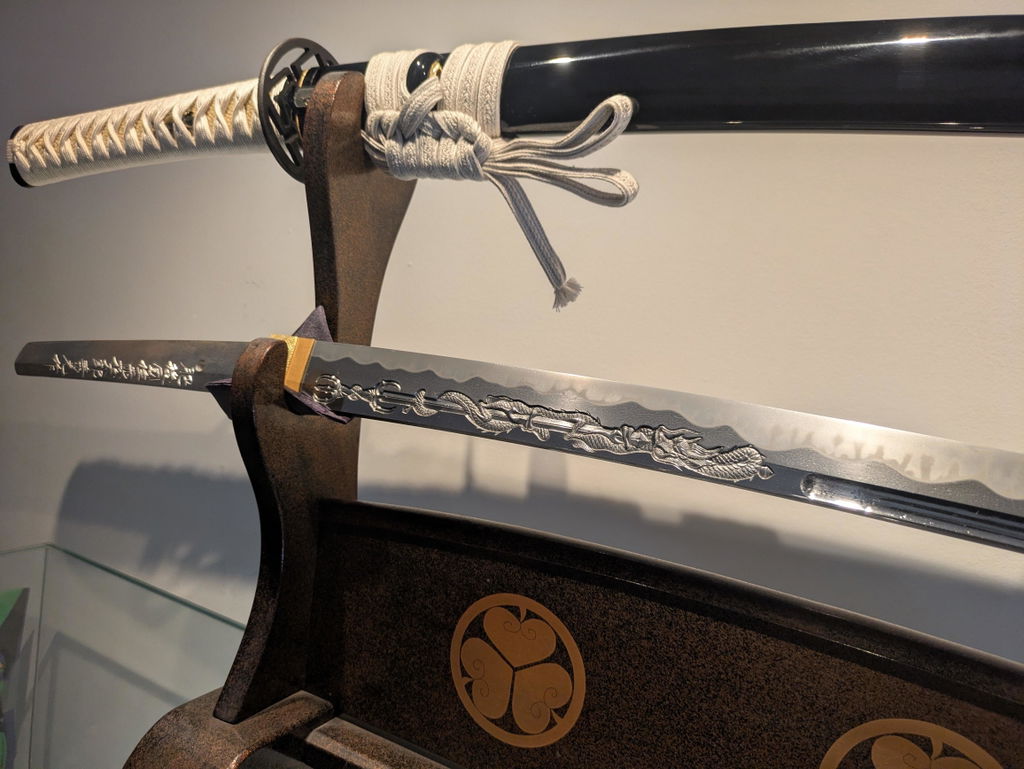
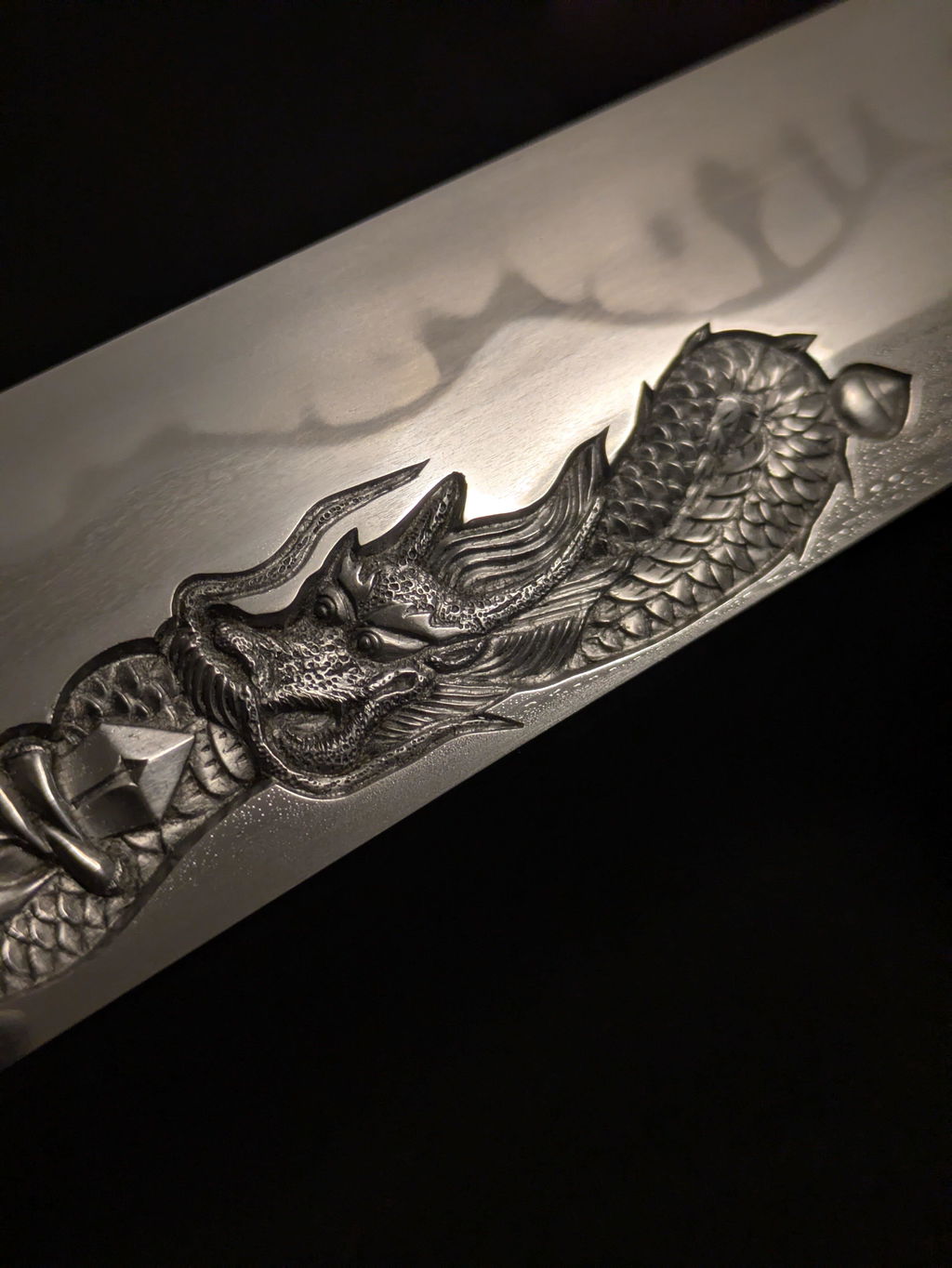
This is a shinogi-zukuri katana with an iori-mune and a chū-kissaki, of ō-suriage mumei (greatly shortened, unsigned) construction — as is entirely typical and expected for a Nanbokuchō blade of this length and date. The nagasa is 72.1 cm (about 28.39 inches, roughly 2 shaku 3 sun 8 bu) with a sori of 2.0 cm (about 0.79 inch), giving a commanding but well-balanced outline. Twin grooves (ni-hon-hi / 二筋樋, kaki-nagashi) are cut on both faces of the blade, running down into the tang. The nakago is ō-suriage with katte-sagari file marks and three mekugi-ana. Motohaba is 28.7 mm and sakihaba 19.5 mm; motokasane 7.4 mm and sakikasane 6.0 mm. The blade alone weighs 720 g, and 1,000 g mounted in its koshirae (without the scabbard).
The blade is preserved in a shirasaya bearing a sayagaki (scabbard inscription) by Honma Kunzan (本間薫山), attributing the work to Reisen Sadamori. Beyond the sayagaki, this very sword is published and illustrated in Honma's reference volume Kantō Hibishō, Zoku (『鑑刀日々抄 続』, p.495), where it is recorded as "Katana, mumei, Reisen Sadamori, ō-suriage" with the note that the workmanship is judged to be that of the Kongōbyōe school and "may well be attributed to Reisen Sadamori." A documented, published pedigree of this kind, from the very scholar who chaired the NBTHK, adds considerable weight and confidence to the attribution.
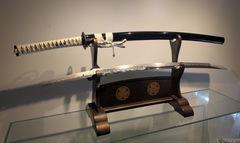
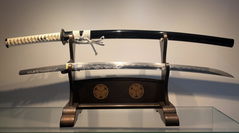
The blade is preserved in the shirasaya described above and, in addition, is furnished with a complete koshirae. The scabbard is a handsome two-tone kawari-nuri (variant-lacquer) saya, and the hilt is bound in pure-silk tsumami-maki (a raised, pinched silk wrap). It is fitted with a tsuba depicting the famous scene of "Han Xin crawling between the legs" (韓信の股くぐり), from the Records of the Grand Historian — the story of the great Han-dynasty general who swallowed a public humiliation, choosing to crawl between a bully's legs rather than throw his life away in a pointless brawl, and who went on to greatness: an emblem of patience and endurance in the service of a larger purpose. The menuki are in the form of a bow and bundled arrows (yumiya / 矢束), long-standing symbols of martial valour and the driving-away of evil.
Between its Jūyō Tōken designation, its Honma Kunzan sayagaki, and its publication in a standard reference by the same scholar, this Reisen Sadamori katana offers a rare combination of quality, rarity and cast-iron provenance. It will reward a collector who values the quiet, classical end of Nanbokuchō Kyūshū work.
¥1,100,000 ¥1,150,000

¥200,000 ¥240,000

¥400,000 ¥430,000

¥390,000 ¥410,000

¥270,000 ¥290,000

¥300,000 ¥330,000


Every blade reflects generations of knowledge, discipline, and precision passed down through traditional Japanese swordmaking. From the forging of steel to the final finishing touches, each piece is shaped with patience, mastery, and deep respect for heritage.

From carefully selected materials to the refined finishing of every surface, each sword is crafted and presented with uncompromising attention to detail. Our commitment to authenticity ensures every piece reflects true tradition, lasting quality, and enduring cultural value.

Designed with balance, simplicity, and purpose, our blades embody the harmony between refined form and skilled craftsmanship. Each sword represents a thoughtful union of strength, elegance, and the timeless discipline of Japanese artisans.