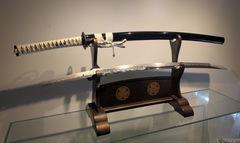
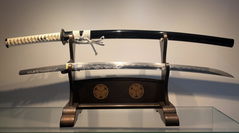
Antique Japanese Wakizashi Sword - Mumei, Shinto Era (36.6 cm)
¥200,000 ¥240,000

This blade has been acquired. Discover other exceptional swords currently available in our collection.


A strikingly individual and high-toned ubu (original-length), unsigned (mumei) tanto, worthy of its NBTHK Kichō Tōken ("Precious Sword") authentication. Made in the late Edo period, around the Ansei era (1854–1860), by a swordsmith active in Hitachi province (present-day Ibaraki), it is a chūmon-uchi — a special custom order in which a samurai or discerning patron projected his own sense of beauty onto the blade — and is attributed by the NBTHK to Sukemitsu (伝 祐光).
Freshly polished and nearly flawless, the blade shows a ground and edge in very sound (kenzen) condition. What first catches the eye is the thick kasane and the kanmuri-otoshi construction, in which the upper back is boldly beveled down. To the crisp sharpness of a shōbu-zukuri form it adds the strength of the kanmuri-otoshi profile — a tanto with the spirit of a practical fighting blade. A bō-hi (straight groove) is carefully carved through from the base up into the shinogi-ji: not merely to lighten the blade but as a deliberate design element, giving the elaborate surface composition that only a true custom order tends to receive.
The jigane is a finely and carefully forged ko-itame (small wood-grain), beautifully packed — a superb skin that reveals the master's meticulous hand. The hamon is based on a calm, gently undulating ko-notare, into which refined, softly rounded ko-gunome mix with elegance. The boundary with the ground (habuchi) is bright and clear white, drawing the eye with a deep, satisfying appeal. From tang to tip the temper is without any hagire or slackening — a flawless, thoroughly healthy hamon to be savored.
Though unsigned, the blade is judged (den) to be the work of Yokoyama Kijūrō Sukemitsu. Sukemitsu was a master smith who served as a retained swordsmith of the Mito domain (present-day Ibaraki) in the late Edo (bakumatsu) period. His rare skill was highly esteemed, and in Kaei 2 (1849) he was taken into the service of the Mito lord Tokugawa Nariaki, invited to the Shirahatayama arms manufactory that Nariaki established and becoming one of the domain's representative smiths. Amid the storm of sonnō-jōi ("revere the Emperor, expel the barbarians") that swept the age, when the Mito Tengu-tō rose in arms in Genji 1 (1864) demanding the closing of Yokohama port, Sukemitsu himself is said to have joined that Tengu-tō uprising — a smith whose life ran through the very heart of the bakumatsu.
The tanto is preserved in a plain wood shirasaya (resting scabbard) with a copper habaki, accompanied by a wooden placeholder blade (tsunagi) — a clean, respectful way to keep and enjoy a fine documented blade.
An ubu, unsigned late-Edo tanto attributed to the Mito master Yokoyama Sukemitsu — a custom-order blade of thick kanmuri-otoshi form with a full bō-hi, its finely forged ko-itame and bright ko-notare temper preserved in near-flawless condition and carrying the NBTHK's Kichō Tōken authentication. A distinctive, historically resonant piece, ready to appreciate exactly as it is.
¥200,000 ¥240,000

¥400,000 ¥430,000

¥390,000 ¥410,000

¥270,000 ¥290,000

¥300,000 ¥330,000


Every blade reflects generations of knowledge, discipline, and precision passed down through traditional Japanese swordmaking. From the forging of steel to the final finishing touches, each piece is shaped with patience, mastery, and deep respect for heritage.

From carefully selected materials to the refined finishing of every surface, each sword is crafted and presented with uncompromising attention to detail. Our commitment to authenticity ensures every piece reflects true tradition, lasting quality, and enduring cultural value.

Designed with balance, simplicity, and purpose, our blades embody the harmony between refined form and skilled craftsmanship. Each sword represents a thoughtful union of strength, elegance, and the timeless discipline of Japanese artisans.