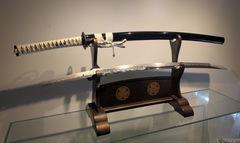
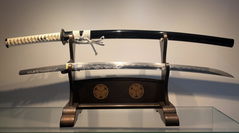
Antique Japanese Wakizashi Sword - Mumei, Shinto Era (36.6 cm)
¥200,000 ¥240,000

A rare, signed (zaimei) yoroidōshi (armor-piercing tantō) with an unshortened (ubu) tang has arrived, by the master smith Unju Fujiwara Nobukazu (運寿藤原信一), who worked in Tanba Province, dated the first year… [Keiō 3, 1867]. It carries the NBTHK (Nihon Bijutsu Tōken Hozon Kyōkai) "Hozon Tōken" certification, and is housed in a full period mounting — a characterful kizami-saya (ribbed scabbard) fitted with a lively gold boar (inoshishi) de-menuki. It is a solid, authentic piece from end to end.
The blade has been given a fine polish and is in superb condition in both steel and temper. One small area of thin black rust, about 1 cm across, is found roughly 6 cm above the mune-machi (back notch); it does not significantly detract from appreciation, and reads instead as a touch of honest age. The jigane is a finely and densely packed ko-itame (small wood-grain) covered with fine ji-nie, giving a very clear, crisp texture. The temper line is based on a dignified, straight suguha, mixed with a very shallow notare and delicate ko-midare, the temper edge covered with fine, even nie that glows brightly. Rather than relying on flamboyance, it captivates through the quality of the forging and the clarity of the edge — a work full of the refinement one expects of a fine Bakumatsu smith.
This is a robust yoroidōshi (armor-piercer) design, built with an extremely thick kasane of about 9 mm against a base width of only 26.2 mm. It is further shaped in u-no-kubi-zukuri — the back (mune) side pared down from the middle of the blade toward the tip — and carries a graceful saki-zori (curvature toward the point). The combination gives it the overwhelming solidity and sharp, purposeful stance of a custom-forged (chūmon-uchi) blade, uniting massive thickness with a keen, elegant silhouette.
Nobukazu was a master smith celebrated for his outstanding forging skill in Bakumatsu-period Tanba Province (present-day central Kyoto / eastern Hyōgo). He was a pupil of Ishidō Unju Koreichi. The tang bears a clear date of "Keiō 3" (1867), conveying that this is a practical yet highly artistic work made against the turbulent backdrop of the closing years of the Edo period.
The blade comes in a full period mounting: a characterful kizami-saya (finely ribbed/carved scabbard) fitted with a spirited gold boar de-menuki. A matching kozuka (small utility-knife handle) is also included, and the overall state of preservation is very good. The pairing of a solid, functional blade with a chic, refined ribbed mounting heightens its appeal as a collector's piece.
A powerful u-no-kubi-zukuri form with a 9 mm thickness and a beautiful saki-zori, an ubu signature bearing the Bakumatsu date of Keiō 3, a period mounting set off by its boar menuki, and NBTHK Hozon certification — a flawless piece in every respect, and a must-see for enthusiasts and collectors alike.
¥200,000 ¥240,000

¥400,000 ¥430,000

¥390,000 ¥410,000

¥270,000 ¥290,000

¥300,000 ¥330,000


Every blade reflects generations of knowledge, discipline, and precision passed down through traditional Japanese swordmaking. From the forging of steel to the final finishing touches, each piece is shaped with patience, mastery, and deep respect for heritage.

From carefully selected materials to the refined finishing of every surface, each sword is crafted and presented with uncompromising attention to detail. Our commitment to authenticity ensures every piece reflects true tradition, lasting quality, and enduring cultural value.

Designed with balance, simplicity, and purpose, our blades embody the harmony between refined form and skilled craftsmanship. Each sword represents a thoughtful union of strength, elegance, and the timeless discipline of Japanese artisans.