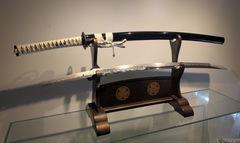
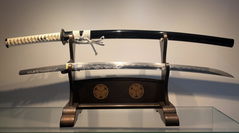
Antique Japanese Wakizashi Sword - Mumei, Shinto Era (36.6 cm)
¥200,000 ¥240,000

We are pleased to present a rare, signed (zaimei) katana with an unshortened (ubu) tang by Fujiwara Masatsugu (藤原正次), a skilled smith who worked in Musashi Province in the Tenpō era of the late Edo period. Its greatest appeal lies in a distinguished double provenance: it carries the important papers of two separate generations of appraisal — the NBTHK "Tokubetsu Hozon Tōken" and the older "Tokubetsu Kichō Tōken" — together with a highly prized scabbard inscription (sayagaki) by Honami Kōson, a towering figure of the modern sword world. Freshly polished and virtually free of flaws, both the steel and the temper line retain a fresh, lustrous vitality. The result is a blade of exceptional reliability and outstanding collection value.
In addition to the "Tokubetsu Kichō Tōken" (Especially Precious Sword) paper issued in the Shōwa era, this katana carries the current NBTHK (Nihon Bijutsu Tōken Hozon Kyōkai) "Tokubetsu Hozon Tōken" (Especially Worthy of Preservation) paper — a luxurious double-certification that few blades can boast. Having passed multiple rigorous examinations across the generations, its authenticity as a genuine work and its value as an asset are placed on the firmest possible footing. The older Tokubetsu Kichō paper (1969) even bears the name of the then-chairman, Marquis Hosokawa Moritatsu.
Masatsugu belonged to the celebrated school of Suishinshi Masahide, the renowned founder of the Shinshintō ("new-new sword") revival. He was the adopted son and heir of the second-generation Masahide (known as Hakuyū Nyūdō), and is counted in the third generation of this distinguished lineage. Working in Musashi Province (Edo) during the Tenpō era of the late Edo period, he inherited the teachings of his father and grandfather and left behind many fine swords combining practical strength with beauty. The tang is ubu and retains its clear period signature (ubu-zaimei), giving the piece outstanding documentary value. The blade also carries a period ownership inscription, "owned by Fujiwara Masazumi" (藤原正純所持).
Freshly polished and virtually free of flaws (kizu), the blade is in exceptionally healthy condition. The jigane is a finely and densely packed itame (wood-grain) pattern, covered with fine ji-nie that lends it depth, moisture, and clarity. The temper line is based on a dignified suguha (straight hamon) tinged with a gentle notare (shallow undulation), the temper edge glowing with an even, bright nie. Rather than relying on flamboyance, it captivates through the quality of the forging and the clear brilliance of the edge — a concentrated display of the high technical skill for which Masatsugu is known.
A handsome bō-hi (single straight groove) is carved cleanly into both faces of the blade, heightening its dignified appearance while producing an excellent weight balance in the hand. With a solid, powerful figure in both width and thickness, it nonetheless sweeps into a beautiful, flowing curvature toward the tip.
Beyond its double certification, the plain wooden shirasaya (resting scabbard) bears a sayagaki (scabbard inscription) by Honami Kōson, the foremost authority in sword appraisal and research of the Shōwa era. Swords carrying a Kōson sayagaki are highly treasured on the market, and it stands as a major highlight, further attesting that this is the fine work of a master smith.
Folded together, the assurances of two generations of certification, the ubu period signature of the Tenpō master Fujiwara Masatsugu — a smith in the legitimate bloodline of Suishinshi Masahide — the beautifully carved bō-hi on both faces, and the sayagaki of Honami Kōson make this a supreme collection piece that no connoisseur should overlook.
¥200,000 ¥240,000

¥400,000 ¥430,000

¥390,000 ¥410,000

¥270,000 ¥290,000

¥300,000 ¥330,000


Every blade reflects generations of knowledge, discipline, and precision passed down through traditional Japanese swordmaking. From the forging of steel to the final finishing touches, each piece is shaped with patience, mastery, and deep respect for heritage.

From carefully selected materials to the refined finishing of every surface, each sword is crafted and presented with uncompromising attention to detail. Our commitment to authenticity ensures every piece reflects true tradition, lasting quality, and enduring cultural value.

Designed with balance, simplicity, and purpose, our blades embody the harmony between refined form and skilled craftsmanship. Each sword represents a thoughtful union of strength, elegance, and the timeless discipline of Japanese artisans.