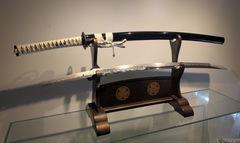
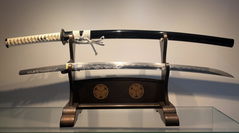
Antique Japanese Wakizashi Sword - Mumei, Shinto Era (36.6 cm)
¥200,000 ¥240,000

Sō Nobuyasu is a swordsmith of Fukuoka Prefecture and a member of the Kyushu branch of the All Japan Swordsmith Association. The Sō name is one of the best known in modern Kyushu swordmaking: Sō Tsutomu (宗勉) and Sō Masachika (宗昌親), both of Fukuoka, each attained mukansa (exhibition-exempt) rank, and the Sō smiths are known above all for Sōshū-den work and for blades in the manner of the late-Edo master Minamoto Kiyomaro. Nobuyasu has placed among the prize-winners at the Omamori-gatana (protective sword) Exhibition. A katana commissioned through Tozando is forged to order by the smith himself and priced as set by the All Japan Swordsmith Association (全日本刀匠会).
Nobuyasu works in Fukuoka Prefecture, the old province of Chikuzen, and forges under his own name, Sō Nobuyasu. He belongs to the Kyushu branch of the All Japan Swordsmith Association, alongside Sō Masachika and the other smiths of northern Kyushu.
The Sō line of Fukuoka goes back to Sō Masamitsu (宗正光), who trained under Shirō Kunimitsu (四郎國光) of Ōmuta. His son Sō Tsutomu (1927–2015) began forging in 1946, specialized in Sōshū-den and Kiyomaro utsushi (faithful recreations), and was made mukansa in 1990, signing his blades Chikushū Sannō-jū (筑州山王住, "resident of Sannō, Chikuzen"). Tsutomu's son Sō Masachika, born in 1958, studied metallurgy at Kyushu University before entering his father's forge, won the Takamatsu-no-miya Prize in 2005 and was made mukansa in 2006.
At the 13th Omamori-gatana Exhibition, organized by the All Japan Swordsmith Association, Nobuyasu won the Sanyo Shimbun Prize, sixth place in the blade division. At the 14th exhibition he placed eleventh in the blade division, receiving the All Japan Swordsmith Association Prize.
The Sō tradition is rooted in Sōshū-den, the school of Masamune and his followers, with its bold nie (bright, visible crystals) and activity such as kinsuji and sunagashi (lines and streaks of nie within the hamon). Its signature theme is the work of Minamoto Kiyomaro (源清麿), the late-Edo smith whose powerful Sōshū-style blades are among the most admired of the shinshintō period. The Sō smiths have also worked in Bizen-den and Yamashiro-den, and in the tōran-ba (billowing wave) hamon associated with Tsuda Echizen no Kami Sukehiro. A commissioned katana can be discussed with Nobuyasu in terms of shape, hamon and the classical model the owner has in mind.
A commissioned katana by Sō Nobuyasu is a blade from Fukuoka in the tradition of one of Kyushu's most distinguished swordmaking names. It is a blade made for one owner, to be handed down as a family treasure. Please contact us to discuss specifications and lead time.
¥200,000 ¥240,000

¥400,000 ¥430,000

¥390,000 ¥410,000

¥270,000 ¥290,000

¥300,000 ¥330,000


Every blade reflects generations of knowledge, discipline, and precision passed down through traditional Japanese swordmaking. From the forging of steel to the final finishing touches, each piece is shaped with patience, mastery, and deep respect for heritage.

From carefully selected materials to the refined finishing of every surface, each sword is crafted and presented with uncompromising attention to detail. Our commitment to authenticity ensures every piece reflects true tradition, lasting quality, and enduring cultural value.

Designed with balance, simplicity, and purpose, our blades embody the harmony between refined form and skilled craftsmanship. Each sword represents a thoughtful union of strength, elegance, and the timeless discipline of Japanese artisans.