

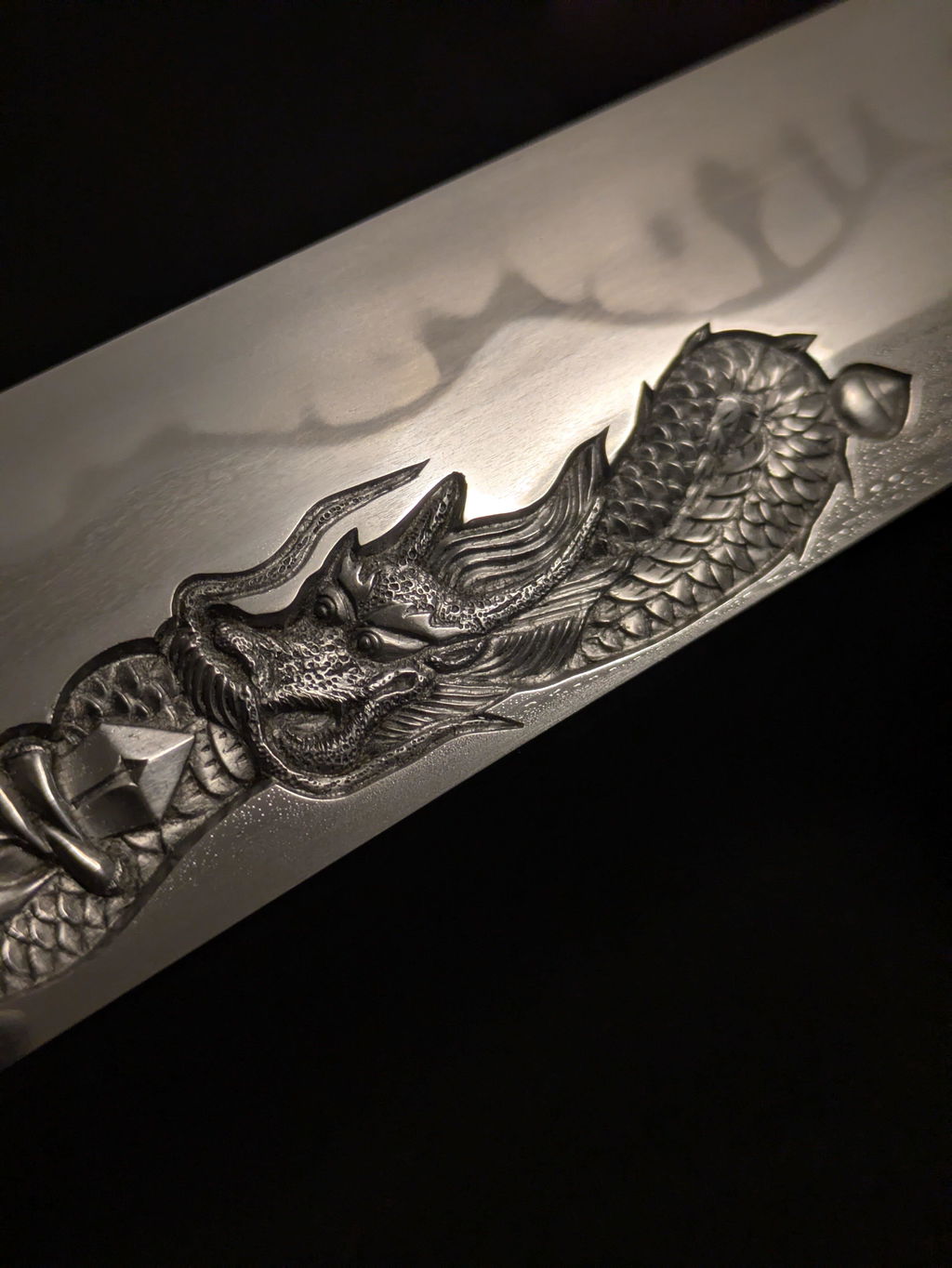
Hold a Japanese sword under a single angled light source — a lamp tilted low to the side, or raking morning sun through a window — and tilt the blade slowly. At a certain angle, the hamon comes alive. What you see is not a line. It is a world: points of light scattered like frost, a misty band flowing like morning fog over a valley, streaks that flash like lightning or drift like sand in water. Every one of these phenomena has a name, a metallurgical origin, and a meaning for attribution. At the centre of all of them are two concepts that every serious collector must understand: nie (沸) and nioi (匂). This article explains both — and what knowing them changes about the way you read a blade.
The Same Material — Two Different Scales
Nie and nioi are not different substances. They are the same material — martensite, the extremely hard crystalline structure formed when steel is quenched rapidly from high temperature — appearing at two different scales. This is the single most important fact about the relationship between them, and it is also the key to understanding why they look so different under light.
When a blade is coated with clay before quenching, the cutting edge (either uncoated or thinly coated) cools rapidly. The spine, insulated by thicker clay, cools slowly. This differential cooling drives the differential hardening that gives nihonto its legendary performance: a hard, sharp edge and a resilient spine. The boundary between these two zones — where rapidly cooled martensite meets the softer steel of the body — is the hamon. And within that boundary, the specific cooling rate and the steel's carbon content determine whether the martensite crystals that form are large enough to be individually visible (nie) or so fine that they merge into a continuous haze (nioi).
Recognising the difference is important: nie gives a rougher, brighter appearance and often accompanies more vibrant hataraki like kinsuji, whereas nioi hamon appear smoother and more silvery. This distinction is not merely aesthetic — it is a diagnostic tool, because different schools of swordsmithing developed characteristic preferences for nie-dominant or nioi-dominant hamon that are still readable today, centuries later.
Nie are individual martensite crystals large enough to be seen — not with magnification, but with the naked eye under good raking light. Each one catches and reflects light independently, producing the sparkling, almost glittering quality that experienced collectors describe as similar to frost on glass, sugar crystals, or stars scattered across a dark sky. When you tilt a blade with abundant nie and the light suddenly hits a cluster of them, the effect is unmistakable — bright, multi-directional, alive.
The word nie means "boiling" or "frothing" — a reference to the appearance of the crystals at the hamon boundary, which can look like the surface of water beginning to boil: individual points of activity, each distinct, each reflecting light at its own angle. This visual impression reflects the metallurgical reality: nie forms where the cooling rate was slightly slower, allowing larger martensite laths to develop, and where the steel's carbon content supports that crystal growth.
Nie appears not only at the hamon boundary but also within the body steel (ji-nie) — individual crystals scattered across the jihada in the ji. Ji-nie is one of the strongest indicators of Sōshū-den influence, and its presence on an unsigned blade is significant attribution evidence. The density, distribution, and specific character of nie — whether fine (ko-nie) or large (ō-nie), sparse or abundant, evenly distributed or clustered — all carry diagnostic weight for determining school, period, and quality.
Nioi are martensite crystals so fine that the eye cannot resolve them individually — even with a loupe at 10× or 15×. Instead of appearing as separate points of light, they diffuse light collectively, producing the continuous, milky-white, slightly translucent band that traces the hamon's contour. This is the quality that gives the hamon its characteristic appearance in most classic Japanese swords: not a sharp line, but a soft glow, like fog on a mountain ridge or the halo around a lamp on a misty night.
The word nioi means "scent" — an unusually evocative choice for a visual phenomenon, but one that captures something true about the quality: nioi is perceived rather than directly seen, apprehended as an atmosphere rather than a specific object. It has depth and character without the clear definition of nie. Nioi is typically the primary component of the main hamon line, outlining its shape with a soft, milky white band.
Nioi forms where cooling is most rapid and uniform — at the very edge of the hardening zone, where the clay-free steel is quenched most aggressively. The extreme cooling rate produces martensite crystals too small to resolve individually. The quality of nioi — its evenness, its brightness, the clarity of its boundary (nioi-guchi) — is one of the primary indicators of a smith's technical command of the quenching process. An even, clear, bright nioi-guchi represents consistently controlled differential hardening across the entire blade.
Large enough to catch and reflect light independently. Appears as frost, stars, or scattered grains. Produces a bright, textured, dynamic quality in the hamon. Dominant in Sōshū-den; also characteristic of Yamato and certain Yamashiro schools. Can appear in the ji (ji-nie) as well as the hamon.
Too small to resolve individually, even with magnification. Appears as a flowing, milky-white band. Produces a smooth, soft, luminous quality. The primary component of the hamon line in most blades. Dominant in Bizen-den; also characteristic of many Yamashiro schools. The clarity of the nioi-guchi boundary is itself a quality indicator.
Nioi holds it like morning mist.
Both are martensite — one seen, one felt."
The Activities — What Nie and Nioi Produce
Nie and nioi do not simply sit at the hamon boundary. They move, cluster, extend, and create patterns that are collectively called hataraki (働き) — "activities" or "workings." Each hataraki has a specific form, a specific composition (nie-based, nioi-based, or mixed), and a specific diagnostic value. Understanding the main hataraki is the next step after learning to distinguish nie from nioi.
Nie, Nioi, and the Five Great Schools — Reading Attribution from Activity
The relationship between nie/nioi character and school attribution is not a coincidence. Each of the five great regional traditions — the Gokaden — developed distinctive approaches to clay coating, tamahagane composition, and quenching technique that produced characteristic nie and nioi signatures. Learning these signatures gives the collector a powerful diagnostic framework for every blade they encounter.
相州伝
備前伝
山城伝
大和伝
美濃伝
How to Actually See Nie and Nioi — A Practical Viewing Guide
All of the above knowledge is useless without the ability to see what you are reading about. Nie and nioi are not visible under most lighting conditions — they require specific viewing technique to reveal themselves. This is why many collectors who have owned Japanese swords for years have never properly seen their blade's nie and nioi: not because the blade lacks activity, but because the viewing conditions were wrong.
- Use a single, angled light source. A small, focused LED flashlight or a lamp directed at a shallow angle across the blade surface is ideal. The light must be raking — almost parallel to the blade's surface — to catch the facets of individual nie crystals and the misty depth of nioi. Overhead light flattens everything and obscures both.
- Tilt the blade slowly while watching the hamon. Nie will suddenly sparkle as the angle hits each crystal's specific reflection direction. Nioi will appear as a soft glow that shifts in character as the angle changes. The blade should be in constant slow motion — static viewing at a single angle misses most of what is there.
- Use a dark background. A dark cloth or a shaded wall behind the blade reduces visual noise and allows the subtle glow of nioi and the sparkle of nie to stand out clearly against a dark field.
- View at 30–45 cm distance. Too close loses the overall flow of the hamon; too far loses the individual crystal activity. The viewing distance that allows you to see both the hamon's shape and its texture simultaneously is the productive range.
- Clean the blade before viewing. Oil, fingerprints, and dust all obscure nie and nioi. A properly maintained, clean blade surface is a prerequisite for meaningful hamon observation. Even a thin film of old oil can flatten the appearance of nie completely.
- A jeweler's loupe at 10× is useful for confirmation — not for primary assessment. Nie and nioi are primarily appreciated with the naked eye. The loupe confirms what the naked eye suggests; it should not substitute for learning to read the blade without magnification first.
described for collectors who want to understand
Every piece in Tozando's antique collection is described in terms of its hamon activity — including the nie and nioi character, the hataraki present, and what they indicate about attribution. Browse the collection or ask our specialists to explain the hamon of any specific piece you are considering.
In Closing — The Light That the Steel Holds
Nie and nioi are not decorative details added to a Japanese sword after the fact. They are the direct physical record of the quenching process — the evidence that specific steel, at a specific temperature, was cooled at a specific rate by a smith who knew exactly what he was doing. Every crystal of nie, every cloud of nioi, every kinsuji and ashi and utsuri, is a consequence of decisions made by the smith: what tamahagane to use, how to mix and apply the clay, how hot to bring the blade, what to quench it in, how to move it through the water.
Learning to see nie and nioi is not learning to see decoration. It is learning to read the record of those decisions — to look at the hamon and understand, at least in part, what the smith intended and how successfully he achieved it. The attribution value of nie and nioi follows from this: different schools developed different approaches to these decisions, and the resulting crystal activity reflects those differences in ways that centuries of subsequent study have made readable.
When the light catches the nie on a great Sōshū blade and those crystals sparkle across the hamon like frost on steel, you are not looking at a beautiful effect. You are looking at the direct physical consequence of a specific human decision, made seven hundred years ago, by one of the most skilled metalworkers the tradition has ever produced. Knowing that is what changes the way you look.
Sources: Swords of Japan — "Studying Hamon" (April 2025); Tozando Katana Shop — original article "Understanding Nie vs. Nioi" (February 2026, authored by Takahiko Kimura); meiboku.info — "Japanese Blade Characteristics" (after Nagayama Kokan); japaneseswordindex.com. The Gokaden nie/nioi characteristics reflect the standard framework as presented in Nagayama Kokan's Tōken Kantei Dokuhon and consistent with NBTHK kantei practice. Individual smiths and periods within each tradition vary; the descriptions represent characteristic tendencies rather than universal rules.

Leave a comment: