

The curve of a Japanese sword is one of the most beautiful things in the world of crafted objects. It is also one of the most misunderstood. Most people assume it is a design choice — a deliberate aesthetic decision, like the curve of a violin or the arch of a cathedral. In fact, the sori (反り) — the distinctive arc of a Japanese blade — is primarily the product of physics. It emerges naturally from the same process that creates the hard edge and the visual hamon: the sudden plunge of a hot blade into cold water. Understanding why it happens changes how you see every sword you will ever look at.
The Misconception — and Why It Matters
It is a widely spread misconception that the curvature of a Japanese sword comes entirely from the quenching process. The truth is more nuanced — and more interesting. The swordsmith shapes the blade before quenching, the quenching process creates and modifies the curvature, and the final adjustment may require careful correction work after quenching. The sori is the result of a dialogue between the smith's intention and the physics of steel — not a simple accident of the furnace.
Understanding this matters for collectors because it means that the curve of a blade carries information. It tells you something about the smith's school and period, the type of clay coating used, the quenching medium, and the quality of the steel. A blade with no natural curvature from quenching, or one that was bent artificially, tells an experienced appraiser something is wrong before the hamon is even examined. The sori is not decoration — it is evidence.
The Physics — What Actually Happens During Yaki-ire
Yaki-ire (焼き入れ, "firing and inserting") is the critical moment of the Japanese sword-making process — the point at which all the preceding work is either confirmed or destroyed in a matter of seconds. The blade is heated to approximately 1,200°C and then plunged into a water trough. What happens next is a cascade of physical transformations that produces, simultaneously, the hard edge, the soft spine, the visual hamon, and the characteristic curve.
Before quenching, the smith applies a carefully prepared clay mixture (tsuchioki) to the blade surface. The exact recipe of this clay — the proportions of clay, charcoal powder, and grinding stone — is one of the smith's most closely guarded secrets and a major determinant of the hamon's character. The clay is applied thick on the spine (mune) and sides, and left thin or absent near the edge (ha).
The clay's function is thermal insulation. When the blade enters the water, the clay-covered areas cool slowly — the clay traps heat, giving those areas more time to cool gently. The uncoated edge area cools suddenly and extremely rapidly. This difference in cooling rate is the entire mechanism behind everything that follows.
Here is the metallurgical heart of the process. When high-carbon steel is heated to the right temperature and then cooled rapidly, the carbon atoms in the steel do not have time to migrate and organise into their equilibrium positions. Instead, they become trapped in a distorted crystal structure called martensite. This trapped-carbon structure is extremely hard and brittle — it is what gives the edge its extraordinary ability to hold a sharp cutting geometry.
When the same steel cools slowly, the carbon atoms have time to organise into a softer structure called pearlite or troostite. This structure is much softer than martensite but far more resilient — it bends rather than shatters under impact. This is what the clay-covered spine becomes.
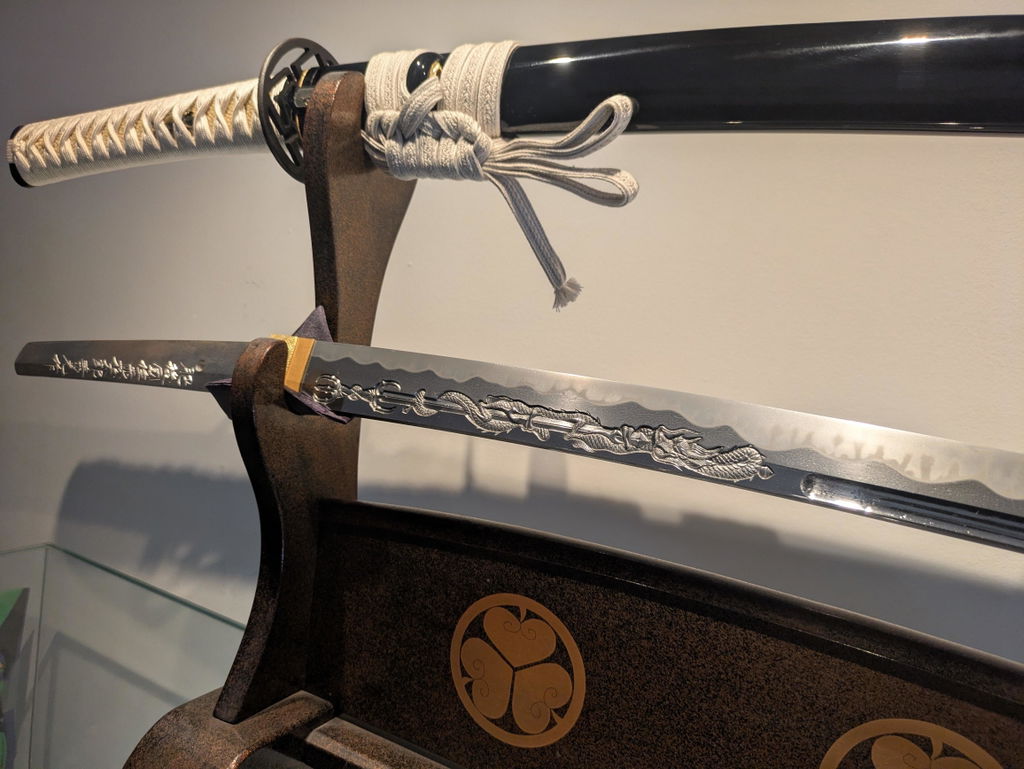
The boundary between these two structures — between the hard martensitic edge and the softer pearlitic spine — is the hamon. The hamon is not painted on, not etched, not decorative. It is the physical boundary between two different crystal structures within the same piece of steel, made visible by the polishing process. The shape of that boundary is determined entirely by where the clay coating ended and the bare steel began — which is why the smith's clay application is the primary creative act of hamon design.
Here is the physics of the sori. When steel transforms from austenite (the hot phase) to martensite (the quenched hard phase), it expands very slightly — the distorted crystal structure takes up slightly more volume than the organised structure of the hot steel. When steel transforms to pearlite (slow cooling), it contracts.
At the moment of quenching, the edge and the spine undergo these transformations at very different times. The edge — uncoated, in direct contact with the water — transforms to martensite almost instantly, expanding. The spine — insulated by clay — cools slowly, eventually contracting as it transforms to pearlite. The spine contracts after the edge has already hardened into its expanded martensite state.
The result: the spine pulls toward the back of the blade as it contracts, while the edge resists because it has already hardened. The blade curves — edge outward, spine inward — producing exactly the characteristic arc of a Japanese sword. The longer the spine is kept hot relative to the edge (by thicker clay or different clay composition), the more pronounced this differential becomes.
This is why a straight blade enters the water and a curved blade emerges. The curvature is a physical record of the differential transformation rates between edge and spine — caused by the smith's clay application and the specific thermal properties of the tamahagane steel.
A skilled smith does not simply watch the curvature emerge passively. Before quenching, the smith may deliberately introduce a slight pre-curvature in the opposite direction (uchizori) — a blade that appears slightly back-curved before entering the water. This counteracts the curvature that will emerge during quenching, allowing the final curve to land closer to the intended shape.
After quenching, if the resulting sori differs from the intended shape, careful adjustment work can correct it — though this requires great skill and carries the risk of cracking the just-hardened blade. The master smith does not fight the physics — they anticipate it, prepare for it, and work with it to produce the intended result. A blade whose curvature is exactly right is the product not of lucky physics but of decades of experience reading how a specific steel will move through the water.
The nihonto's composite hardness — hard enough at the edge to rival glass, tough enough at the spine to absorb impact without shattering — is the result of the differential hardening process. No modern stainless steel or tool steel matches this combination in the same way.
The sori is the physical record of the physics of transformation."
The Three Types of Sori — Reading the Curve
The position of the deepest point of the curvature along the blade's length is not arbitrary — it reflects the period and school of the sword, and experienced appraisers read it as one of the primary diagnostic features of a blade's origin.
Deepest curvature near the base of the blade. Associated with Heian and Kamakura period tachi — the oldest and most prestigious form. The low curve was functional for the mounted warrior's downward strike.
Deepest curvature at the centre of the blade — the most common form, named after the graceful arc of a Shinto torii gate. Associated with Nanbokuchō and early Muromachi period swords. The standard reference point for curve comparison.
Deepest curvature toward the tip of the blade. Associated with late Muromachi and Edo period swords — particularly the katana form developed for infantry combat and quick-draw (iaijutsu) technique. The forward curve helps in the draw-cut stroke.
Sori Through the Ages — Period Characteristics
| Period | Typical sori type | Curvature character | Functional reason |
|---|---|---|---|
|
Heian–Kamakura c.900–1333 |
Koshi-zori | Deep, pronounced — often 30+ mm; sometimes called fumbari (base-heavy) | Designed for mounted cavalry — the low curve maximised cutting power in a downward sword stroke from horseback |
|
Nanbokuchō 1336–1392 |
Torii-zori / shallow | Very shallow or nearly straight — the so-called nanbokuchō style is often striking for its near-straightness | Political turmoil and changing warfare produced experimental blade forms; longer and wider blades with reduced curvature |
|
Muromachi 1392–1573 |
Torii-zori | Moderate, even curve; shorter and more practical than Kamakura period | Shift from cavalry to infantry combat; shorter, faster blades with even curvature suited close-quarters fighting |
|
Edo period 1603–1868 |
Saki-zori | Moderate — forward-weighted curve; elegant proportions | Peace period made swords symbols of status as much as weapons; curvature optimised for the quick-draw (iaijutsu) technique |
|
Shinsakutō (modern) post-1948 |
Variable by tradition | Smiths choose curvature appropriate to the school and period they are working in | Modern licensed smiths may reproduce classical period styles or develop their own — the choice of curvature is a deliberate artistic statement |
What the Sori Tells the Collector — Reading a Blade
For collectors, understanding the physics of sori transforms the act of looking at a blade from aesthetic appreciation to analytical reading. The curvature carries information that an appraiser uses before looking at the hamon, the steel grain, or the signature. Here is what to look for:
- The position of the maximum curvature narrows the period and category immediately. A deep koshi-zori with a long, elegant profile suggests Kamakura or early Nanbokuchō period tachi. A moderate torii-zori on a shorter blade suggests Muromachi or Edo katana. A forward saki-zori on a slender form suggests Edo period.
- The degree of curvature relative to blade length is measured in Japanese appraisal as the sori dimension in sun — recorded on the NBTHK certificate alongside blade length. This ratio is a key diagnostic. A very shallow curvature on a long blade is characteristic of the Nanbokuchō period. Deep curvature on a shorter blade may suggest restoration or alteration.
- Artificial curvature is detectable. A blade that was bent after quenching — either by the smith to correct an unexpected result, or by later alteration — shows different stress marks in the steel and a different character in the hamon near the curve's deepest point. An authentic sori that emerged naturally from yaki-ire shows a consistent relationship between the hamon activity and the curvature position that cannot be easily faked.
- The relationship between sori and hamon is one of the subtlest and most revealing things an appraiser reads. Because both emerge from the same quenching process, they should be physically consistent with each other — the hamon's activity and the curvature's character should tell the same story about how the blade was heated and quenched. Inconsistency between the two is a signal worth investigating.
- Modern reproduction blades have acid-etched fake hamon and no natural sori. A mass-produced blade with an etched pattern has no differential hardening — it is uniformly hardened throughout, and any apparent curvature was shaped mechanically before hardening. The absence of a genuine physical relationship between hamon and sori is one of the clearest ways to distinguish authentic nihonto from sophisticated fakes.
Why Tamahagane Responds Differently
One final element is worth understanding: the physics described above works best with tamahagane — the traditional Japanese steel produced from iron sand in the tatara furnace. Modern steels, including high-quality tool steels and stainless steels used in less expensive sword productions, do not respond to differential clay hardening in the same way.
Tamahagane's unique properties emerge from its specific composition: varying carbon content across the bloom, the presence of trace elements from the iron sand and charcoal, and a crystalline microstructure that develops over three to four days of smelting. Tamahagane responds to yaki-ire in ways that modern steels do not replicate — producing the deep, three-dimensional nie and nioi activity within the hamon that makes authentic nihonto visually unique. Modern licensed smiths using authentic tamahagane from the Shimane Prefecture tatara produce blades that respond to quenching in ways that no modern steel can match. The physics is the same; the material is not.
a record of the physics that made it
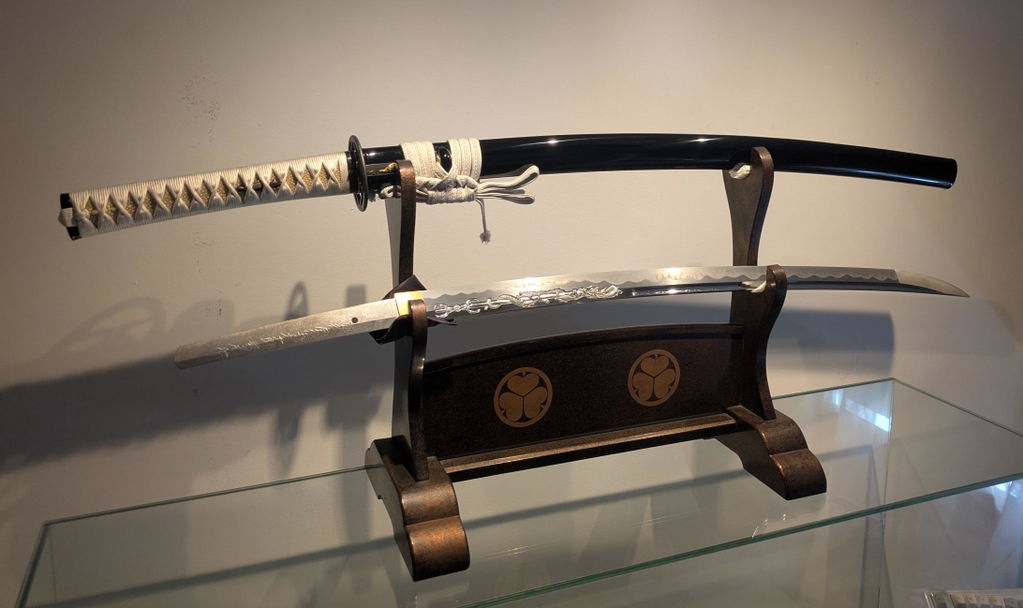
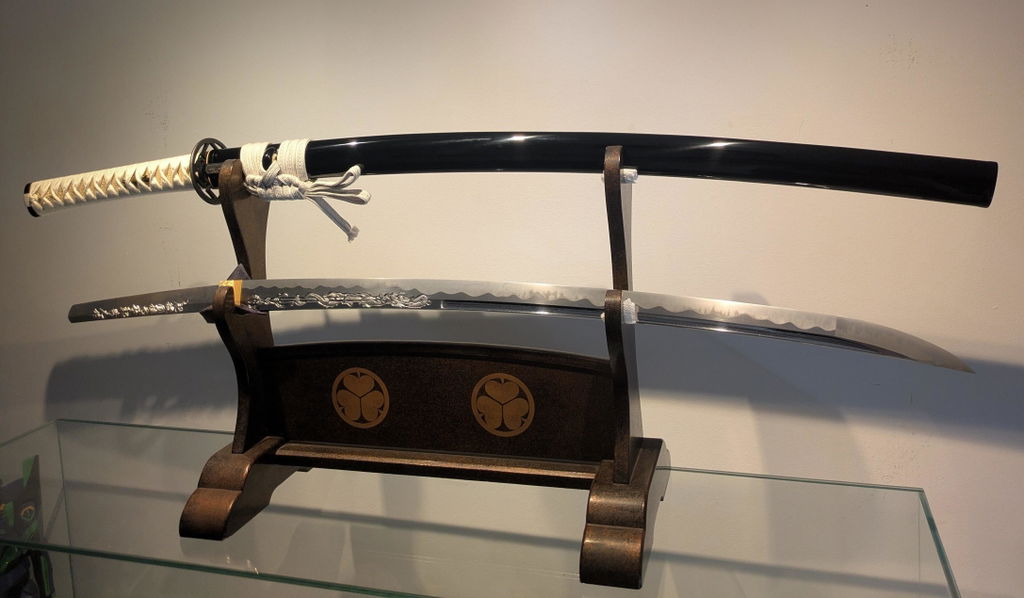
Every sword in the Tozando collection was forged using traditional tamahagane steel and authentic differential clay hardening — the same process that has produced the sori, the hamon, and the unique visual character of Japanese swords for over a thousand years. NBTHK certified, shipped from Kyoto.
In Closing — Beauty Born from Physics
The sori of a Japanese sword is one of the most beautiful lines in the world of crafted objects. It is also, as we have seen, one of the most physically meaningful. The curve is the record of a transformation: of steel changing its crystal structure at different rates across the width of the blade, of the spine contracting as the edge hardens, of the smith's clay application guiding a natural physical process toward an intended aesthetic and functional outcome.
Every time you look at the curve of a Japanese blade, you are looking at physics made visible — at the record of 1,200°C meeting cold water, of martensite forming at the edge while pearlite grows at the spine, of a craft tradition that learned to work with the nature of steel rather than against it. The smith did not invent the curve. They learned to anticipate, guide, and perfect a phenomenon that the steel itself wanted to produce.
That is what it means to work with a living material — and it is why, a thousand years later, the curve of a Japanese sword still looks like nothing else in the world.
Sources: TrueKatana — "Why Are Katanas Curved?" (2026); Tokyo Nihonto — "Hamon Nihonto: How to Read the Temper Line"; RomanceOfMen — "Katana Hamon"; Wikipedia — "Hamon (swordsmithing)"; sword-buyers-guide.com — "Sori"; Quora — "Did the curves in Japanese tachi and katana swords come completely from heat treatment..."; Tozando Katana Shop — "Why Are Japanese Swords Said to Be the Best in the World at Cutting?"; NCBIlibraries — "Energy-resolved neutron imaging study of a Japanese sword signed by Bishu Osafune Norimitsu" (PMC).
Note: The metallurgical descriptions in this article are simplified for a general audience. Actual steel microstructure involves multiple phases and transition states; the description of martensite vs. pearlite represents the key distinctions relevant to understanding the hamon and sori formation. Rockwell hardness figures are approximate and vary by steel composition and specific quenching conditions.

Leave a comment: