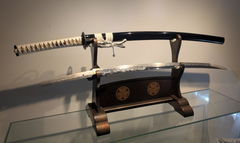
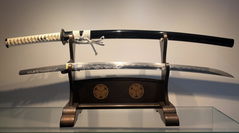
Antique Japanese Tantō Sword - Mumei, Shinshinto Era (22.4 cm)
¥400,000 ¥430,000

We are pleased to present a katana certified as Hozon Tōken by the NBTHK (Nihon Bijutsu Tōken Hozon Kyōkai), the work of Kanetoshi (包俊), a master smith of the Tegai school, one of the great schools of Yamato Province (present-day Nara Prefecture), active from the end of the Kamakura period through the Nanboku-chō period. Its 2 shaku 3 sun form, drawing an elegant koshi-zori (curvature centered near the hilt), carries a superb jigane of venerable antiquity, in which a dark, tightly forged, flowing itame-hada is strongly mixed with masame-hada (straight grain), the very essence of Yamato blades. The ko-nie-deki suguha (straight temper line of small nie), with hotsure and kinsuji emerging from its stillness, radiates a sacred dignity forged under the authority of Tōdai-ji. Accompanied by a superb shirasaya bearing a prestigious sayagaki (scabbard inscription) of observations written boldly in rich black ink, and a kinpaku-oshi hitoe habaki (single-layer, gold-foil-covered blade collar), this is a supreme blade worthy of being cherished as the very essence of Yamato kotō (old swords).
The jigane is an itame-hada that flows throughout with a standing grain (hadadachi), strongly mixed with masame-hada, the greatest characteristic of Yamato blades. Thick ji-nie adhere to it and fine chikei (dark lines within the steel) appear, showing the dark, tight, moist texture and tenacious iron character (tetsumi) unique to kotō. The hamon is based on a ko-nie-deki suguha, gently mixed here and there with hotsure (frayed lines), uchinoke (crescent-shaped nie), and ko-midare (small irregularities). The temper edge is bright and clear, and within the hamon, ashi and fine kinsuji and sunagashi run through, presenting the quiet, deep activity unique to Yamato blades. Freshly polished and free of mi-kobore (chips) or major flaws, it splendidly combines the ancient beauty of the Kamakura to Nanboku-chō periods with a sound blade condition.
This blade boasts an imposing length of 2 shaku 3 sun (approx. 69.7 cm), with a marked taper between motohaba and sakihaba (width at base and tip) and an elegant koshi-zori, presenting the typical sword form of the Kamakura to Nanboku-chō periods. Together with its tight, sharply pointed kissaki (point), it conveys the dignified bearing of a Yamato warrior. The nakago (tang) is ōsuriage mumei (greatly shortened, unsigned), with two open mekugi-ana (peg holes). It is covered with a deep, chestnut-colored old patina (ko-sabi) matured over long ages, silently telling of the weight of history of a Yamato kotō blade.
Yamato blades (Nara) are broadly divided into the "Yamato Goha" (Five Yamato Schools: Senjuin, Tegai, Ichimonji, Shikkake, and Hōshō), which developed as practical fighting swords for the warrior monks under the authority of great temples such as Tōdai-ji and Kōfuku-ji.
Among them, the Tegai school, which set up its workshops before the Tengai-mon gate of Tōdai-ji, was founded by Kanenaga (包永) and fused practicality and beauty at a very high level, becoming the most powerful of the five Yamato schools.
Kanetoshi (包俊) is a master smith of this Tegai school, active from the end of the Kamakura period to the Nanboku-chō period. His works fully display the orderly masame-hada and clear suguha techniques characteristic of the Tegai school.
The blade is accompanied by a luxurious kinpaku-oshi hitoe habaki (single-layer, gold-foil-covered blade collar), which further highlights the dignity of this old sword. In addition, it comes with a shirasaya (plain wood resting scabbard) bearing a sayagaki on which observations are written boldly in rich black ink, quietly telling of the history of its careful inheritance and the high distinction of this blade.
Bearing an attribution to "Kanetoshi," a rare master smith of the Tegai school, the sayagaki-inscribed shirasaya, carefully passed down together with its Hozon Tōken certificate, speaks to its unshakable historical value. Pursuing an essential beauty free of ornament, this work is a historical heritage worthy of being passed down for generations as a true sword for appreciation and a family treasure. Please savor the supreme beauty of the Yamato smiths, handed down across countless ages.
¥400,000 ¥430,000

¥270,000 ¥290,000

¥300,000 ¥330,000


Every blade reflects generations of knowledge, discipline, and precision passed down through traditional Japanese swordmaking. From the forging of steel to the final finishing touches, each piece is shaped with patience, mastery, and deep respect for heritage.

From carefully selected materials to the refined finishing of every surface, each sword is crafted and presented with uncompromising attention to detail. Our commitment to authenticity ensures every piece reflects true tradition, lasting quality, and enduring cultural value.

Designed with balance, simplicity, and purpose, our blades embody the harmony between refined form and skilled craftsmanship. Each sword represents a thoughtful union of strength, elegance, and the timeless discipline of Japanese artisans.