Antique Japanese Tantō Sword - Mumei, Shinshinto Era (22.4 cm)
¥400,000 ¥430,000

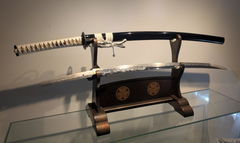
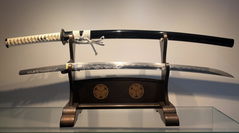
A masterpiece conveying the profound aesthetics of Yamato kotō (old swords) and the tradition of the Shikkake school, whose de facto founder was Norinaga (則長). This is a wakizashi certified as Hozon Tōken by the NBTHK (Nihon Bijutsu Tōken Hozon Kyōkai), strongly preserving the tradition of the Shikkake school, renowned as a distinguished house of Yamato Province (present-day Nara Prefecture). While carrying on the tradition of the Yamato Goha (Five Yamato Schools), it displays a "richly expressive jigane mixed with mokume" quite distinct from uniform masame, a gently flowing "notare hamon," and an archaic "yakizume bōshi" that runs cleanly out to the tip — the deep flavor and the very essence of practical beauty characteristic of the Shikkake school are displayed unsparingly. Furthermore, the mounting is complete with a beautifully polished-out black-lacquered same-zaya (ray-skin scabbard), a sō-zame-maki tsuka (hilt fully wrapped in ray skin), an iron sukashi tsuba, and finely worked fittings and a kozuka carrying the prayers of the samurai house — carp, Ise-ebi (spiny lobster), and shishi (lion) — and the blade is also accompanied by a shirasaya bearing a sayagaki, allowing you to enjoy to your heart's content the classical elegance of the blade together with a mounting of the highest artistic order.
The jigane is an itame-hada that flows throughout with a standing grain (hadadachi), gently mixed with fine mokume (burl-grain). Fine ji-nie adhere thickly to it and fine chikei (dark lines within the steel) intertwine, showing the dark, tight, moist texture unique to kotō and the tenacious iron character (tetsumi) characteristic of the Yamato smiths.
The hamon is based on ko-nie-deki (small nie), a gently undulating "notare" mixed with ko-midare (small irregularities), and the temper edge is bright and clear. Within the hamon, ashi, fine kinsuji, and sunagashi run through, showing rich movement following the undulations of the notare.
The bōshi (tip temper) shows no kaeri (turn-back), running cleanly out to the tip in the notare manner of the hamon — a classical yakizume. This yakizume bōshi is a traditional feature often seen in the ascetic (shugen) smiths of Ko-Yamato (such as the Senjuin school and the early Shikkake school) and in the older styles of the Yamato Goha. It embodies consideration for polish-wear in actual combat and an unornamented practical beauty, and is a major point of appreciation conveying the archaic form and sacred dignity of the Yamato tradition to the present day. Freshly polished, it maintains a very sound condition free of mi-kobore (chips) or fatal defects.
This blade boasts a generous length of slightly under 1 shaku 5 sun 1 bu (approx. 45.7 cm), with a moderate taper between motohaba and sakihaba (width at base and tip) and an elegant koshi-zori (curvature centered near the hilt), presenting the typical wakizashi form of the Kamakura to Nanboku-chō periods. Together with its tight, sharply pointed kissaki (point), it shows a bearing in which the battle-readiness of the samurai and a refined aesthetic sense are in harmony. The nakago (tang) is ōsuriage mumei (greatly shortened, unsigned), with one open mekugi-ana (peg hole). It is covered with a deep, chestnut-colored old patina (ko-sabi) matured over long ages, bearing an overwhelming antiquity that silently tells of its long history.
Among the Yamato Goha (Senjuin, Tegai, Ichimonji, Shikkake, and Hōshō) that developed in Yamato Province (present-day Nara Prefecture), the Shikkake school is the school that set up its workshops in the area called "Shikkake," behind Tōdai-ji, and established its own distinctive style. Its de facto founder and the great master who represents the school is "Norinaga" (則長), a smith of the late Kamakura period.
While the Yamato tradition is generally associated with the "strong masame-hada" symbolized by the Hōshō school, the greatest distinguishing feature of the Shikkake school is said to be that, while based on itame, "mokume-hada" and ō-itame are gently mixed in, for example toward the shinogi. Rather than remaining purely masame, mokume reminiscent of the growth rings of wood emerges within the forging, producing a jigane with a particularly moist luster and depth even among Yamato kotō. In the hamon as well, not only suguha-chō but also gentle notare and ko-gunome are mixed in, presenting highlights rich in feeling such as hotsure and uchinoke along the temper edge, and the classical "yakizume bōshi" that runs cleanly out to the tip.
Granted an attribution to the "Shikkake school" (den Shikkake) in its NBTHK appraisal, this blade, combining a "supreme jigane mixed with mokume" quite distinct from uniform masame with a classical undulating hamon, is an extremely valuable masterpiece that fully tells of the lineage and traditional techniques of the Shikkake school.
The saya (scabbard) is a "togidashi-same-zaya" (polished-out ray-skin scabbard), luxuriously covered entirely in natural ray skin, coated with layers of black lacquer, and then carefully polished out on the surface. The superb mottled pattern woven by the deep luster of the lacquer and the white nodules of the polished-out ray skin is truly a crystallization of natural beauty and craftsmanship, and it is a top-grade specification also excellent in water resistance and durability. The tsuka (hilt) underlay employs "sō-zame-maki," fully wrapped in superb ray skin with uniformly large nodules. Owing to its excellent toughness, ray skin was of course practical as a non-slip grip, and its countless large nodules (oya-tsubu) were also prized by samurai as auspicious symbols of the prosperity of descendants and the warding off of evil. The fittings, too, are crafted with the deep prayers and designs of the samurai house. The fuchi-kashira are finely carved with a "carp," which relates to the Chinese legend of the "Dragon Gate" (tōryūmon) and symbolizes advancement in life, fortune in contests, and the strong will to overcome rough waves; an "Ise-ebi" (spiny lobster), praying for longevity and health; and "fish," signifying the prosperity of the family — embodying the samurai house's wishes for prosperity.
Furthermore, the menuki (hilt ornaments) and the accompanying kozuka (utility knife) are powerfully carved in relief with the "shishi" (lion), king of beasts and the mightiest guardian deity that repels evil. The fine gold work of the shishi rising from the gold-colored nanako (fish-roe-textured) ground of the kozuka brings protection against evil and an overwhelming dignity to its owner, adding a distinction that makes this blade the finest of protective swords (mamori-gatana).
The koshirae is fitted with a round iron sukashi tsuba (openwork hand guard), and the blade with a gold-colored habaki (blade collar). In addition, the blade is accompanied by a shirasaya (plain wood resting scabbard) bearing a sayagaki (scabbard inscription), allowing it to be stored and preserved in its finest condition.
A supreme treasure to cherish, in which the profound beauty of a Yamato kotō blade and the beauty of a koshirae imbued with the wishes of the samurai house are fused. The skill of the Shikkake school, whose de facto founder was Norinaga, and its "den Shikkake" attribution attest to its historical value, and the yakizume bōshi conveying the sacred dignity of Ko-Yamato further heightens the true pleasure of appreciation. The togidashi-same-zaya and the artistic koshirae with its auspicious designs that accompany it are truly the finest mounting, in which the pride and prayers of the samurai house have come to fruition. The overwhelming romance and bearing hidden in its graceful form of slightly under 1 shaku 5 sun 1 bu will deeply satisfy the expectations of enthusiasts, both as a sword for appreciation and in the joy of ownership. We invite you to enjoy to your heart's content, in your own hands, this masterpiece handed down across countless ages to the present day.
¥400,000 ¥430,000

¥270,000 ¥290,000

¥300,000 ¥330,000


Every blade reflects generations of knowledge, discipline, and precision passed down through traditional Japanese swordmaking. From the forging of steel to the final finishing touches, each piece is shaped with patience, mastery, and deep respect for heritage.

From carefully selected materials to the refined finishing of every surface, each sword is crafted and presented with uncompromising attention to detail. Our commitment to authenticity ensures every piece reflects true tradition, lasting quality, and enduring cultural value.

Designed with balance, simplicity, and purpose, our blades embody the harmony between refined form and skilled craftsmanship. Each sword represents a thoughtful union of strength, elegance, and the timeless discipline of Japanese artisans.