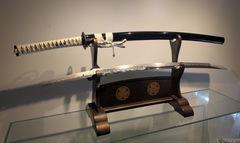
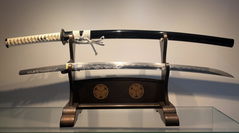
Antique Japanese Wakizashi Sword - Mumei, Shinto Era (36.6 cm)
¥200,000 ¥240,000

We are pleased to present an extraordinary Bakumatsu-period tantō in exceptional condition, crafted during the turbulent final years of the Edo period (February 1867 / Keiō 3) by the celebrated Inshu domain swordsmith Heki Fujiwara Kanetsugu (日置藤原兼次). The blade is accompanied by a prestigious Tokubetsu Kichō Tōken certificate from the NBTHK.
A distinguished disciple of Yokoyama Sukekane, Kanetsugu served as an official domain swordsmith for the Ikeda family of Inshu (Tottori) starting in 1862 (Bunkyū 2). Following the Meiji Restoration, he relocated to Tokyo, where his master craftsmanship earned him monumental commissions: forging the ceremonial sword for the Ise Grand Shrine's Shikinen Sengū in 1886, and reproducing imperial treasures from the Shōsōin in 1887. In May 1907, he had the rare honor of forging a sword in the presence of the Crown Prince at Tottori Castle.
The nakago (tang) is ubu (original) with a single mekugi-ana and clear, bold inscriptions. The omote (front) reads "Heki Fujiwara Kanetsugu saku" (日置藤原兼次作), while the ura (back) reads "Keiō san-nen nigatsu jōjun" (慶応三年二月上旬 / early February 1867).
Forged in February 1867, this blade was created at the height of the political upheaval leading directly to the Taisei Hōkan (Restoration of Imperial Rule) by Tokugawa Yoshinobu later that same year.
The blade has been fully polished and is in pristine, flawless condition. Presenting a classic hira-zukuri form with a robust thickness and impressive weight, it exudes a commanding presence. The jigane features a well-kneaded itame-hada (wood-grain pattern) with distinct forging layers and visible yubashiri (spilling nie), complemented by clear ji-nie. The hamon is a refined ko-gunome filled with a rich nioiguchi, flowing into a midare-komi bōshi that turns back into ō-maru.
This hira-zukuri, iori-mune blade carries a nagasa (edge length) of 28.4 cm and a slight sori (curve) of 0.1 cm, with a substantial motohaba of 28.9 mm and motokasane of 7.3 mm — a sturdy, well-proportioned form.
This complete package features dual high-quality mountings. The aikuchi koshirae is beautifully crafted with a rattan-wrapped tsuka (hilt) and sō-zame (full ray skin) saya, featuring an original kozuka (utility knife) and an unusual Western-style custom kurikata (cord-fastening fitting). The shirasaya is constructed with premium buffalo-horn accents.
A masterfully preserved Bakumatsu tantō with historical significance, dual mountings in superb condition, and provenance from an elite domain smith. A magnificent set to elevate any world-class collection.
¥200,000 ¥240,000

¥400,000 ¥430,000

¥390,000 ¥410,000

¥270,000 ¥290,000

¥300,000 ¥330,000


Every blade reflects generations of knowledge, discipline, and precision passed down through traditional Japanese swordmaking. From the forging of steel to the final finishing touches, each piece is shaped with patience, mastery, and deep respect for heritage.

From carefully selected materials to the refined finishing of every surface, each sword is crafted and presented with uncompromising attention to detail. Our commitment to authenticity ensures every piece reflects true tradition, lasting quality, and enduring cultural value.

Designed with balance, simplicity, and purpose, our blades embody the harmony between refined form and skilled craftsmanship. Each sword represents a thoughtful union of strength, elegance, and the timeless discipline of Japanese artisans.