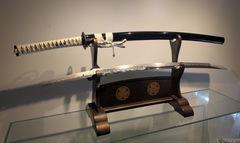
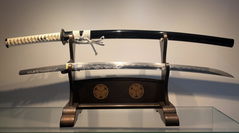
Antique Japanese Wakizashi Sword - Mumei, Shinto Era (36.6 cm)
¥200,000 ¥240,000

This is more than a maintenance mat. It is a tribute to the swordsmith Miyairi Kozaemon Yukihira (宮入小左衛門行平), printed with Honō ni Inoru (炎に祈る) — a motto the smith brushed in his own hand. At 195 cm (approx. 76.8 in) long, it lays out a complete katana during care, giving your iaitō (practice sword), shinken (live blade), or shinai a resting place on a surface that honors the tradition it serves.
Honō ni Inoru may be read as “a prayer within the flame” — the reverence a smith brings to the forge fire from which a blade is born. It is not a stock slogan but the smith’s own words, in the smith’s own hand.
Miyairi Kozaemon Yukihira (real name Miyairi Kei) is a leading contemporary swordsmith and the current chairman of the All Japan Swordsmiths Association. Born in Nagano in 1957, he is the second son of Miyairi Akihira (宮入行平), a Living National Treasure and founder of the Miyairi school, under whom he began training in 1977; after his father’s death he continued under Fujiyasu Masahira, a senior disciple. Certified by Japan’s Agency for Cultural Affairs in 1982, he took the inherited name Kozaemon Yukihira in 1996 and was recognized as mukansa (無鑑査, “exempt from examination” — the highest standing a living smith can hold) in 2000. Working in the Sōshū tradition after the Nanbokuchō master Shizu Kaneuji, his blades are admired for their graceful form, clear jigane (surface steel), and soft hamon (temper line).
Measuring 195 × 25 cm (approx. 76.8 × 9.8 in), the mat comfortably holds a full katana: a blade of up to about 2.45 shaku (approx. 74 cm / 29.2 in) sits perfectly within it, while a 2.5-shaku blade (approx. 75.8 cm) rests with the handle just past the end. The soft microfiber surface gives the saya (scabbard) and the steel a clean place to rest and will not scratch them while you oil and wipe. At roughly 1 mm thick and only 82 g (approx. 2.9 oz), it folds flat and travels easily to the dōjō, an exhibition, or a fellow collector’s. It has no non-slip backing, so use it on a flat, stable surface.
Wash with a mild, neutral detergent (or a microfiber-specific one). Avoid fabric softener, which clogs the fibers and lowers absorbency, and avoid bleach and optical brighteners, which damage them. Hand washing is gentlest: use lukewarm water (about 30–40 °C / 86–104 °F), press or knead gently, then rinse thoroughly. If machine washing, place the mat in a laundry net and wash it on its own — or on a gentle/hand-wash cycle — to keep lint from cotton items off the print. Being a polyester/nylon microfiber, it is sensitive to heat: do not tumble-dry, iron, or sterilize it in boiling water. Hang it to dry in a well-ventilated, shaded spot, away from direct sunlight, which can stiffen the fibers over time.
Miyairi Kozaemon Yukihira forges today and accepts commissions for newly made swords. If this mat has drawn you to his work, you can begin a blade of your own — a katana shaped entirely by his hand. Commission a newly forged katana by Miyairi Kozaemon Yukihira →
One of a four-smith tribute series, each mat dedicated to a master swordsmith and carrying his own brushed motto. Choose the smith whose work speaks to you — or collect the series.
¥200,000 ¥240,000

¥400,000 ¥430,000

¥390,000 ¥410,000

¥270,000 ¥290,000

¥300,000 ¥330,000


Every blade reflects generations of knowledge, discipline, and precision passed down through traditional Japanese swordmaking. From the forging of steel to the final finishing touches, each piece is shaped with patience, mastery, and deep respect for heritage.

From carefully selected materials to the refined finishing of every surface, each sword is crafted and presented with uncompromising attention to detail. Our commitment to authenticity ensures every piece reflects true tradition, lasting quality, and enduring cultural value.

Designed with balance, simplicity, and purpose, our blades embody the harmony between refined form and skilled craftsmanship. Each sword represents a thoughtful union of strength, elegance, and the timeless discipline of Japanese artisans.