

Every blade in Tozando's collection has a title that follows a specific structure — and a description that uses a specific vocabulary. To a new collector, these titles can seem like compressed codes: "Katana — Sadanobu — AJSA Certificate — Shirasaya Koshirae — Ubu Nakago — Gendai Era." To an experienced collector, each element communicates essential information about the blade before the description is even read. This article decodes that structure — explaining what every element of a Tozando title and description means, what to look for, and how to use our listings to make an informed decision.
Part One — Anatomy of a Tozando Title
Every Tozando product title follows the same structure. Here are two real examples from our current collection, broken into their components:
The title leads with the period and blade type — which narrows the blade's character immediately — followed by the smith or attribution, and then certification where applicable. Together these elements give an experienced collector a nearly complete picture before the full description is read. We will now decode each element in detail.
Element 1 — Blade Type
The katana is the standard Japanese sword — worn edge-upward through the belt (obi) from the Muromachi period onward. A blade length over 2 shaku (60.6cm) is the legal definition. Most katana in Tozando's collection range from 65cm to 75cm blade length. The katana replaced the tachi (worn edge-downward, suspended from the belt) as the dominant sword form from around the 15th century.
The wakizashi was the shorter companion sword worn alongside the katana — together forming the daisho, the paired swords that were the mark of samurai status. Blade length between 1 shaku (30.3cm) and 2 shaku (60.6cm). Wakizashi are often more accessible at entry-level price points than equivalent-quality katana, making them an excellent starting point for a serious collection.
A blade under 1 shaku (30.3cm). Tanto are among the most collectable of all nihonto formats — their shorter canvas concentrates the smith's technical mastery into a smaller space, and some of the most extraordinary jihada and hamon in the tradition appear on tanto. They are also among the most practical for display in limited spaces.
Element 2 — Smith Name or Attribution
The second element of the title is the smith's name or school attribution. This is one of the most information-dense elements in the listing — it communicates period, school, region, and quality simultaneously to anyone familiar with the major smiths and schools.
For mumei (unsigned) blades, the title will show the school rather than the smith: "Bizen Osafune School," "Yamashiro-den," or similar. This is not a lesser category — many of the tradition's greatest blades are unsigned, and the attribution to a specific school by NBTHK appraisers carries genuine authority. See our article on mumei swords and why they are among the most valuable for the full context.
Element 3 — Certification
Where present, the certification level appears in the title. This is one of the first things experienced collectors look for.
| Title term | Full name | What it means | Value implication |
|---|---|---|---|
| Hozon | NBTHK Hozon Token (保存刀剣) | Confirmed genuine nihonto of genuine merit by NBTHK panel examination | Entry-level certification — authentic and documented |
| Tokubetsu Hozon | NBTHK Tokubetsu Hozon Token (特別保存刀剣) | Above-average quality confirmed by more exacting NBTHK examination | Mid-range — where serious collecting begins |
| Juyo | NBTHK Juyo Token (重要刀剣) | Exceptional historical and artistic significance — fewer than 10,000 blades designated | Significant — institutional-level collecting |
| AJSA Certificate | All Japan Swordsmanship Association | Alternative authentication body — valid for certain categories of blade | Confirms authenticity; different from NBTHK hierarchy |
| (no certification noted) | Uncertified genuine nihonto | Japanese government registered but not submitted to NBTHK — still genuine | Often represents significant value — see our article on uncertified blades |
Element 4 — Mounting Type
An unlacquered honoki (magnolia) wood scabbard and handle — no tsuba, no fittings, no lacquer. This is the correct long-term storage mounting for a Japanese sword. When a blade is listed in shirasaya, it typically means the blade is being sold without decorative koshirae — either because the koshirae was lost, or because the blade was stored in shirasaya for preservation. Shirasaya is not an incomplete koshirae — it is a different object, designed for preservation rather than display.
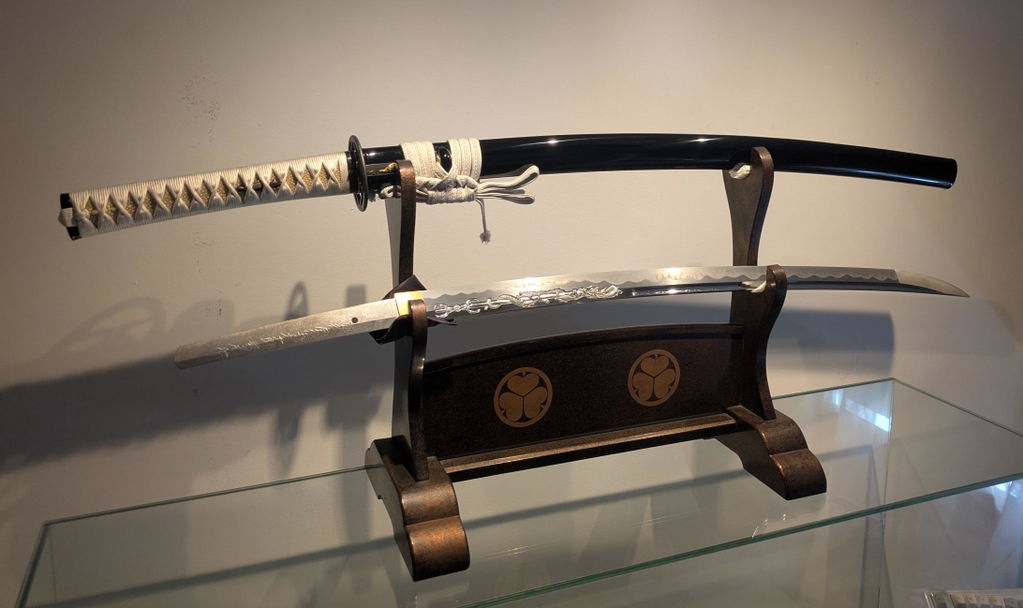
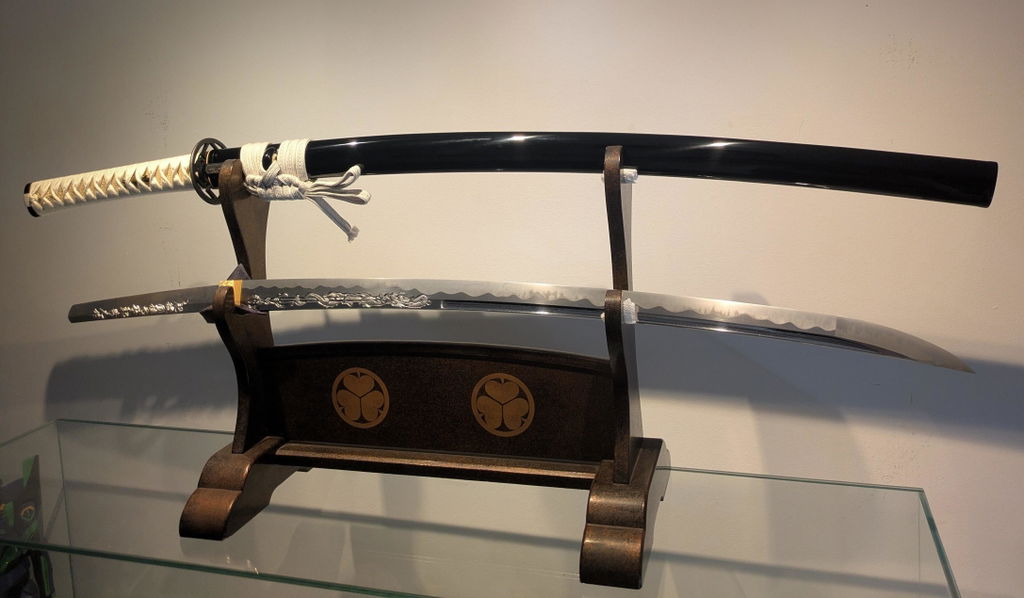
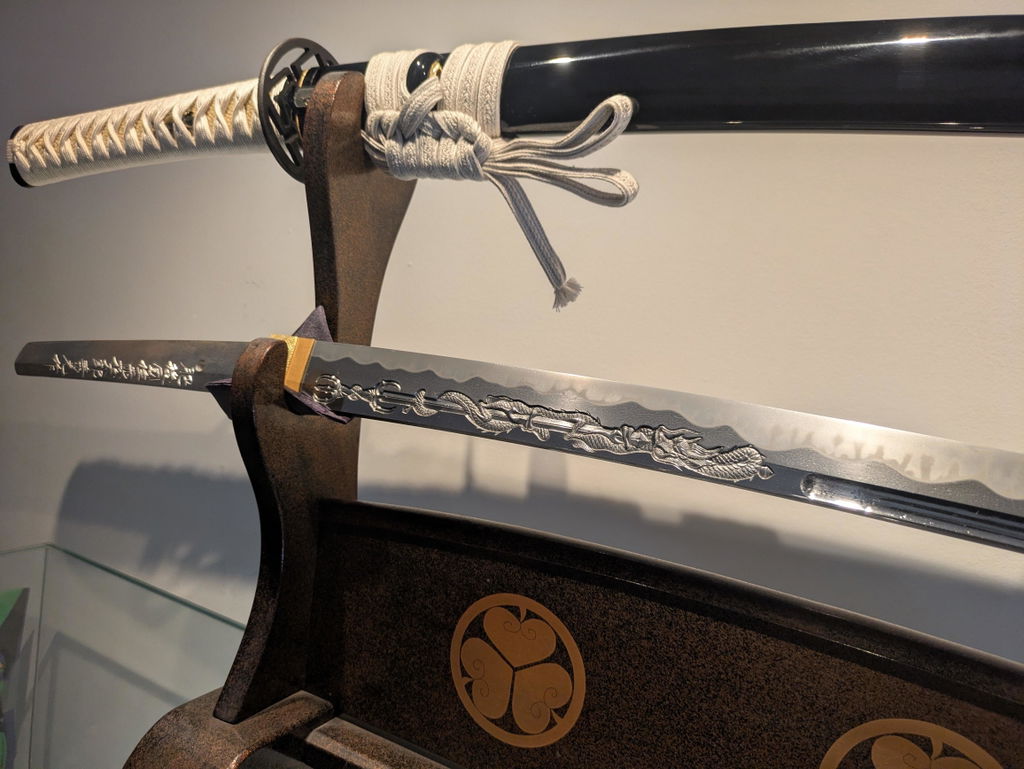
The complete decorative mounting — lacquered scabbard (saya), wrapped handle (tsuka), guard (tsuba), and all associated metal fittings (fuchi-kashira, menuki, kojiri). When a listing shows koshirae, the description will specify whether the koshirae is period-appropriate to the blade or later, whether the fittings carry NBTHK certification, and the overall condition of the mounting. Period koshirae with certified fittings can add significantly to a blade's total value — sometimes approaching or exceeding the blade's own value.
Specific koshirae types named in titles include: Aikuchi (no tsuba — typical for tanto), Handachi (a hybrid style blending tachi and katana mounting conventions), and others.
Element 5 — Nakago (Tang) Condition
The nakago is in its original condition as left by the swordsmith — unshortened, with the original file marks (yasurime), the original tip shape (nakago-jiri), and — where signed — the smith's original inscription. Ubu nakago is the most desirable condition for a collector: the blade retains all of its original physical evidence intact. An ubu nakago on an antique blade means the complete physical record of the smith's work is present and readable.
The nakago has been shortened — typically because the blade was remounted from a longer tachi style to a shorter katana style at some point in its history. Suriage is extremely common in antique blades of the Kamakura and Muromachi periods, and does not diminish a blade's quality or authenticity. It does, however, mean that the original tip shape and some of the original file marks have been altered, and — most significantly — that any signature in the shortened portion is lost. Ōsuriage indicates extensive shortening, with most of the original nakago removed.
Element 6 — Period
| Title term | Japanese | Approximate dates | Character |
|---|---|---|---|
| Koto Era | 古刀 (ことう) | Before 1596 | "Old sword" — spans Heian through Momoyama. The tradition's classical period. |
| Kamakura Era | 鎌倉時代 | 1185–1333 | The golden age of sword-making. Bizen, Yamashiro, Yamato, Soshu at their historical peaks. |
| Muromachi Era | 室町時代 | 1336–1573 | Mass production era — quality varies widely. Finest pieces remain exceptional. |
| Shinto Era | 新刀 (しんとう) | 1596–1780 | "New sword" — Edo period. Different steel character; some extremely fine work. |
| Shinshinto Era | 新々刀 (しんしんとう) | 1781–1876 | "New new sword" — late Edo revival of classical styles. Often excellent quality. |
| Gendai Era | 現代刀 (げんだいとう) | 1876–present | "Modern sword" — post-Meiji. Includes work by the finest living and recently deceased smiths. |
Part Two — Reading the Description
The title gives you the framework. The description fills it in with the physical evidence that determines whether this specific blade is right for you. Here are the terms that appear most frequently in Tozando's descriptions and what each one means.
The jihada is the grain pattern visible in the blade's steel — the result of the folding process and the specific iron-sand and smelting methods of the school. Common types: itame (wood-grain, the most common), mokume (burl wood — rounder, more three-dimensional), masame (straight grain — characteristic of Yamato-den), ayasugi (cedar grain — characteristic of certain schools). The quality of the jihada — its fineness, evenness, and the hataraki (activities) within it — is one of the most important quality indicators in a blade.
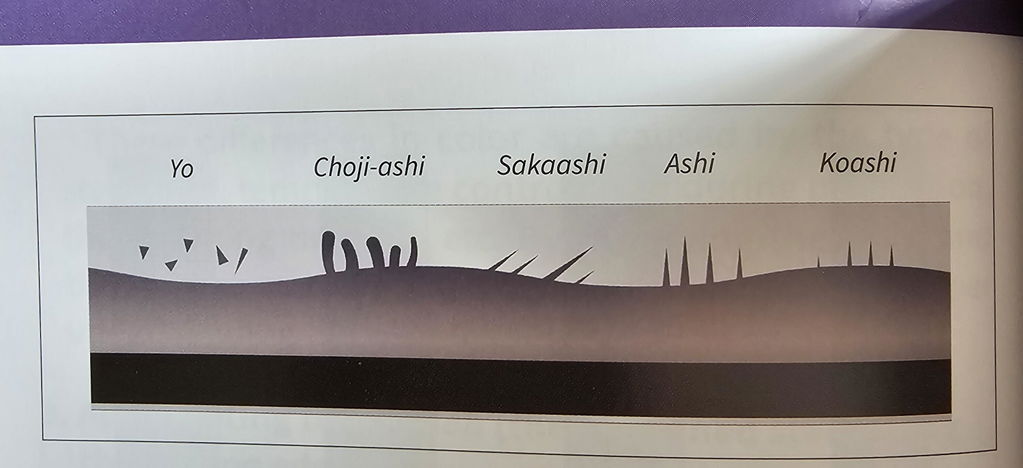
The hamon is the boundary pattern between the hardened edge and the softer spine — created by the differential clay coating and water quenching process. Common types in Tozando descriptions: suguha (straight — elegant, refined, characteristic of Yamashiro-den and high-quality Shinto work), gunome (regular semicircular waves), choji (clove-blossom — the classic Bizen pattern), notare (gentle undulating wave). The description of the hamon's nioiguchi (the boundary line itself — ideally "tight" and well-defined) is particularly important.
"Zero flaws such as flaws, rust, or chips" — Tozando's strongest condition statement. The blade is in exceptional preservation with no detectable surface defects. "Kizu" (傷) refers to a flaw in the steel — any kizu present will always be disclosed and its location described. "Polish thinning" indicates the blade has been polished multiple times and the steel is becoming thinner — relevant to future polish potential. Tozando always discloses condition issues; we do not describe a blade's condition more favourably than the evidence supports.
written for a collector — not marketing copy
written to make a sale. The difference matters."
with the vocabulary to understand what you are seeing
Every blade in Tozando's collection is described using the terms explained in this article. Browse the collection with this guide open, or contact our specialists to walk through any specific listing with you — explaining what each element means for that particular piece.
In Closing — The Listing Is the Assessment
A Tozando listing is not a catalogue entry written to sell a blade. It is a specialist's assessment — written to give a collector everything they need to make an informed decision about whether a specific blade is right for them. The title encodes the essential facts. The description fills in the physical evidence. The certification confirms the independent authentication.
Reading that assessment correctly is a skill that develops with experience. This article has given you the vocabulary. The collection gives you the practice. And our specialists are available to bridge the gap — explaining what any element of any listing means for any blade you are considering, at any stage of your collecting life.
The best purchase you will make from Tozando is the one where you understood exactly what you were buying before you bought it. That is what our listings are designed to make possible.

Leave a comment: