

Tozando has been selling authentic Japanese swords to collectors worldwide since 1989. Over those nearly four decades, we have watched a parallel market grow — a global industry producing objects that look like Japanese swords, carry Japanese-sounding names, and are sold at prices that seem almost reasonable for what they appear to be. We visited one of the factories that produces these objects. What we saw there is something every person who has ever typed "buy katana" into a search engine should read before they spend a single dollar.
First — What a Genuine Japanese Sword Actually Is
Before describing what we saw in the factory, it is worth establishing precisely what a genuine Japanese sword is — because the gap between the definition and what is sold online is the entire subject of this article.
A genuine nihonto (日本刀) is a blade forged in Japan by a licensed swordsmith using tamahagane — steel smelted from Japanese iron sand in a traditional tatara furnace by the NBTHK, produced only three or four times a year in limited quantities. The smith folds, works, and shapes this steel by hand over days of concentrated labour. The blade is coated in clay before quenching — the process that produces the characteristic hamon temper line. After forging, it passes through a certified tōgishi (polisher) whose work alone may take weeks. The finished blade is registered with Japan's prefectural Board of Education and carries a government Token Toroku-sho registration certificate. If it meets the NBTHK's standards, it may carry an authentication certificate from Japan's foremost sword appraisal body.
Every element of this process — the licensed smith, the tamahagane steel, the government registration, the NBTHK certification — is specific to Japan. It cannot be replicated overseas. There is no such thing as a genuine nihonto made outside Japan. What exists outside Japan are objects that resemble nihonto in shape. They are not the same thing.
What We Saw — A First-Hand Account of the Factory
Japan's Firearms and Swords Control Law restricts the importation of sword-shaped objects into Japan, which meant that for many years, the overseas "katana" manufacturing industry was largely invisible to those of us working in Japan's sword world. On a trip abroad, we were given access to one such facility. The following is a direct account of what we observed.
Our initial impression was the factory's size. The image that came to mind was not a craft workshop — it was a major electronics or automobile manufacturer. Industrial-scale equipment occupied vast floor space. The machinery used to produce sword blades was operating continuously, turning out blade-shaped objects one after another from what appeared to be standard industrial steel stock.
Before forging, long thin plates of steel were stacked in piles — the raw material for hundreds or thousands of blades. There was no prayer before the work, no individual attention to each piece of metal, no selection of material for its specific properties. The process was the same as making any other metal component: feed material in, run the machine, collect the output.
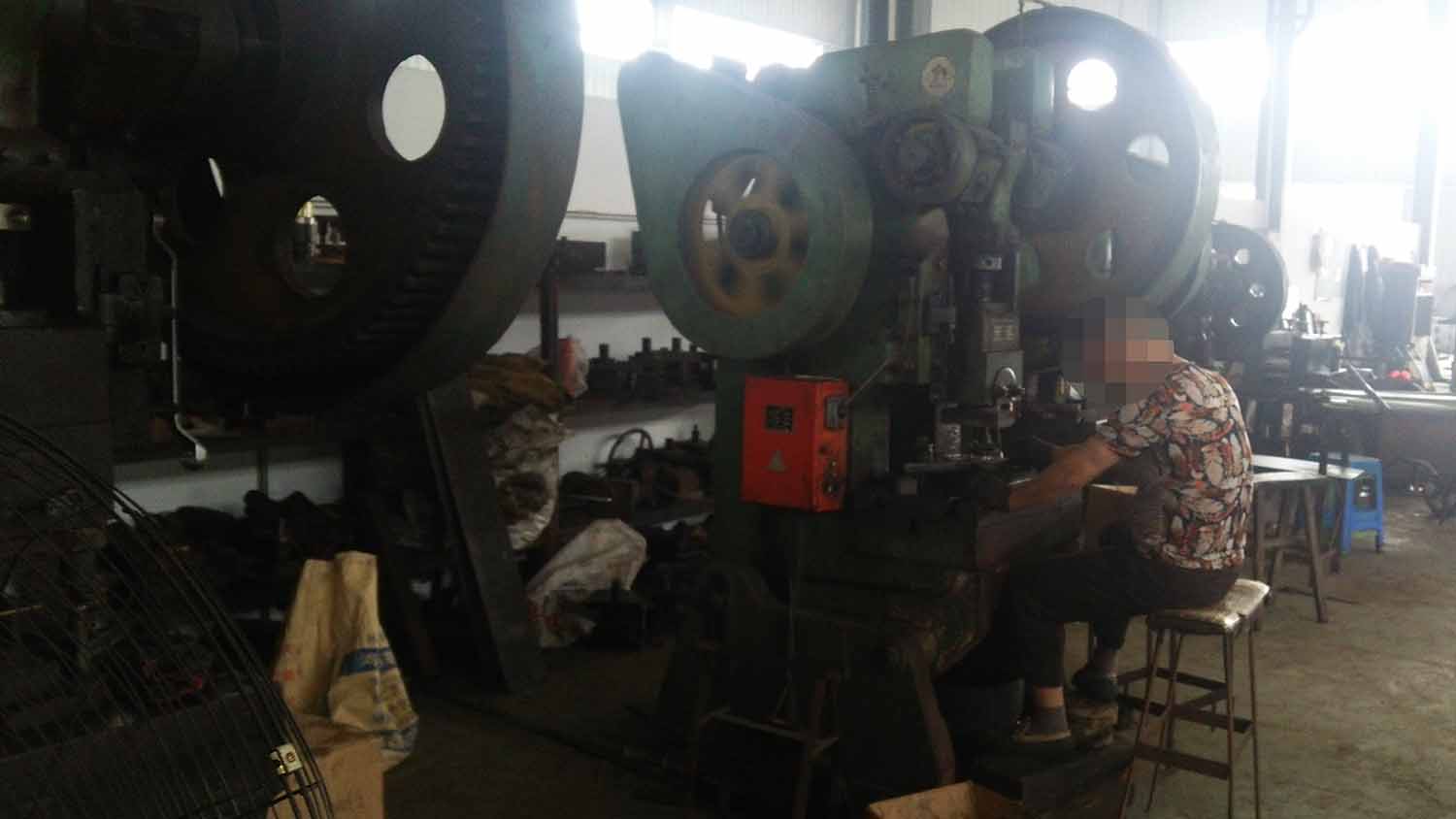
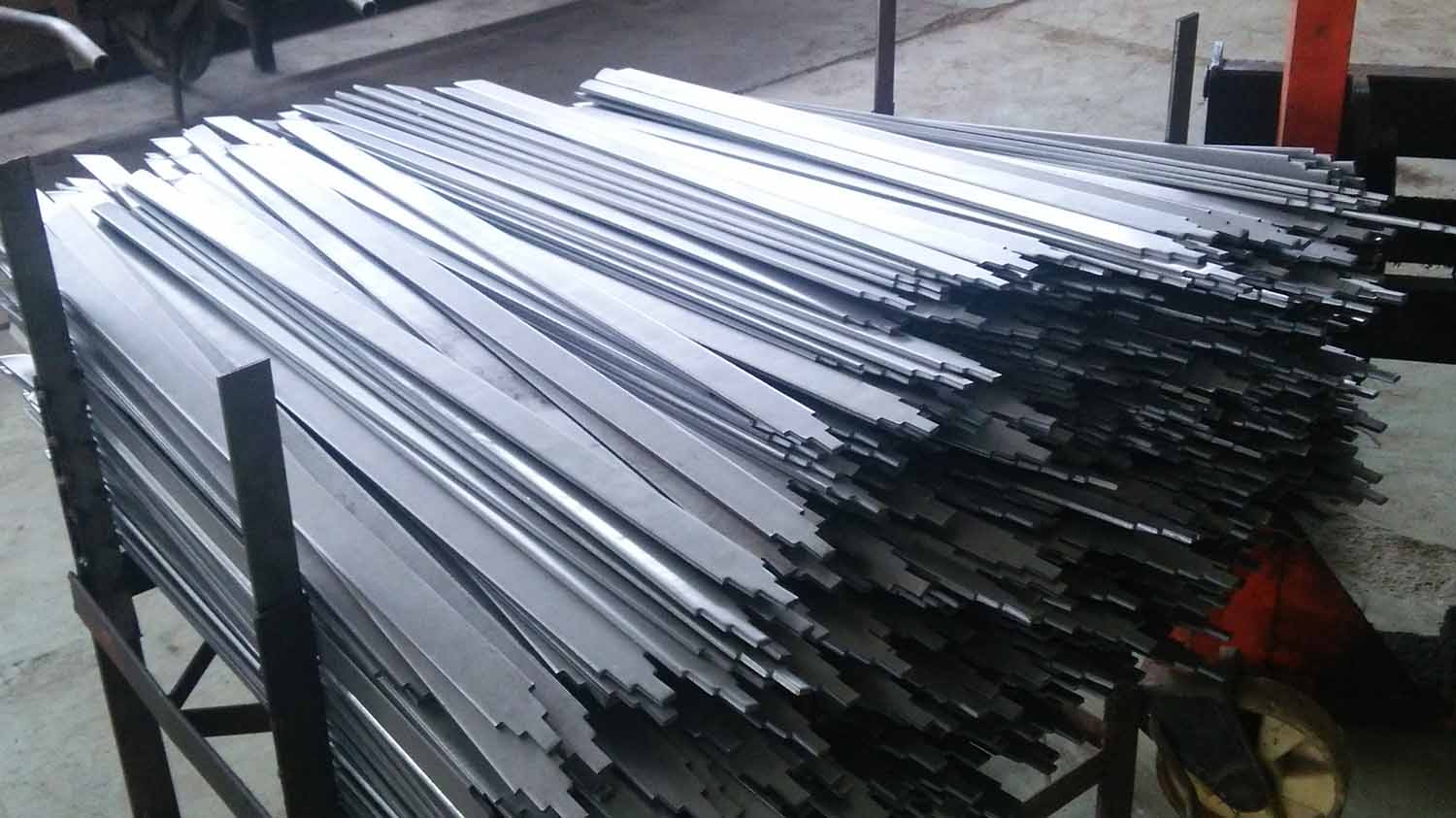
Inside the factory — industrial-scale production bears no resemblance to a licensed Japanese smith's workshop
After the blades emerged from the machines, workers with grinders shaped them into the katana silhouette. The final "polish" was applied by hand using a towel, a whetstone, and sandpaper. The completed blades were then stacked with the cutting edge facing down — piled like lumber, with no individual handling or protection.
In a Japanese swordsmith's workshop, polishing a single blade is a separate specialist's work — a certified tōgishi who may spend two to four weeks on a single piece, working through a sequence of progressively finer stones to reveal the steel's grain pattern and the hamon's full character. The polish is not merely aesthetic. It is the process that makes the blade's quality readable.

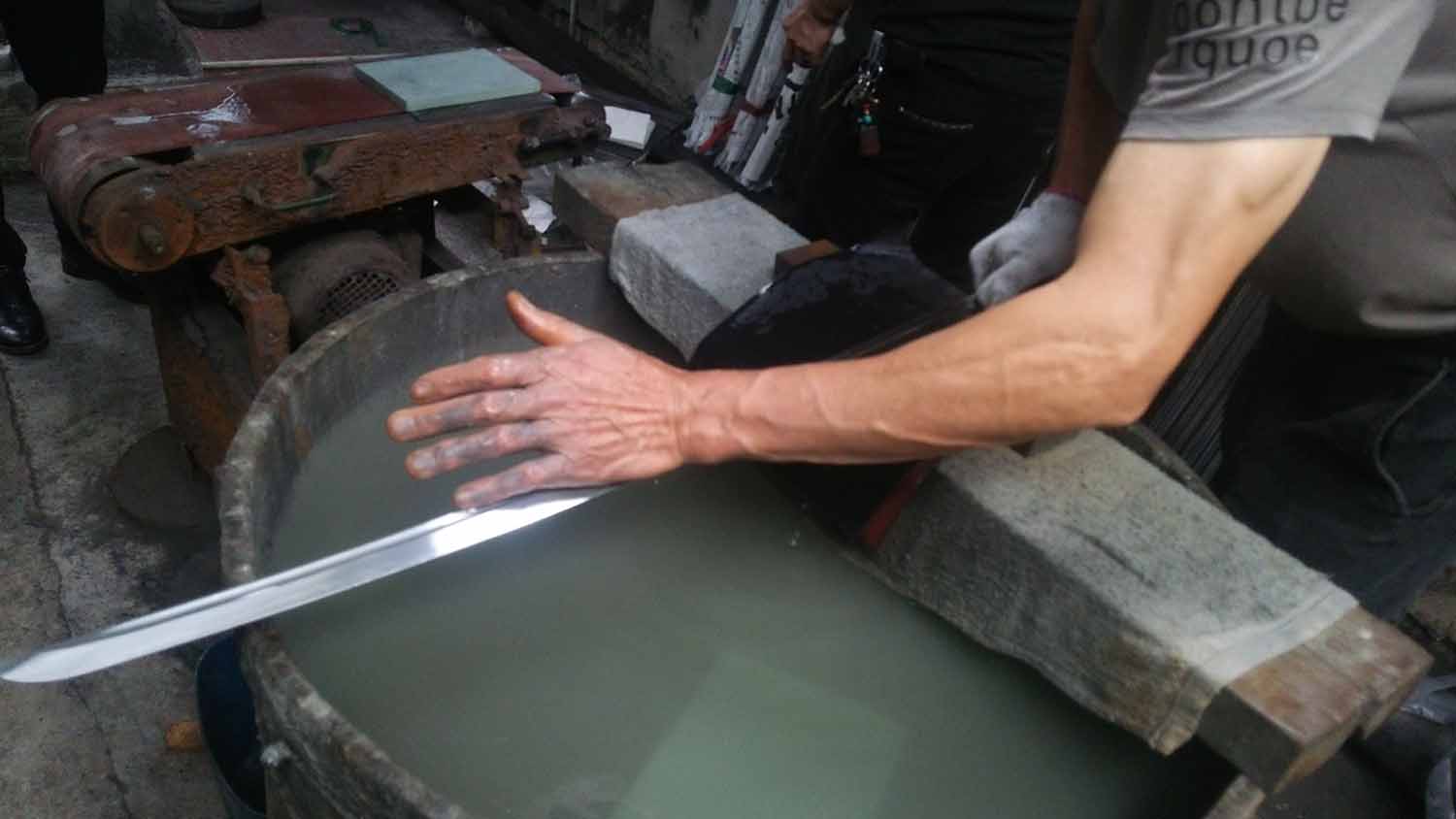
Completed blades stacked cutting-edge down — the handling alone signals the difference in how these objects are valued
In a separate area of the factory, metal fittings — tsuba, fuchi-kashira, menuki — were being pressed from dies. The same factory was also producing model guns using the same equipment and the same process. The precision was not high. The fittings and the gun parts came from the same production line, distinguished only by the shape of the die.
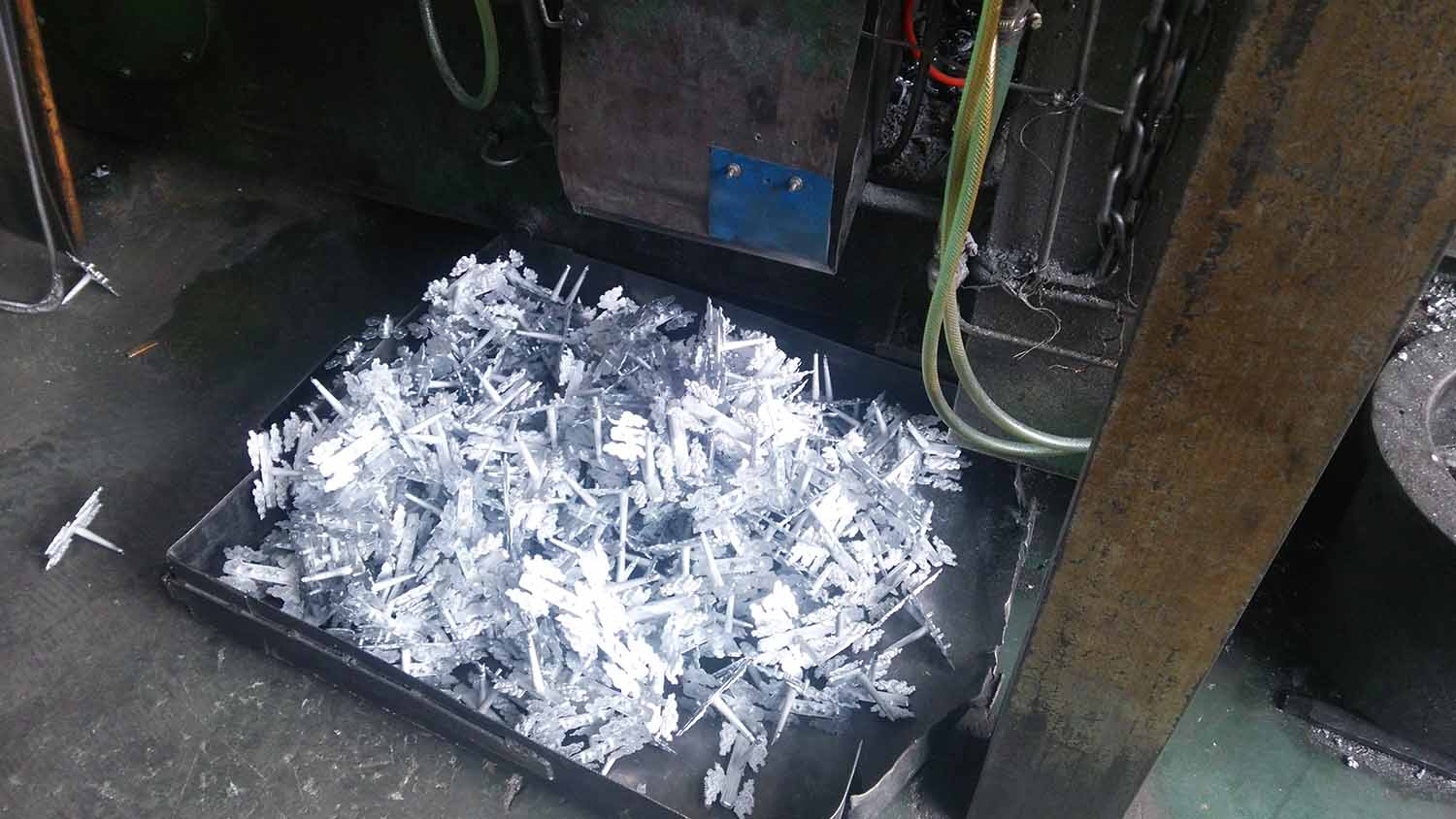
Metal fittings pressed from dies — the same equipment also produced model gun components
Adjacent to the blade factory was a scabbard production facility. At first glance, the sheer number of wooden scabbards hanging from strings looked like stacked firewood. We asked one of the workers what wood the scabbards were made from. His answer: "I don't know. It doesn't matter what kind of wood it is."
The surface of the exposed wood was still damp. This is significant: wood used for sword scabbards must be thoroughly dried before use, or it will warp, split, and — critically — trap moisture against the blade, accelerating corrosion. The production was entirely mechanised, with no hand finishing.
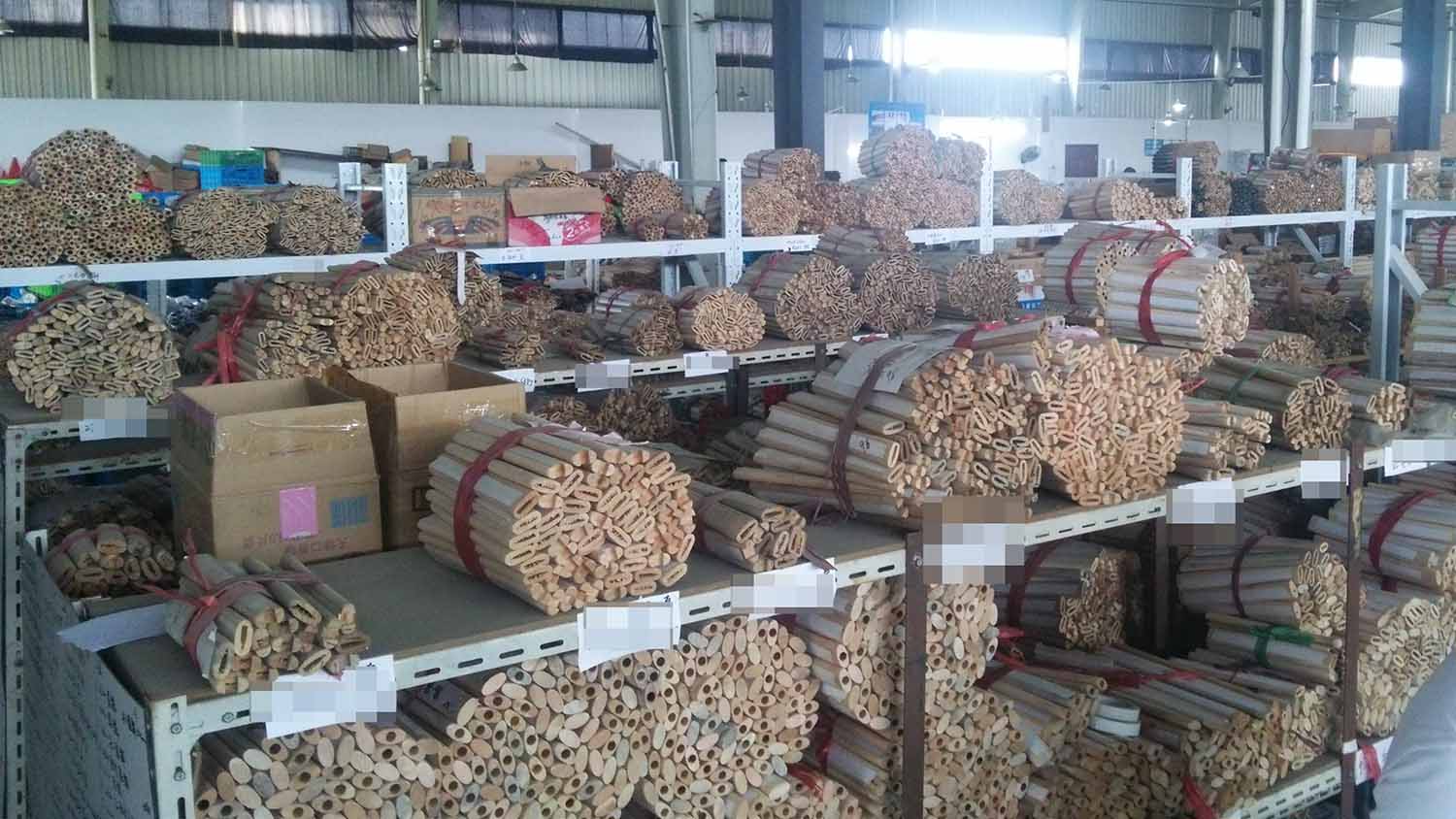
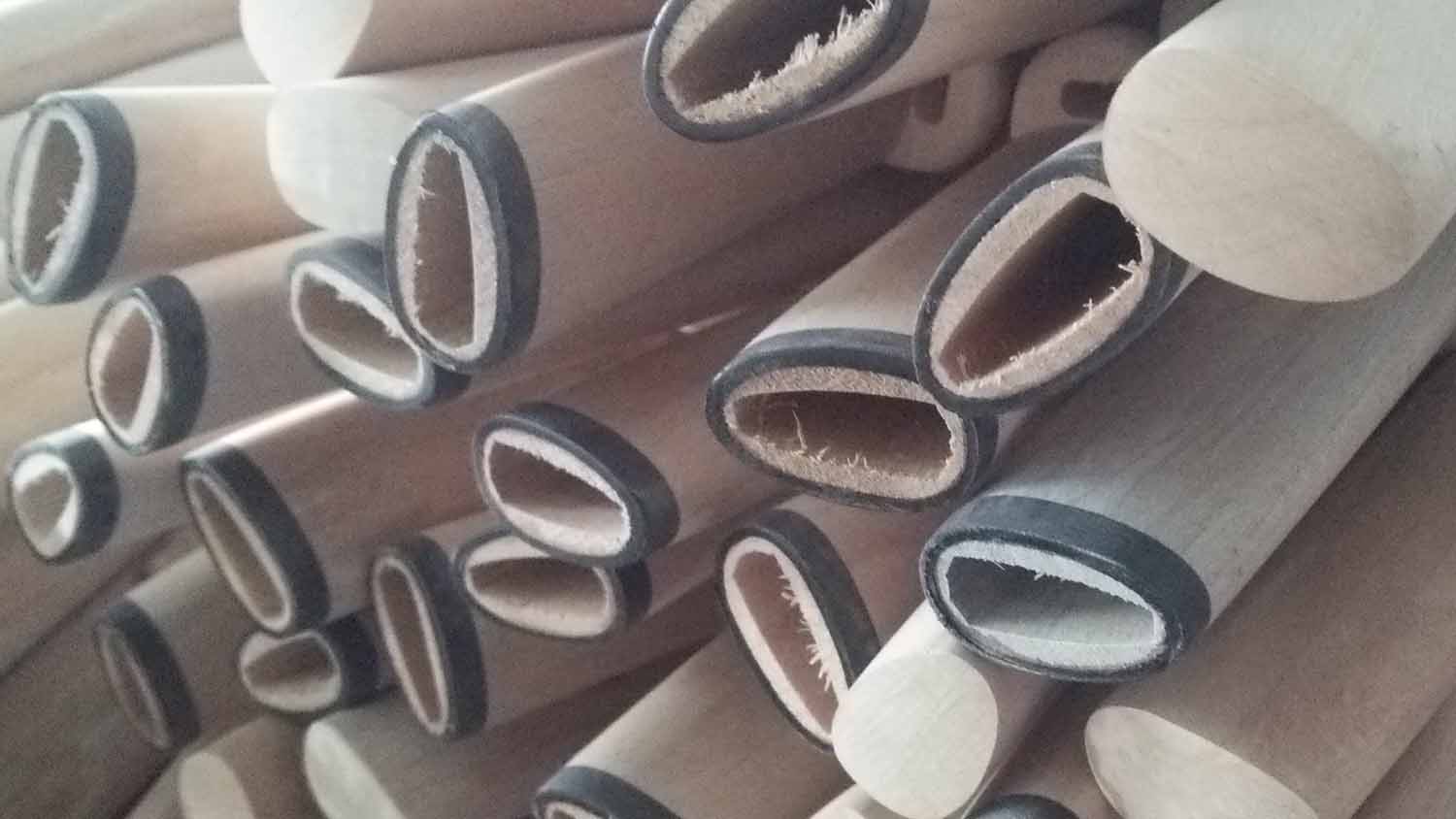
Scabbards at the factory — the worker's answer when asked what wood was used: "It doesn't matter"
The tsukamaki (handle wrapping) was being carried out by part-time workers with the blade already attached to the handle — the opposite of how the process is done on a genuine nihonto, where the handle alone is placed on a special stand for precise, controlled wrapping.
More significantly: the wrapping was being done without the alternating twists known as sashiomote — the technique that locks each section of the wrap against unwinding if the cord is damaged. Instead, each twist was placed on the same side, facing the same direction. The result looks like correct tsukamaki from a distance. It is structurally incorrect and will unravel differently from genuine work under the stress of use.
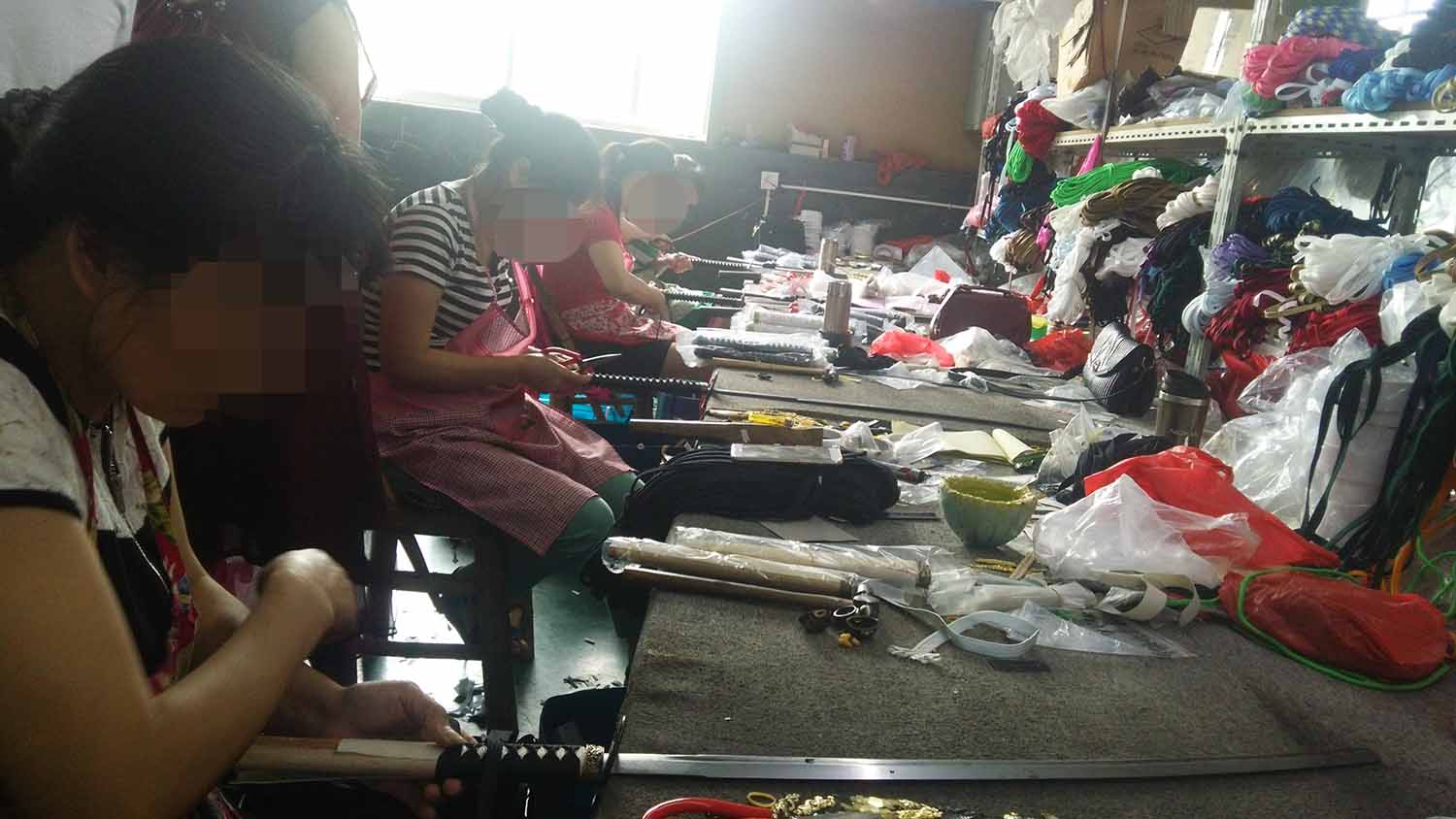
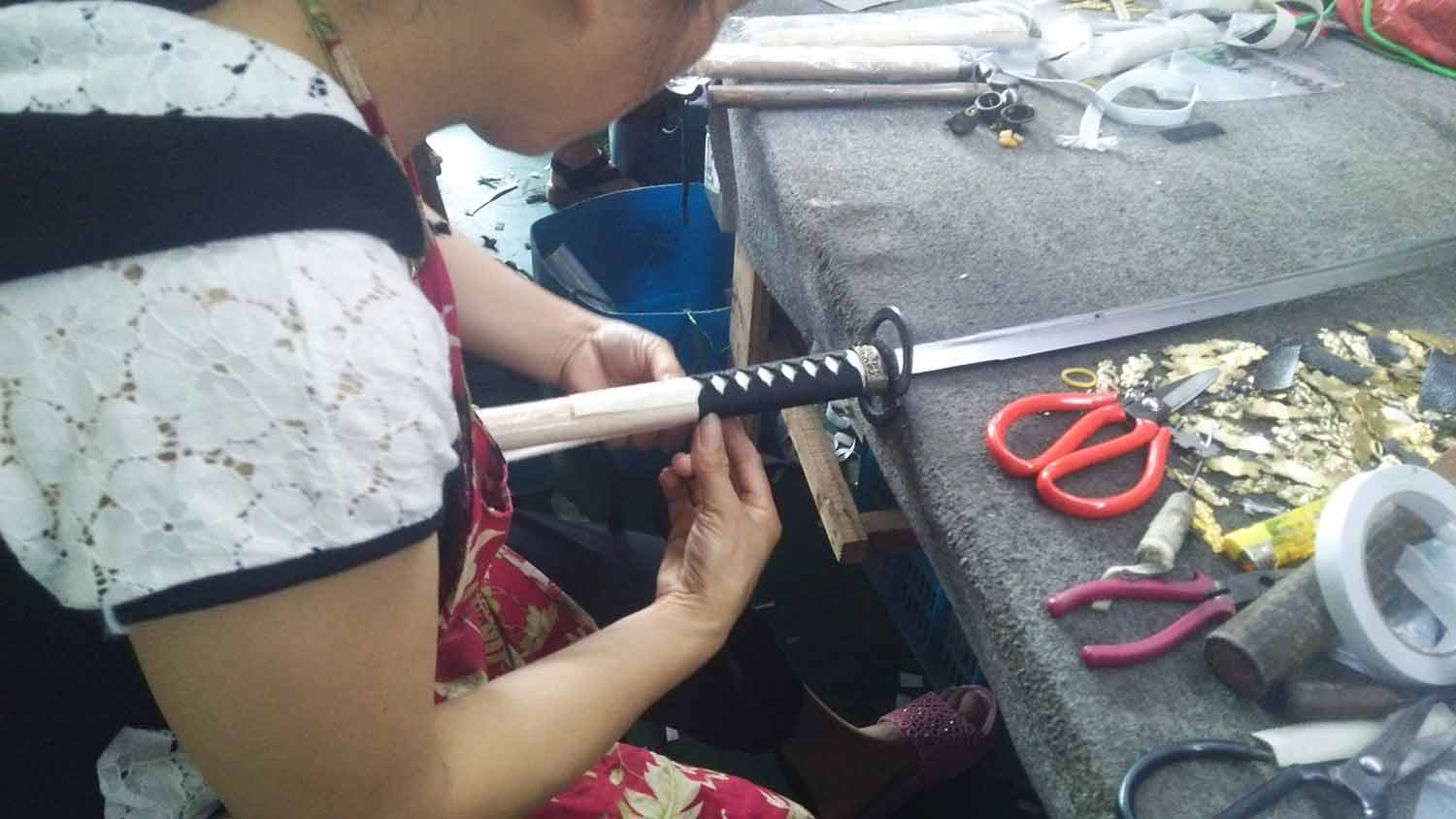
Tsukamaki with the blade attached — the opposite of correct practice, and a detail invisible unless you know what to look for
'It doesn't matter what kind of wood it is.'
For a genuine Japanese sword, it matters enormously."
The Difference — What You Are Actually Buying
- Forged from tamahagane — steel smelted from Japanese iron sand in a traditional tatara furnace
- Made by a government-licensed swordsmith producing at most 24 blades per year
- Each blade individually forged by hand over multiple days
- Differential clay hardening produces a genuine hamon with characteristic school and period features
- Polished by a certified tōgishi over 2–4 weeks to reveal jihada and hamon
- Registered with Japan's prefectural Board of Education — legally traceable
- NBTHK certification available — authenticated by Japan's foremost appraisal body
- Fittings by specialist craftspeople — tsuba, habaki, handle by separate experts
- Shirasaya in magnolia wood fitted precisely to the individual blade
- Made from industrial steel stock — no tamahagane, no tatara, no traditional smelting
- No licensing requirement — unlimited production with no regulatory oversight
- Machine-produced blade shapes, not individually forged
- Acid-etched or machine-ground surface line mimics hamon appearance — no actual differential hardening of the type that defines nihonto
- Finished with grinders, sandpaper, and towel — no tōgishi, no jihada readable
- No government registration — no legal identity in Japan, no export documentation as nihonto
- No NBTHK certification possible — not nihonto under any definition
- Pressed die fittings — same production line as model guns
- Unknown wood, still damp — "it doesn't matter what kind of wood it is"
Why This Matters Beyond the Money
The financial dimension is straightforward: a buyer who pays $500 for an object they believe is a $5,000 Japanese sword has been defrauded of the difference in value. But the damage extends beyond any individual transaction.
Japan's licensed swordsmiths number approximately 300 people. Each has spent a decade or more in apprenticeship before being permitted to forge a single blade for sale. They work within a regulatory framework designed to preserve a thousand-year tradition as a living art form, not merely as a historical artifact. Their output — at most 24 blades per year per smith — sustains the tradition and the knowledge that underlies it.
Every buyer who purchases a Chinese-manufactured "katana" believing it to be an authentic Japanese sword is not merely losing money. They are removing demand from the system that keeps the genuine tradition alive. The licensed smith whose work commands $8,000 for a Hozon-certified blade is competing, in the perception of an uninformed buyer, against a machine-made object selling for $300. That competition is not fair, not accurate, and not in the interest of anyone who cares about the tradition these objects purport to represent.
registered, certified, and fully documented
Every sword in Tozando's collection carries its original Japanese government registration certificate and, where applicable, NBTHK authentication papers. We have been shipping genuine nihonto to collectors in over 30 countries since 1989 — not objects that look like Japanese swords, but Japanese swords. The difference is everything this article describes.
In Closing — The Factory Visit We Are Glad We Made
We visited the factory because we wanted to understand, first-hand, what the global "katana" market actually produces. What we found was not surprising in its existence — we knew these factories existed — but clarifying in its specifics. The worker who told us the scabbard wood "doesn't matter" was not being dishonest. He was describing, with complete accuracy, the relationship between his factory's products and the tradition they imitate.
The swordsmiths we are privileged to work with have spent their lives inside a tradition where every detail matters — the composition of the steel, the angle of the fold, the character of the clay coating, the temperature of the water. That tradition has produced objects of extraordinary quality for over a thousand years. It is currently sustained by approximately 300 licensed practitioners in Japan. It deserves to be understood, supported, and — when a buyer is ready — properly acquired.
We made this visit so that we could describe what we saw. We describe it here so that you can make an informed decision. That decision — between an object that looks like a Japanese sword and a Japanese sword — is one that only a buyer with accurate information can make correctly.
This article is based on a first-hand visit by Tozando Co., Ltd. staff to an overseas sword manufacturing facility. The observations recorded are direct accounts of what was seen during that visit. Figures on licensed swordsmiths (approximately 300) and annual production limits (24 blades per smith per year) reflect Japanese government regulations and NBTHK records as of 2026. The description of tamahagane production (3–4 times per year by the NBTHK) reflects current production schedules. The characterisation of the NBTHK certification system reflects its published requirements.

Leave a comment: