

Every Japanese sword has two identities. One lives in the steel — in the jihada, the hamon, the geometry shaped by a swordsmith over days at the forge. The other lives in the mounting — the lacquered scabbard, the wrapped handle, the guard, the fittings — the ensemble that surrounds the blade and carries it through the world. In Japanese, this second identity has a name: koshirae (拵え). Koshirae is not decoration applied to a blade. It is a complete work of art in its own right — the collaboration of five or six specialist craftspeople, each with their own tools, their own training, and their own centuries of accumulated technique. Understanding it changes how you see, evaluate, and experience every Japanese sword you encounter.
What Koshirae Is — More Than a Mounting
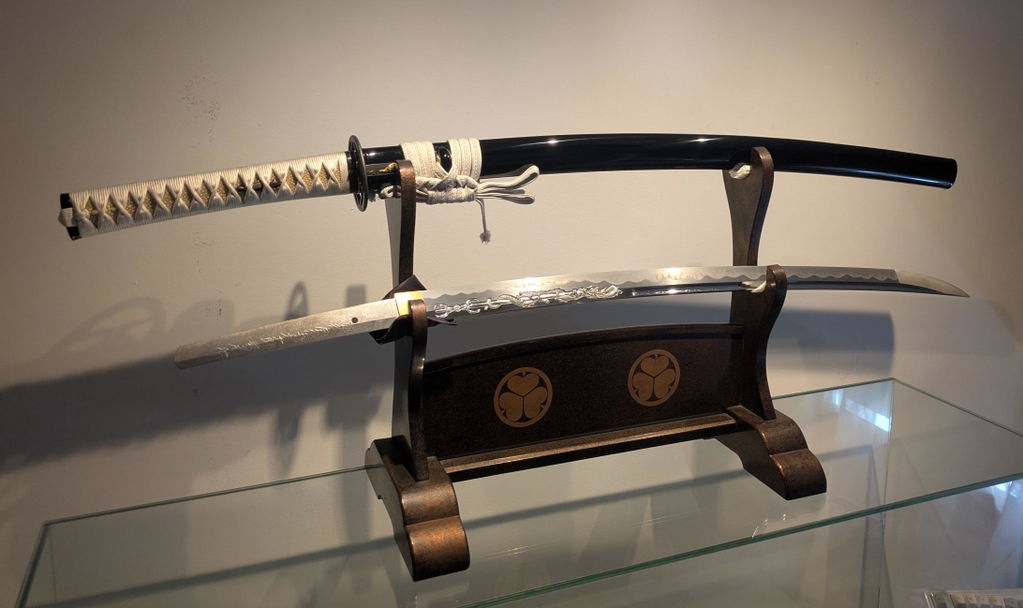
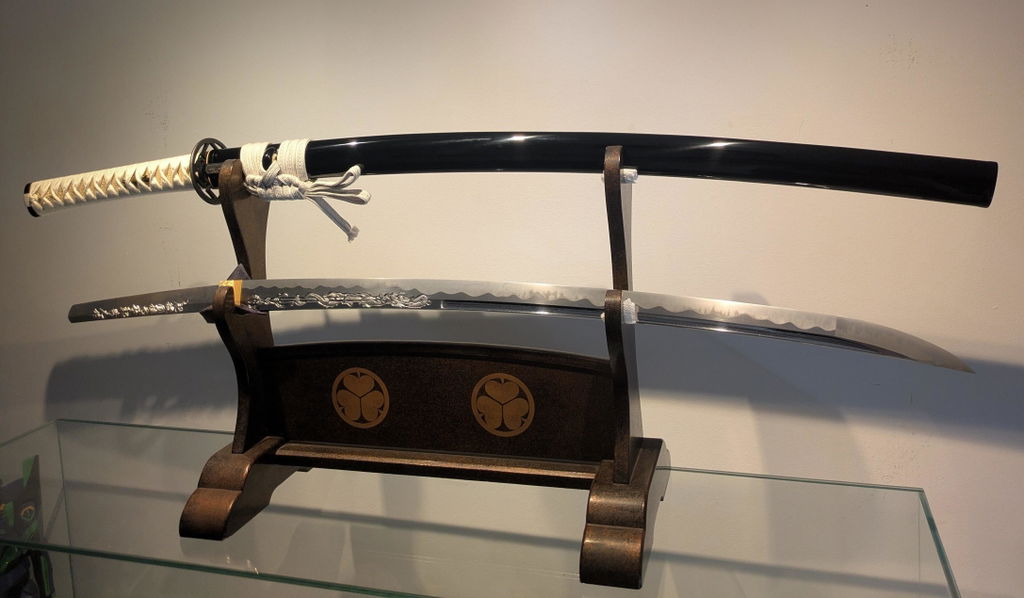
A koshirae is the complete set of Japanese sword mountings — made to carry, protect, and use the blade — fitted to a specific sword and designed as a coherent, functional ensemble. The word encompasses everything that surrounds the blade when the sword is in its working or display state: scabbard, handle assembly, guard, and all the fittings that connect, secure, and ornament these components.
The relationship between blade and koshirae in the Japanese sword tradition is distinctive and often misunderstood. A blade does not belong to a single koshirae permanently. Over its life — spanning centuries and dozens of owners — a significant blade may pass through many different mountings, each reflecting the tastes, status, and intentions of a specific owner at a specific historical moment. Sword enthusiasts valued the work of famous metalworkers — especially the Goto family's kodōgu (small fittings), Yokoya Somin's bold tsuba designs, and the Hirata school's enamel menuki — sometimes more than the blades themselves. Today, koshirae components frequently appear at sword fairs and art auctions as independent items, without blades. Named metalworkers' pieces can command prices that rival or exceed mid-range blades.
The koshirae is simultaneously a functional object, a historical document, and an art work. Its style, materials, and iconography reveal when and where a sword was used, who owned it, and what they wished to communicate about themselves through their sword. Reading a koshirae — understanding why specific motifs were chosen, recognising the school of the metalworker, dating the lacquer technique — is its own branch of nihonto scholarship.
The Components — Each a Specialist's Domain
The saya is the scabbard — the outer housing that protects the blade when not in use. Its construction begins with honoki (magnolia wood), which is split, hollowed to receive the blade with precise tolerances, and then rejoined. The precision of this hollowing is critical: the blade must slide smoothly without metal-to-metal contact with the scabbard's interior, while fitting snugly enough to stay in place during movement. A saya-shi who truly knows their craft shapes the interior around the specific contours of the specific blade.
The finished wood core is then covered in urushi lacquer — a process that may involve dozens of layers applied over weeks, each layer dried and polished before the next is applied. The variety of urushi finishes is enormous: kuro nuri (black gloss), roiro nuri (mirror black), nashiji (gold-flecked "pear skin"), aogai (mother-of-pearl inlay), and many others, each with its own technical demands and aesthetic character. A fine Edo-period saya in perfect condition is a technically demanding lacquer work in its own right — and is valued as such by connoisseurs of Japanese lacquer as well as sword collectors.
The saya incorporates several fixed fittings: the koiguchi (口 — the scabbard mouth, traditionally fitted with buffalo horn), the kurikata (栗形 — the knob through which the sageo cord is threaded), and the kojiri (鐺 — the protective fitting at the scabbard's tip, also traditionally buffalo horn).
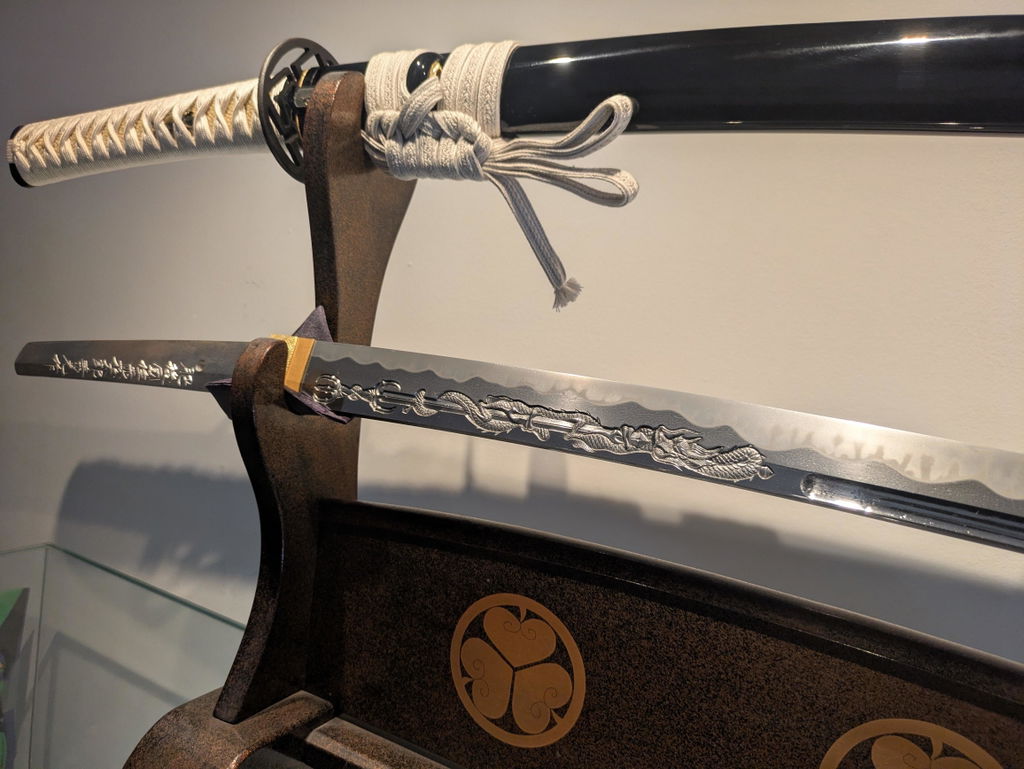
The tsuka is the handle — built over the nakago (tang) of the blade, covered in samegawa (ray skin), and wrapped in silk or cotton ito (cord) in patterns that vary by style and period. For a complete guide to the tsuka and how to evaluate its quality, see our dedicated article The Tsuka — How to Tell a Genuine Handle from a Factory-Made Imitation.
The tsuka's construction involves the collaboration of several craftspeople: the saya-shi who shapes the wooden core (tsuka-gaki), the specialist who applies the samegawa, and the tsukamaki-shi who performs the ito wrapping in the correct technique — including the alternating moroneri twist that locks each section of the wrap independently. The menuki (handle ornaments) are positioned beneath the wrap as both grip aid and decorative element. The quality of the tsuka assembly is the most immediately tangible indicator of a koshirae's overall craft standard — and one of the most reliably diagnostic indicators of factory-made imitation versus genuine traditional craft.
The tsuba is the guard — the plate positioned between blade and handle that protects the hand and marks the visual centrepiece of the koshirae. Among all koshirae components, the tsuba is most celebrated as an independent art form. Tsuba are made from iron, brass, copper, or alloys such as shakudo (copper-gold) and shibuichi (copper-silver). Decorative techniques include sukashi (cut-through openwork), takabori (relief carving), zogan (inlay), and sukidashi (low-relief sculpture). By the Edo period, specialist tsuba makers had established their own schools and hereditary lineages, including the Goto, Hirata, and Yokoya families.
The tsuba's cultural weight in Japanese sword history is unique among koshirae components. Whole collecting disciplines exist around specific schools of tsuba making. Tsuba are bought, sold, and inherited independently of blades. The NBTHK certifies tsuba independently through its tosogu kantei process — a named, documented tsuba by a recognised school can be authenticated and valued entirely separately from any blade it accompanies. A Goto school tsuba, a Yokoya Somin work, or a significant iron tsuba by the Owari tradition may command prices measured in tens of thousands of dollars — independent of any blade.
Iconographic themes on tsuba range from natural subjects (seasonal flowers, birds, landscapes) to mythological scenes, Buddhist and Shinto imagery, and the heraldic devices of specific daimyo families. The motif choice was not arbitrary — it communicated the owner's cultural references, spiritual affiliations, and social standing to every samurai who encountered them.
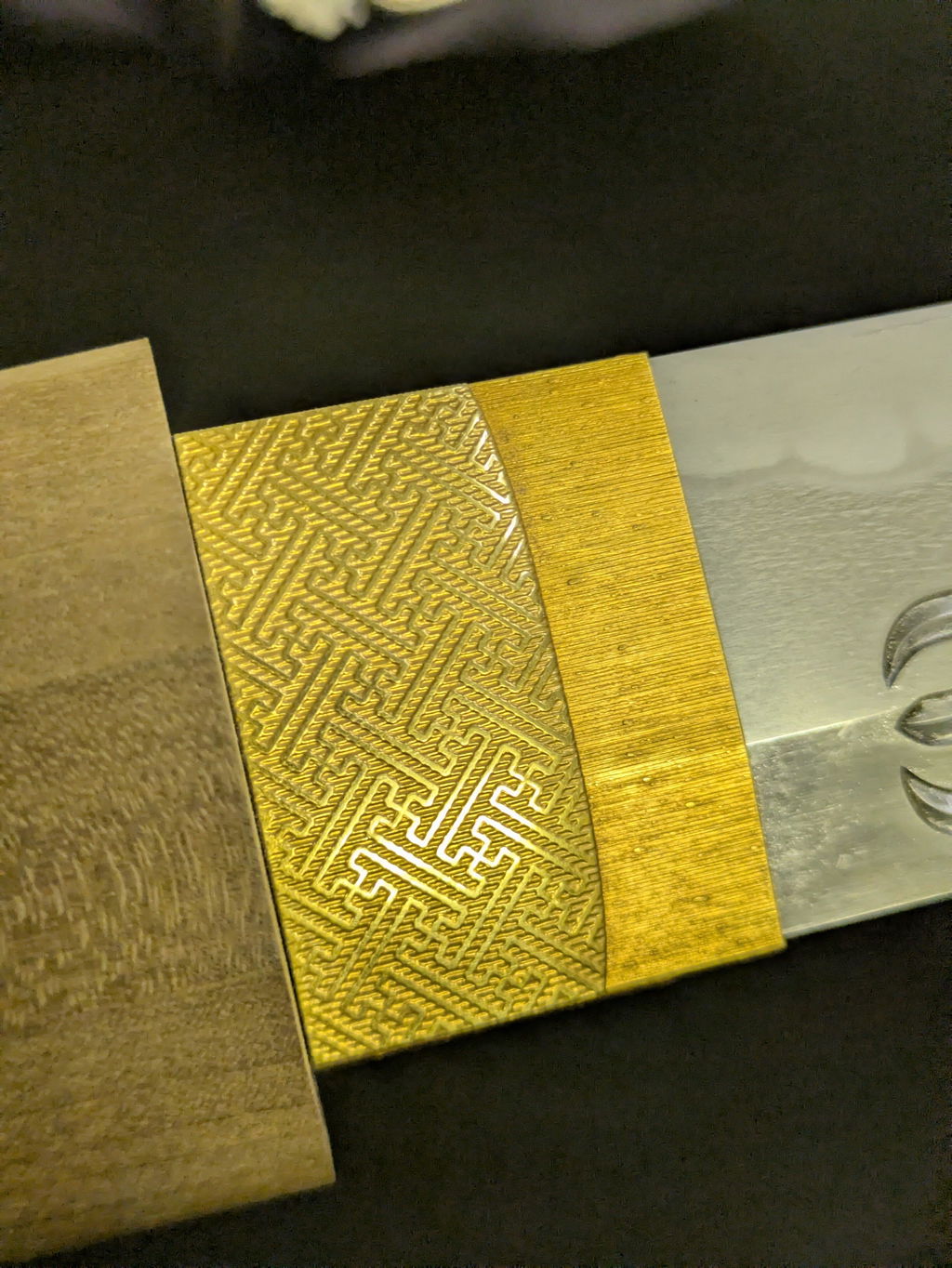
The habaki is the metal collar fitted directly to the blade at the base — the single most mechanically critical component of the entire koshirae. Its function is dual: it locks the blade in the saya by engaging the koiguchi (scabbard mouth), and it provides a stable base against which the tsuba and seppa rest. The fit of the habaki to the specific blade is as precise as the fit of the saya — it is made for this blade alone, to tolerances measured in fractions of a millimetre.
Habaki are most commonly made from copper, gold-foiled copper (kinpuku), or solid gold on very fine pieces. The surface treatment varies: plain polished metal, hammered texture, or decorative file work. On museum-grade blades, the habaki may itself be a work of art — gold habaki with carved motifs are found on the most prestigious pieces.
The seppa are the two thin metal washers placed on either side of the tsuba, between the tsuba and the habaki on one side and the fuchi on the other. Seppa are thin metal spacers placed on either side of the tsuba to achieve a precise fit. Despite their apparent simplicity, correct seppa are essential — an ill-fitting tsuba that wobbles is almost always a seppa problem, and worn or missing seppa are one of the most common issues in period koshirae requiring restoration.
The fuchi is the metal collar at the guard end of the handle — the ring of metal between the tsuba and the tsuka's wrapped surface. The kashira is the pommel cap at the far end of the handle, securing the final knot of the ito wrap. These two components are invariably made as a matched pair by the same metalworker — in the same material, in the same style, with matching or complementary decorative motifs. A fuchi and kashira from different sources, however beautiful individually, represent an incomplete or restored koshirae.
The fuchi-kashira is where the metalworker's artistic contribution to the koshirae is most concentrated. A matched Goto school fuchi-kashira in shakudo (shakudo nunome zogan) with the Tokugawa aoi-mon (hollyhock crest) is a historically significant piece with its own authentication papers. When evaluating a koshirae's completeness and integrity, the matching of the fuchi-kashira — same artist, same school, same material, complementary motif — is the primary diagnostic. Mismatched fuchi-kashira are among the most common indicators of a koshirae assembled from separate sources rather than created as a unified commission.
Menuki are the small metal ornaments positioned beneath the tsuka-ito wrap on both faces of the handle. Their dual role — functional grip enhancement and decorative element — makes them unique among koshirae components. Positioned at the natural pressure points of the gripping hand, the three-dimensional menuki create subtle contours beneath the ito wrap that help locate and stabilise the grip without conscious thought.
Menuki are made in pairs — one for the omote (outer) face and one for the ura (inner) face of the tsuka, offset from each other rather than directly opposite. They should be positioned correctly in terms of tenchi — orientation — with the motif facing the correct direction for each face. A reversed or misoriented menuki is a reliable indicator of incorrect remounting.
In the Goto school's tradition, menuki, kozuka, and kogai were collectively known as mitokoro-mono (三所物 — "three-place things") — the three small fittings that completed a formal koshirae. A complete matched set of mitokoro-mono by the Goto school — menuki, kozuka handle, and kogai — is among the most prestigious complete koshirae fitting sets in the tradition, and has been collected independently of any blade since the Edo period.
The sageo is the cord threaded through the kurikata on the saya and used to secure the sword to the wearer's belt or to bind the saya in specific situations. In traditional wearing, the sageo's colour and material communicated the wearer's status — high-ranking samurai wore sageo in specific colours corresponding to their position. For display and collection purposes, the sageo's colour should complement the overall colour scheme of the koshirae. A period-correct sageo in the appropriate colour and material for the koshirae's provenance adds to the ensemble's historical completeness. A sageo in the wrong colour — or a modern replacement in synthetic material — is a minor but detectable indication of restoration or replacement.
seventeen generations of Japan's greatest sword fittings artists
No discussion of koshirae is complete without the Goto family. The Goto family served the Ashikaga, Oda, Toyotomi, and Tokugawa shogunates in unbroken succession across seventeen generations — from the founder Goto Yujo (1440–1512) through to the Meiji period. No other family in Japanese craft history maintained this level of continuous official patronage across so many successive governments for so long.
Goto Yujo established his craft at the court of the eighth Ashikaga shogun, Yoshimasa — the same patron who shaped the "Higashiyama culture" that produced so much of Japan's classical aesthetic tradition in the late 15th century. The Goto family's role was to produce the official fittings for the shogunate's swords — a position that gave their work both official sanction and the concentrated refinement that comes from serving demanding, culturally sophisticated patrons over generations.
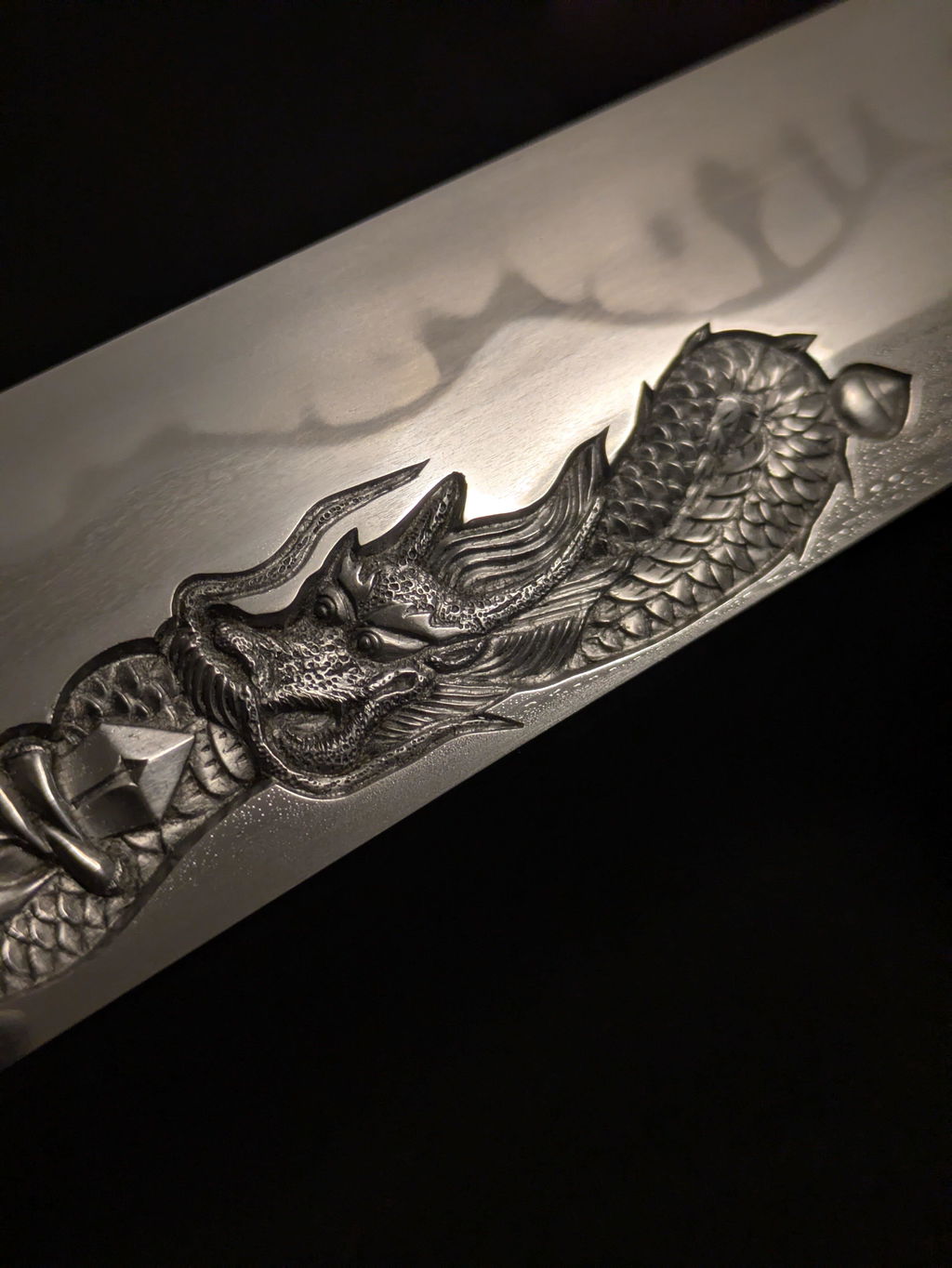
The Goto school's characteristic materials — shakudo (a copper-gold alloy that polishes to a deep, lustrous black) and shibuichi (copper-silver, producing subtle grey tones) — combined with their mastery of kebori (hair-fine line engraving) and nunome zogan (grid-cut gold inlay) to produce a recognisable aesthetic of controlled, formal elegance. The motifs they favoured — dragons, phoenixes, the aoi-mon (Tokugawa hollyhock crest), the paulownia — were not chosen freely but were assigned by the shogunate's protocol. This formal constraint, paradoxically, produced work of extraordinary refinement: every element optimised within a strict framework, the way a sonnet is optimised within the fourteen-line form.
A complete koshirae with authenticated Goto school fittings — fuchi-kashira, menuki, kozuka, and kogai, all matched — is one of the most prestigious complete sword fittings sets available in the Japanese art market. Individual Goto pieces are regularly certified by the NBTHK through its tosogu kantei process and appear at major auction houses independently of any blade.
Each one it carries is a portrait of an owner — their rank, their taste, their moment in history."
Koshirae and Value — What Period Fittings Actually Add
A good Edo-period katana with a Hozon certificate in shirasaya typically sells for $5,000 to $9,000. Put that same blade in authenticated period koshirae with NBTHK-certified Goto school fuchi-kashira and the price climbs to $18,000 to $35,000. The fittings are not an accessory. They are a significant portion of the asset.
| Configuration | Typical market range | What the premium reflects |
|---|---|---|
| Blade in shirasaya only | Base value of blade alone | Steel, attribution, NBTHK certification |
| Blade + shirasaya + period koshirae (unsigned fittings) | +20–50% over shirasaya | Historical completeness, display value, period authenticity |
| Blade + shirasaya + period koshirae (named school fittings) | +100–300% over shirasaya | Named school attribution, NBTHK tosogu certification, historical significance |
| Blade + shirasaya + Goto school certified complete koshirae | +300–500%+ possible | Highest tier of metalwork, historical provenance, institutional certification |
| Period koshirae alone (without blade) | $2,000–$50,000+ depending on school | Independent art work — certifiable, collectable without any blade |
Tozando's specialist craftspeople at your service
Most dealers who sell Japanese swords can tell you about koshirae. Very few can make one for you. Tozando employs in-house koshirae craftspeople — specialists in saya, tsuka, habaki, and fittings assembly — whose work is available to international collectors wishing to commission a custom mounting for a blade they already own, or to have existing koshirae repaired or restored.
The range of work our craftspeople undertake includes:
- New shirasaya — custom magnolia wood scabbard and handle, fitted precisely to your specific blade. The simplest and most protective form of mounting, and the starting point for any long-term preservation plan.
- New koshirae from scratch — a complete custom mounting designed and executed to your specification: choice of lacquer finish, ito colour and material, tsuba selection from our inventory, fittings sourced or commissioned. From contemporary understated to period-style formal.
- Habaki replacement or repair — a worn or ill-fitting habaki is one of the most common issues in both antique and modern swords. Our habaki-shi fits each new habaki to the specific blade, restoring the precise fit that the koshirae's integrity depends on.
- Tsukamaki re-wrapping — when the ito on an existing tsuka has loosened, worn, or been incorrectly wrapped, our tsukamaki-shi can re-wrap using the correct moroneri technique in your choice of ito colour and material.
- Saya repair and lacquer restoration — damaged or worn lacquer on a period saya can be restored by our saya-shi without compromising the scabbard's original character. We also fit replacement koiguchi, kurikata, and kojiri when originals are damaged or missing.
- Complete koshirae restoration — for period koshirae requiring comprehensive work across multiple components, our team can coordinate the full restoration to bring a deteriorated mounting back to the condition appropriate for a significant collection.
All commission work is undertaken with the same standards we apply to the swords in our own collection. International collectors can commission remotely — we work from photographs and measurements for initial assessment, and coordinate the blade's shipping to and from Kyoto for the physical work where required.
from shirasaya to complete custom mounting
Whether you need a simple new shirasaya, a complete custom koshirae for a blade you already own, or restoration work on a period mounting, Tozando's in-house specialists are available to international collectors. Contact us to discuss your requirements — we will advise on options, timelines, and costs for any koshirae project.
In Closing — The Second Art of the Japanese Sword
A blade without koshirae is like a painting without a frame — complete in itself, but incomplete as a presentation. And in the Japanese sword tradition, the koshirae is far more than a frame. It is a second artwork, made by different hands, in different materials, with different skills, that enters into conversation with the blade it surrounds. At its finest — a Kamakura-period tachi in period uchigatana-koshirae with Goto school fittings, the whole ensemble documented and certified — the combination of blade and mounting tells a story that neither can tell alone: a story about the specific historical moment in which they were brought together, the person who commissioned the combination, and the aesthetic vision that shaped every element of the ensemble.
Learning to read koshirae — to understand the lacquer techniques, to recognise the metalworking schools, to identify when a mounting is original versus assembled, to evaluate the quality of each component against the standards of its craft tradition — is the work of years. But it begins with understanding what each component is, who made it, and what distinguishes excellence from adequacy at every level of the craft.
The blade speaks in steel. The koshirae speaks in lacquer, silk, shakudo, and gold. Together, they say everything a Japanese sword has to say.
Sources: Toukenza — "Koshirae: Sword Mounting Guide" (April 2026); Tokyo Nihonto — "What Is Koshirae?" (2026), "The Art of Koshirae: Tsuba, Fuchi, Kashira, and What Makes a Mounting" (March 2026); Military Wiki / Fandom — "Japanese Sword Mountings"; Katana Heaven — "Every Part of a Katana: Anatomy Guide for Collectors" (May 2026); 紡盛堂 — "後藤家と家彫の起源" (July 2025); 名宝屋 — "金工の後藤家とは"; Samurai Museum Shop — "Episode 8: Sword Mountings." Goto family generational count (17) and historical patronage record confirmed from multiple Japanese-language sources. Value multiplier figures are indicative market estimates based on published auction and dealer data; individual pieces vary significantly.
Note: Commission enquiries for koshirae work are subject to current craftspeople availability and scheduling. International shipping of blades for koshirae work follows the same export/import documentation requirements as described in our export process guide. Contact Tozando for current timelines and costs before committing to a project.

Leave a comment: