

Your First Blade —
7 Points Every Beginner Should Know
Before Buying a Japanese Sword
From understanding what makes a sword truly authentic to avoiding the most common — and costly — mistakes.
You are standing in front of a gleaming Japanese sword — the curve, the light moving along the blade, the absolute stillness of it. You want to own one. But where do you start? The world of nihonto is rich, rewarding, and complex — and for beginners, it can feel like a minefield. This guide cuts through the confusion with seven essential points that every first-time buyer needs to understand.
The good news: with the right knowledge, choosing your first Japanese sword does not have to be overwhelming. The less good news: approximately 70% of "antique katanas" sold online are either outright fakes or severely misattributed pieces. The difference between a rewarding first purchase and a costly mistake is simply knowing what to look for — and what to avoid.
The 7 Essential Points
-
1PointUnderstand what "authentic" actually means
Before anything else, you need to know what you are buying — or trying to buy. The word nihonto (日本刀, "Japanese sword") refers specifically to swords forged using traditional Japanese methods, with tamahagane steel, by a licensed swordsmith. Three criteria must all be met: traditional material, traditional method, and legal licensing by Japan's Agency for Cultural Affairs.
This matters because the market is flooded with items that look like Japanese swords but are not nihonto. Mass-produced replicas use stainless or high-carbon steel and industrial methods. These may be attractive and even functional, but they are in a completely different category — culturally, legally, and financially — from an authentic Japanese sword.
A further layer of complexity: even genuine, traditionally-made old blades may carry gimei — false signatures, where a famous smith's name has been added to a blade they did not forge, usually to inflate its value. This practice was widespread in the late Edo and Meiji eras. Authentication is not optional; it is the foundation of every purchase.
-
2PointKnow your purpose before you choose a blade
The single most important question before any purchase is: what do you want this sword for? Your answer shapes everything else.
For collectorsNihonto / Shinsakuto$5,000 and aboveAuthentic Japanese swords — antique or newly forged by a licensed smith. The real thing, with full documentation and cultural significance. The focus of this guide.
For martial artsIaitō / Functional katana$300 – $2,000Unsharpened iaitō for iaido practice, or functional carbon-steel blades for tameshigiri. Well-made, purpose-built, but not classified as nihonto.
For displayDecorative replica$50 – $500Stainless steel display pieces. Fine for aesthetic purposes, but unsafe for use and of no value as collectibles or investments.
Starting pointModern shinsakuto$5,000 – $20,000Many experienced dealers recommend starting with a modern sword by a licensed smith. Full provenance from day one, no authentication uncertainty, and genuine craft quality.
If your goal is to own a true nihonto — a work of traditional Japanese craft — the entry point is realistic at around $3,000–$5,000 for a documented antique, or $5,000 and above for a newly forged piece by a licensed smith. Any seller claiming to offer an authentic antique katana for under $1,000 is not offering an authentic antique katana.
-
3PointLearn to read the three visual signatures of authenticity
You do not need to be an expert to recognize the basic visual markers of a genuinely forged blade. Three elements tell the story:
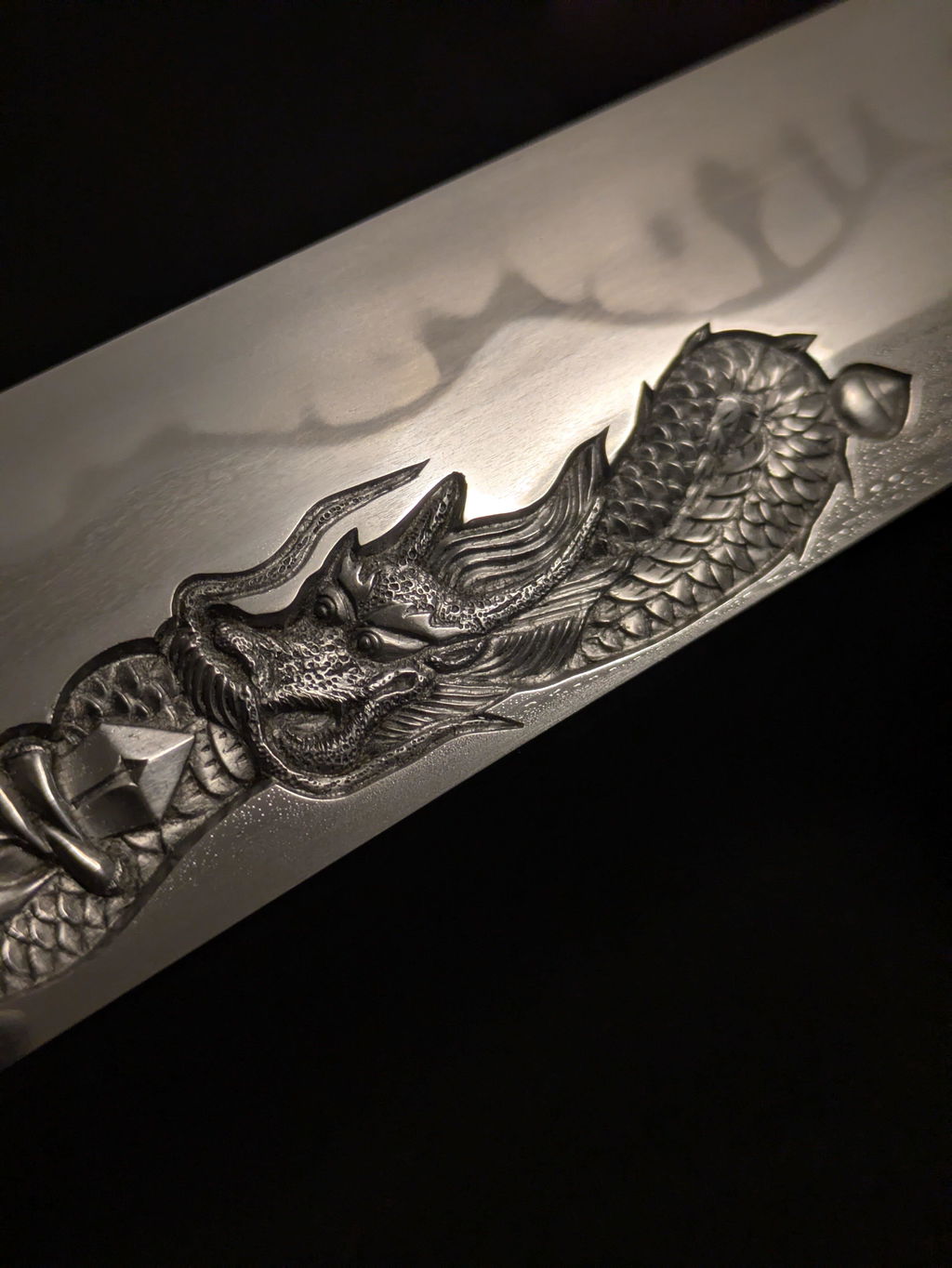
The hamon (temper line). The wavy or undulating line running along the edge of the blade, created by differential clay hardening during yaki-ire. A real hamon has depth, variation, and a three-dimensional quality visible under raking light. An acid-etched imitation hamon — the most common fake — looks flat, uniform, and too perfectly defined. If the hamon looks "printed on," treat it with suspicion.
The jihada (steel grain). The visible texture of the folded steel, resembling the grain of fine wood. Examine the flat of the blade in good light. If you can see no grain pattern, the blade was not traditionally forged. The grain may be subtle, but in an authentic blade it is always present.
The kissaki (point). The tip of a well-made sword should have a clean, sharp yokote line — the boundary between the blade body and the point section. A poorly executed or absent yokote is a reliable indicator of low quality or inauthenticity.
-
4PointDemand proper documentation — and know what to look for
In Japan, every authentic sword over 15 cm must be registered as a cultural artifact and carry a torokusho (registration certificate). For antique swords, NBTHK (Nihon Bijutsu Token Hozon Kyokai) certification papers provide additional authentication and grading. These are not optional formalities — they are the legal and commercial foundation of every legitimate nihonto transaction.
When buying, you should receive:
- Original registration certificate (torokusho) — not a photocopy. Verify the registration number matches the sword.
- Original NBTHK papers (for antiques) — at minimum Hozon level. Higher certifications (Tokubetsu Hozon, Jūyō) substantially increase authenticity assurance and value.
- Clear photographs of the nakago (tang) — the full tang, including any signature (mei), must be photographed. This is the primary authentication site.
- Detailed condition report — any kizu (flaws), previous repairs, or alterations should be disclosed in writing.
- Export documentation — if purchasing from Japan for delivery abroad, confirm the seller handles proper export procedures. Japan's Agency for Cultural Affairs controls the export of registered cultural artifacts.
-
5PointUnderstand the price spectrum — and what it means
The range of prices in the nihonto market can be disorienting for first-time buyers. A sword for $3,500 and a sword for $350,000 may appear superficially similar on a website. Understanding why they differ is essential to making a sound purchase.
Price range What to expect Typical category Under $1,000 Replica, decorative piece, or mass-produced imitation. Not a nihonto. Replica / display $1,000 – $3,000 High-quality functional swords (non-nihonto); iaitō; some unsigned Meiji-era pieces of limited collector interest. Functional / borderline $3,000 – $10,000 Entry-level authentic nihonto — unsigned Edo antiques, documented gendaitō, or lower-tier modern shinsakuto. The realistic starting point for genuine collecting. Entry-level nihonto $10,000 – $50,000 Attributed antiques with NBTHK papers; modern swords by ranked smiths; good-condition Muromachi or Shintō pieces. Mid-range collector $50,000+ Significant kotō-period blades; Living National Treasure works; pieces with Jūyō or higher NBTHK designation. Advanced / investment For most first-time buyers, the $3,000–$10,000 range is the right place to start. It is accessible, offers genuine historical and artistic value, and provides the experience of owning and caring for a real nihonto without the complexity of high-value attribution decisions.
-
6PointChoose your seller as carefully as you choose your sword
The nihonto market is one where the seller's expertise and integrity matter as much as the object itself. A dealer who takes time to explain what you are looking at — who provides complete documentation, answers questions transparently, and offers references from previous buyers — is providing value far beyond the transaction.
Signs of a trustworthy seller:
- Clear, unedited photography — blade, nakago, fittings, and all papers — for every piece.
- Membership in or affiliation with recognized bodies such as the NBTHK or established Japanese sword dealer associations.
- Willingness to provide references from previous international buyers for significant purchases.
- Transparent pricing based on formal appraisal, not negotiation.
- Clear return and authenticity guarantee policies in writing.
- Direct handling of export documentation for buyers outside Japan.
Red flags to walk away from:
- Photocopy or digital NBTHK papers — originals only.
- Missing nakago photographs — the tang is non-negotiable for authentication.
- "Possibly Masamune school" or similar vague attributions — this is not an attribution.
- Any claimed antique katana priced under $1,000.
- Pressure to decide quickly, or "only one available" urgency tactics.
- No clear return or dispute resolution policy.
-
7PointBe ready for the responsibilities of ownership
Buying a Japanese sword is not like buying a painting or a watch. It is acquiring a living object — one that will corrode if neglected, lose value if improperly handled, and require ongoing care to remain in good condition. Most first-time buyers underestimate this responsibility; most experienced collectors say it becomes one of the deepest pleasures of ownership.
The essentials of sword care are not complicated, but they must be performed regularly:
- Never touch the blade with bare hands — the oils in your skin cause rust. Handle the blade only with a clean cloth or gloves.
- Oil the blade regularly with traditional chōji oil (clove oil). How frequently depends on your climate — dry environments require less frequent oiling; humid environments more.
- Store the sword properly — in its shirasaya (plain wooden storage scabbard), edge up, in a stable environment away from temperature extremes and direct sunlight.
- Never attempt polishing or restoration yourself — even light cleaning with the wrong materials can damage or destroy a blade's value permanently. Polishing is a specialist profession requiring years of training.
- Know your local legal requirements — ownership and transport regulations for swords vary significantly by country and jurisdiction. Verify these before purchase, and ensure your sword's registration is current and in order.
Along with physical care, consider insuring any significant acquisition. Insurance replacement value typically runs 20–40% higher than fair market value, and specialist art insurers are familiar with nihonto.
it is in their own knowledge."
One More Thing: Start by Educating Your Eye
Every experienced collector says the same thing to beginners: before you buy, look at as many genuine blades as you can. Visit museums. Attend NBTHK study meetings if there is a chapter in your region. Handle certified pieces at reputable dealers and pay attention to how the steel feels, how the hamon looks under different light, how the balance changes as you move the blade.
The eye that has seen many real swords will not be fooled by a good fake. This education costs nothing — and it protects every purchase you will ever make.
Ready to begin?
Browse our collection —
antique and modern, fully authenticated
Every sword in our collection carries complete NBTHK certification, detailed condition reports, and full provenance documentation. Not sure where to start? Our specialists are here to guide you.
In Summary
Buying your first Japanese sword is the beginning of a journey — one that, for those who take it seriously, never really ends. The seven points in this guide will not make you an expert overnight, but they will help you make a purchase you will be proud of: a genuine object, properly documented, honestly priced, and cared for with the attention it deserves.
The sword you choose for your first is often the one you keep for life. Take your time. Ask questions. And buy what you genuinely love.

Leave a comment: