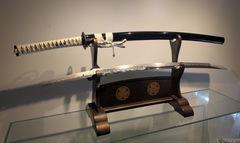
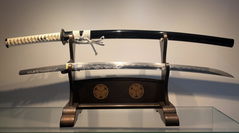
Antique Japanese Wakizashi Sword - Mumei, Shinto Era (36.6 cm)
¥200,000 ¥240,000

Andō Hiroyasu works at the forge of Bizen Osafune Tōken no Sato (備前おさふね刀剣の里), the sword village in Setouchi, Okayama Prefecture, that stands where the great Osafune school flourished in the Kamakura period. A second-generation smith who has also spent two decades working in traditional tatara steel smelting, he has won the Kanzan Prize, one of the special prizes of the NBTHK Gendai Tōshoku-ten (Contemporary Sword Craftsmanship Exhibition), and is known for his pursuit of utsuri, the misty reflection in the steel that marks the finest old Bizen blades. A katana commissioned through Tozando is forged to order by the smith himself and priced as set by the All Japan Swordsmith Association (全日本刀匠会).
Hiroyasu was born Andō Yūsuke (安藤祐介) in 1979. His father, the swordsmith Andō Hirokiyo (安藤広清), had turned to swordmaking after a career as a cook, and Hiroyasu grew up watching him at work. After graduating from high school in 1998 he entered his father's forge as an apprentice; as is customary, his smith name takes the character "Hiro" (広) from his teacher's name.
In 2002 he completed both the Agency for Cultural Affairs' swordsmith training course and training as a junior worker at the Nittōho Tatara (日刀保たたら), the NBTHK's traditional smelter in Okuizumo, Shimane, which produces the tamahagane used by Japan's swordsmiths. He has continued to work there for more than twenty years, training toward the role of murage (master of the smelt). He received his swordsmith's license from the Agency for Cultural Affairs in 2003 and in 2004 began working at the forge in Bizen Osafune Tōken no Sato, where visitors to the Bizen Osafune Japanese Sword Museum can watch him at work. His blades are signed Bishū jū Osafune Hiroyasu saku (備州住長舩広康作, "made by Hiroyasu of Osafune, resident of Bizen").
Hiroyasu's work was first selected for the NBTHK Shinsaku Tōten (New Sword Exhibition) in 2004. At the exhibition, now the Gendai Tōshoku-ten, he won an Effort Prize in 2015 and Excellence Prizes in 2017 and in four consecutive years from 2019 to 2022. In 2022 he received the Kanzan Prize in the tantō division, and in 2023 he won the Kanzan Prize again, this time in the division for tachi and katana. In 2026 he received an Effort Prize in the tantō and ken division.
Hiroyasu has made an utsushi (homage) of the National Treasure tachi Sanchōmō (山鳥毛), the celebrated Kamakura-period masterpiece of Bizen swordmaking. He also produces inseki-tō (隕鉄刀), swords forged with meteoric iron blended into the steel, and through the HITOFURI Project makes small tamahagane pieces such as letter openers to introduce the craft of the sword to new audiences.
Hiroyasu works in the Bizen-den (Bizen tradition) of his home province. The center of his research is utsuri, the faint, misty shadow that rises in the jigane of old Bizen blades but is rarely seen in modern swords. He has succeeded in reproducing it, though he says it is still far from his ideal. In the hamon he seeks the natural, beautiful temper of Kamakura-period swords, and in his Sanchōmō-inspired works he pursues a vivid, flame-like hamon. His long experience at the tatara gives him an unusually deep understanding of the steel itself, from the smelter to the finished blade.
A commissioned katana by Andō Hiroyasu is a blade born in Osafune itself, made by a smith who knows the steel from the furnace onward. It is made for one owner, to be handed down as a family treasure. Please contact us to discuss specifications and lead time.
¥200,000 ¥240,000

¥400,000 ¥430,000

¥390,000 ¥410,000

¥270,000 ¥290,000

¥300,000 ¥330,000


Every blade reflects generations of knowledge, discipline, and precision passed down through traditional Japanese swordmaking. From the forging of steel to the final finishing touches, each piece is shaped with patience, mastery, and deep respect for heritage.

From carefully selected materials to the refined finishing of every surface, each sword is crafted and presented with uncompromising attention to detail. Our commitment to authenticity ensures every piece reflects true tradition, lasting quality, and enduring cultural value.

Designed with balance, simplicity, and purpose, our blades embody the harmony between refined form and skilled craftsmanship. Each sword represents a thoughtful union of strength, elegance, and the timeless discipline of Japanese artisans.