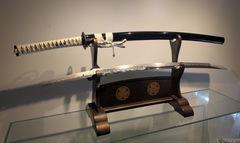
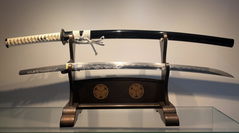
Antique Japanese Wakizashi Sword - Mumei, Shinto Era (36.6 cm)
¥200,000 ¥240,000

Few names in Japanese swordmaking have been carried as long as Kanefusa. The first Kanefusa was working in Seki, Mino Province (present-day Gifu Prefecture), by the mid-fifteenth century, and the line has continued without a break to the present. The 25th-generation Fujiwara Kanefusa trained under the Living National Treasure Gassan Sadakazu (月山貞一) before returning to the family forge in Seki. Today he works alongside his son, the 26th generation, keeping Seki's oldest working sword family at the anvil. A katana commissioned through Tozando is forged to order by the smith and priced as set by the All Japan Swordsmith Association (全日本刀匠会).
Kanefusa XXV was born Katō Katsuo (加藤賀津雄) in 1957 in Gifu Prefecture, the second son of the 24th-generation Kanefusa. On finishing high school in 1975 he became a live-in apprentice (uchi-deshi) to Gassan Sadakazu, one of the defining smiths of the twentieth century, and spent eight years in his forge. He received his swordsmith's license from the Agency for Cultural Affairs in 1982.
In 1983 he returned to Seki to study under his father, and in 1984 he became independent and took the name 25th-generation Fujiwara Kanefusa. His forge, the Nijūgodai Fujiwara Kanefusa Nihontō Tanrenjō (二十五代藤原兼房日本刀鍛錬場), stands in the Oze district of Seki City, the town that has been Japan's best-known blade-making center since the Muromachi period (1336–1573). Father and son regularly give public forging demonstrations at the Seki Traditional Swordsmith Museum (関鍛冶伝承館).
Kanefusa XXV has received the Excellence Prize and the Effort Prize at the Shinsaku Meitō-ten (New Sword Exhibition) of the Society for the Preservation of Japanese Art Swords (NBTHK). He has served as a director of the All Japan Swordsmith Association and has held leading roles in the organizations that preserve Seki-den (the Seki tradition) swordmaking techniques, including the Seki-den Tōshō-kai (関伝刀匠会, Seki Tradition Swordsmiths' Society). In 2017 he made a tachi for the dohyō-iri (ring-entering ceremony) of yokozuna Kisenosato.
The founder of the line created one of the most recognizable hamon in Japanese swordmaking. The "Kanefusa midare" (兼房乱れ) is a large gunome-midare (irregular pattern of rounded, semicircular forms) in which the head of each gunome separates and rises as an independent, rounded peak, with clusters of nie (bright, visible martensite crystals) gathering between the peaks and in the valleys. Its striking appearance was soon adopted by Seki smiths far beyond the Kanefusa school, and it remains the signature of the family today.
Kanefusa XXV works within the Mino-den (Mino tradition), known for practical, sharp and resilient blades, while drawing on the strength of Sōshū-den and the richness of Bizen-den learned in the Gassan forge. His jigane is typically a finely forged itame (wood-grain) with ji-nie (nie in the steel surface), and his sugata are balanced, practical katana proportions suited to both appreciation and use.
A commissioned katana by Fujiwara Kanefusa XXV carries a name that has been signed on blades in Seki for more than five hundred years. It is a sword made for one owner, linking its holder to one of the longest living lineages in Japanese craft. Please contact us to discuss specifications and lead time.
¥200,000 ¥240,000

¥400,000 ¥430,000

¥390,000 ¥410,000

¥270,000 ¥290,000

¥300,000 ¥330,000


Every blade reflects generations of knowledge, discipline, and precision passed down through traditional Japanese swordmaking. From the forging of steel to the final finishing touches, each piece is shaped with patience, mastery, and deep respect for heritage.

From carefully selected materials to the refined finishing of every surface, each sword is crafted and presented with uncompromising attention to detail. Our commitment to authenticity ensures every piece reflects true tradition, lasting quality, and enduring cultural value.

Designed with balance, simplicity, and purpose, our blades embody the harmony between refined form and skilled craftsmanship. Each sword represents a thoughtful union of strength, elegance, and the timeless discipline of Japanese artisans.