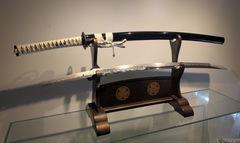
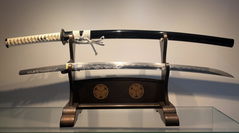
Antique Japanese Wakizashi Sword - Mumei, Shinto Era (36.6 cm)
¥200,000 ¥240,000

Kokuten is a swordsmith of the Komiya family of Ōmuta, Fukuoka Prefecture, the house known as Shirō Kunimitsu (四郎國光), which traces its line to the official smiths of the Yanagawa Domain in the Edo period. Trained in Nara under Kawachi Kunihira (河内國平), he works in Bizen-den in the manner of the Fukuoka Ichimonji school, and has won three special prizes at the Gendai Tōshoku-ten (Contemporary Sword Craftsmen Exhibition), including the Kunzan Prize in 2023. A katana commissioned through Tozando is forged to order by the smith himself and priced as set by the All Japan Swordsmith Association (全日本刀匠会).
Kokuten, whose real name is 小宮治氣, was born in 1980 in Ōmuta, Fukuoka Prefecture, into a family that has made swords and blades for generations. In April 1999 he entered the forge of Kawachi Kunihira in Nara, a holder of Nara Prefecture's Intangible Cultural Property designation. His smith name takes the character 國 (kuni), shared by his teacher and by his family's line of Kunimitsu smiths.
He received his swordsmith's license from the Agency for Cultural Affairs in 2003 and returned to Fukuoka in 2004 to forge in his home town. Some of his blades are signed Miike-jū Kokuten saku kore (三池住國天作之, "made by Kokuten, resident of Miike"), referring to the historic name of the Ōmuta area.
Kokuten first exhibited at the Shinsaku Meitō-ten (New Sword Exhibition) in 2006, winning the Effort Prize and the Newcomer Prize. In all, his record at the exhibition includes seven Effort Prizes and four Excellence Prizes. At the Gendai Tōshoku-ten, the successor exhibition, he has won three special prizes: the Kanzan Prize in 2019, the Kunzan Prize in 2023 and the Kanzan Prize again in 2025. He has also been selected and awarded the Technical Encouragement Prize at the New Japanese Sword and Craft Technique Exhibition of the Nihontō Bunka Shinkō Kyōkai, and received an Honorable Mention at the Omamori-gatana (protective sword) Exhibition.
The Komiya family descends from the goban-kaji (official duty smiths) of the Yanagawa Domain in Chikugo Province. After the 1876 ban on wearing swords, the family turned to kitchen knives and carpenters' tools, and resumed sword production in 1935. The family looks to the Heian-period smith Miike Tenta Mitsuyo (三池典太光世) of the same district as its ideal. In 1939 a blade by the earlier Shirō Kunimitsu won a national cutting-test competition, earning the family the reputation of "the sharpest in Japan," and in the same year one of his swords was among three selected at an exhibition to be presented to the Emperor. Today four smiths of the family are active, each in a different style.
Kokuten works in Bizen-den, taking as his model the Fukuoka Ichimonji school of the Kamakura period, whose blades are prized for their brilliant chōji hamon (a temper line with clove-bud shapes). His work aims at the full, flamboyant jūka-chōji (layered double-clove) of that school, set in a well-forged jigane. A commissioned katana can be discussed with him in terms of shape, hamon and the classical model the owner has in mind.
A commissioned katana by Kokuten joins a family tradition of swordmaking in Ōmuta with the most recent recognition at Japan's leading exhibition. It is a blade made for one owner, to be handed down as a family treasure. Please contact us to discuss specifications and lead time.
¥200,000 ¥240,000

¥400,000 ¥430,000

¥390,000 ¥410,000

¥270,000 ¥290,000

¥300,000 ¥330,000


Every blade reflects generations of knowledge, discipline, and precision passed down through traditional Japanese swordmaking. From the forging of steel to the final finishing touches, each piece is shaped with patience, mastery, and deep respect for heritage.

From carefully selected materials to the refined finishing of every surface, each sword is crafted and presented with uncompromising attention to detail. Our commitment to authenticity ensures every piece reflects true tradition, lasting quality, and enduring cultural value.

Designed with balance, simplicity, and purpose, our blades embody the harmony between refined form and skilled craftsmanship. Each sword represents a thoughtful union of strength, elegance, and the timeless discipline of Japanese artisans.