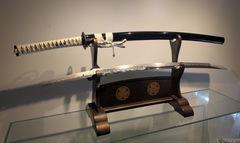
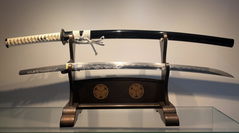
Antique Japanese Wakizashi Sword - Mumei, Shinto Era (36.6 cm)
¥200,000 ¥240,000

Ōno Yoshimitsu is one of the most decorated swordsmiths of the Shōwa and Heisei eras. Five Takamatsu-no-miya Prizes at the Shinsaku Meitō-ten (New Sword Exhibition), mukansa (exhibition-exempt) rank, and sacred swords made for Ise Grand Shrine place him in the first rank of living smiths. His life's work has been the recreation of Kamakura-period Bizen masterpieces, above all the National Treasure tachi Sanchōmō (山鳥毛). His flamboyant jūka-chōji (double-clove) hamon is known among collectors simply as "Ōno chōji." A katana commissioned through Tozando is forged to order by the smith himself and priced as set by the All Japan Swordsmith Association (全日本刀匠会).
Yoshimitsu was born Yoshikawa Mitsuo (吉川三男) in 1948 in Kurosaki, Nishikanbara District, Niigata Prefecture (now part of Niigata City). Drawn to Japanese swords as a student, he entered the forge of Yoshihara Yoshindo (吉原義人) and Yoshihara Kuniie (吉原國家) in 1969, completing his apprenticeship in 1976 while also graduating from Nihon University's College of Agriculture and Veterinary Medicine in 1972. As is customary, his smith name takes one character from his teacher's name.
He received his swordsmith's license from the Agency for Cultural Affairs in 1975 and opened the Ōno Yoshimitsu Forge (大野義光鍛刀場) in Niigata in 1976. The name "Ōno" comes from the place of that first forge. He later moved to Tokyo and has also worked in Okayama, the historical heartland of Bizen swordmaking. Some of his blades are signed Oite Bizen no Kuni Yoshimitsu saku kore (於備前国義光作之, "made by Yoshimitsu in Bizen Province"), while others are signed Echigo no Kuni Yoshimitsu saku (越後国義光作).
Yoshimitsu won the Encouragement Prize at his first Shinsaku Meitō-ten in 1975, followed by consecutive Effort Prizes through 1980 and an Excellence Prize in 1981. He then won the exhibition's highest honor, the Takamatsu-no-miya Prize, in 1982, the Agency for Cultural Affairs Commissioner's Prize in 1983, and the Takamatsu-no-miya Prize again in four consecutive years from 1984 to 1987, five times in all. This record led to his promotion to mukansa, the rank at which a smith's work is exhibited without judging.
His later honors include the Chairman's Prize at the All Japan Swordsmith Association's technical exhibition (2010), designation as an Intangible Cultural Property holder of Katsushika Ward, Tokyo (2012), recognition as the first Special Invited Exhibitor of the Omamori-gatana (protective sword) Exhibition (2016), and the title of Japanese Sword Master Craftsman (日本刀名匠) from the Nihontō Bunka Shinkō Kyōkai (2021).
In 1984 Yoshimitsu was invited to forge a sacred sword (go-shintō) for Ise Grand Shrine's Shikinen Sengū, the ceremonial rebuilding held every twenty years, and in 1989 he made four sacred spears (go-shinboko) for the same ceremony. He was commissioned again for two sacred swords in 2006. In 1996 he produced a reproduction of the kurozukuri no tachi (黒作大刀), a sword in the eighth-century Shōsō-in treasury. He is also known for self-funded research into how different polishing schools change the appearance of the same blade, an approach few smiths undertake.
Yoshimitsu's ideal is the Ichimonji school of Kamakura-period Bizen, and his touchstone is the National Treasure Sanchōmō, which he has recreated repeatedly. His aim is to capture the spirit of the great swords rather than to make literal copies. His signature hamon is a lavish jūka-chōji midare (layered double-clove pattern) in nioi-deki (a temper of fine, mist-like crystals) with ko-nie, rich ashi and yō (activity running toward the edge), and a bright, tight nioiguchi. In his Sanchōmō-style works the nioiguchi forms the distinctive "peninsula" and "island" shapes of the original on the omote side.
The jigane is typically a refined ko-itame (small wood-grain) with abundant ji-nie, often showing utsuri (a misty reflection in the steel), a hallmark of authentic Bizen work. His repertoire also includes saka-chōji (slanting clove) in the manner of the Chū-Aoe school. Classical tachi proportions, with a graceful koshi-zori and a well-balanced kissaki, complete the Kamakura impression.
A commissioned katana by Ōno Yoshimitsu is a rare opportunity to own the work of a living master whose chōji is the reference point for modern Bizen-den swordsmithing. It is a blade made for one owner, to be handed down as a family treasure. Please contact us to discuss specifications and lead time.
¥200,000 ¥240,000

¥400,000 ¥430,000

¥390,000 ¥410,000

¥270,000 ¥290,000

¥300,000 ¥330,000


Every blade reflects generations of knowledge, discipline, and precision passed down through traditional Japanese swordmaking. From the forging of steel to the final finishing touches, each piece is shaped with patience, mastery, and deep respect for heritage.

From carefully selected materials to the refined finishing of every surface, each sword is crafted and presented with uncompromising attention to detail. Our commitment to authenticity ensures every piece reflects true tradition, lasting quality, and enduring cultural value.

Designed with balance, simplicity, and purpose, our blades embody the harmony between refined form and skilled craftsmanship. Each sword represents a thoughtful union of strength, elegance, and the timeless discipline of Japanese artisans.