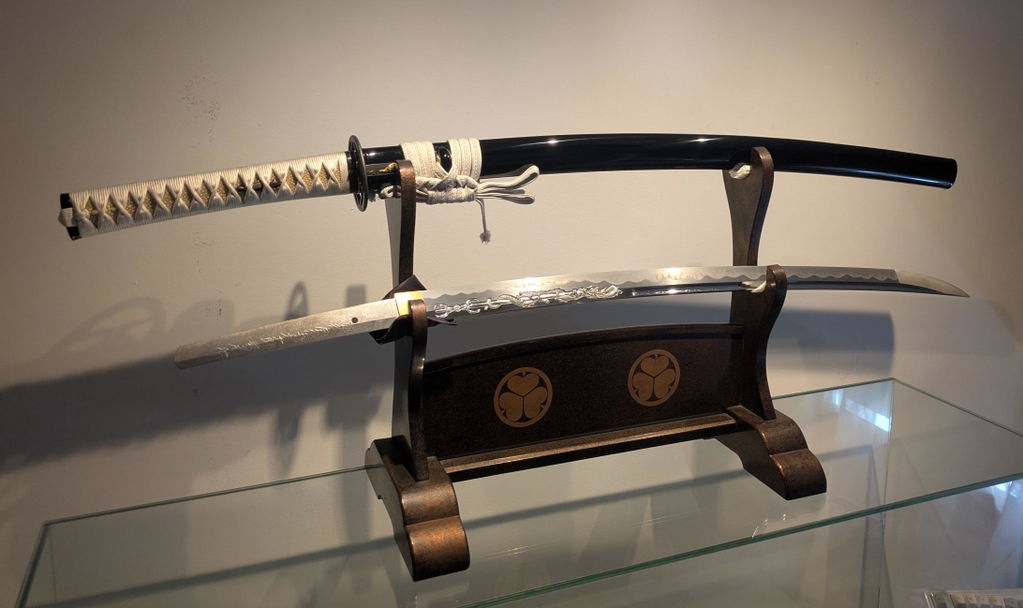
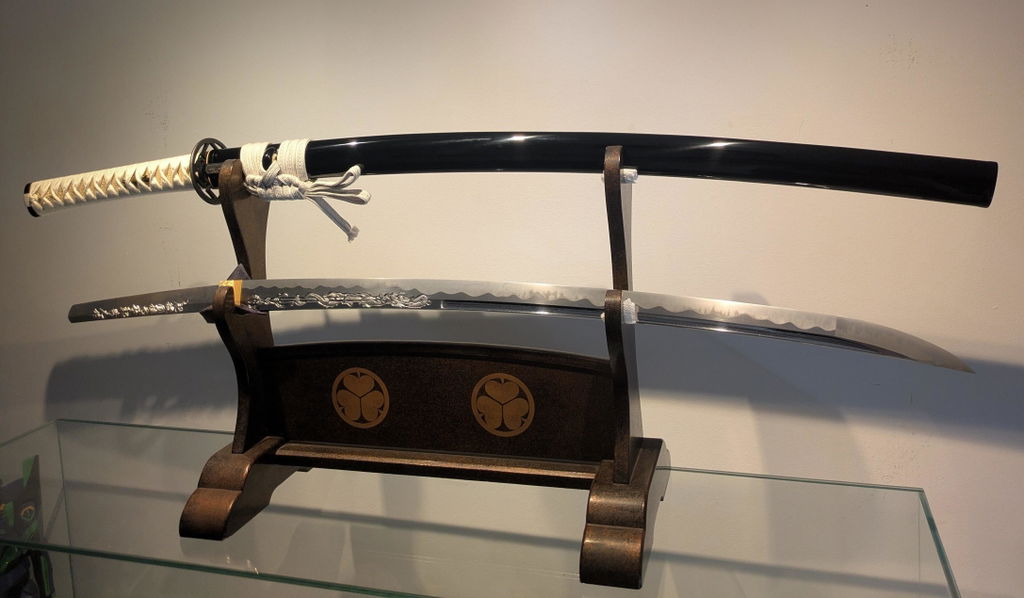
Antique Japanese Katana Sword - Mumei, Shinshinto Era - NBTHK Hozon Token(73.2 cm)
¥1,100,000 ¥1,150,000

We are honored to present an exceptional matched set (daishō) of katana and wakizashi by Shōji Chikuzen-daisuke Fujiwara Naotane (庄司筑前大介藤原直胤) — the great master better known as Taikei Naotane, counted among the "Edo San-saku," the three finest swordsmiths of the shinshintō era. The katana is dated Kaei 3 (1850), when the smith inscribed himself "an old man of seventy-five," and the wakizashi follows the very next year, Kaei 4 (1851). Both blades have been certified by the NBTHK as Tokubetsu Hozon Tōken (Especially Worthy of Preservation), and the pair is complete with a matched period daishō koshirae whose fittings unite the work of two celebrated Edo metalworkers. In historical importance, artistic quality, and state of preservation alike, this is a museum-class treasure.
What truly defines this set is the dating: the katana of Kaei 3 (1850) and the wakizashi of Kaei 4 (1851), just one year apart. This is decisive evidence that the pair is not a later marriage of two unrelated blades, but a set forged in close succession by one and the same master. More remarkable still, Naotane poured two different classical traditions into the one pairing — the Bizen tradition in the katana and the Sōshū tradition (with a rare matsukawa-hada) in the wakizashi — while keeping a consistent dignity of form and a shared clarity of ji and ha across both. The fittings, too, are of a single, coordinated design — the tsuba by Ōmori Eiichi, the fuchigashira by Hirata Harunari, and lavish full-same hilts set with great center-nodules — so that from blade to mounting the set is seamless. A daishō in which blade and koshirae are matched in rank and taste with no compromise is extraordinarily hard to find; a pair of this clear and unbroken pedigree stands as a true summit of collecting.
Shōji Naotane (1778–1857) is one of the supreme masters of the shinshintō period, counted alongside his teacher Suishinshi Masahide and Minamoto Kiyomaro among the "Edo San-saku." Born in Yamagata in Dewa Province, he came up to Edo in his youth and entered the school of Masahide, the great advocate of the sword-revival movement. He rose quickly, was taken into the service of the Akimoto daimyō family of Yamagata, and in Bunsei 4 (1821) received the honorary title "Chikuzen-daisuke," reaching the very pinnacle of the sword world of his day. Naotane's crowning achievement was his gift for completely mastering and freely working all five of the great classical traditions (Gokaden) — Sōshū, Bizen, Yamashiro, Yamato, and Mino — reviving in particular the flamboyance of Bizen and the power of Sōshū. His passion never dimmed with age: past seventy he continued to produce honed masterpieces, and the "seventy-five-year-old" inscription on the katana of this set is the very proof of a master who, in the turbulent closing years of the Edo period, reached the summit of his art — long and especially revered among connoisseurs and discerning collectors.
As their Tokubetsu Hozon certifications attest, both blades are thoroughly healthy and in good polish, allowing their ji and ha to be enjoyed to the full. The great pleasure of this set is that, though both are from Naotane's hand, the katana and the wakizashi let one savor two different traditions side by side.
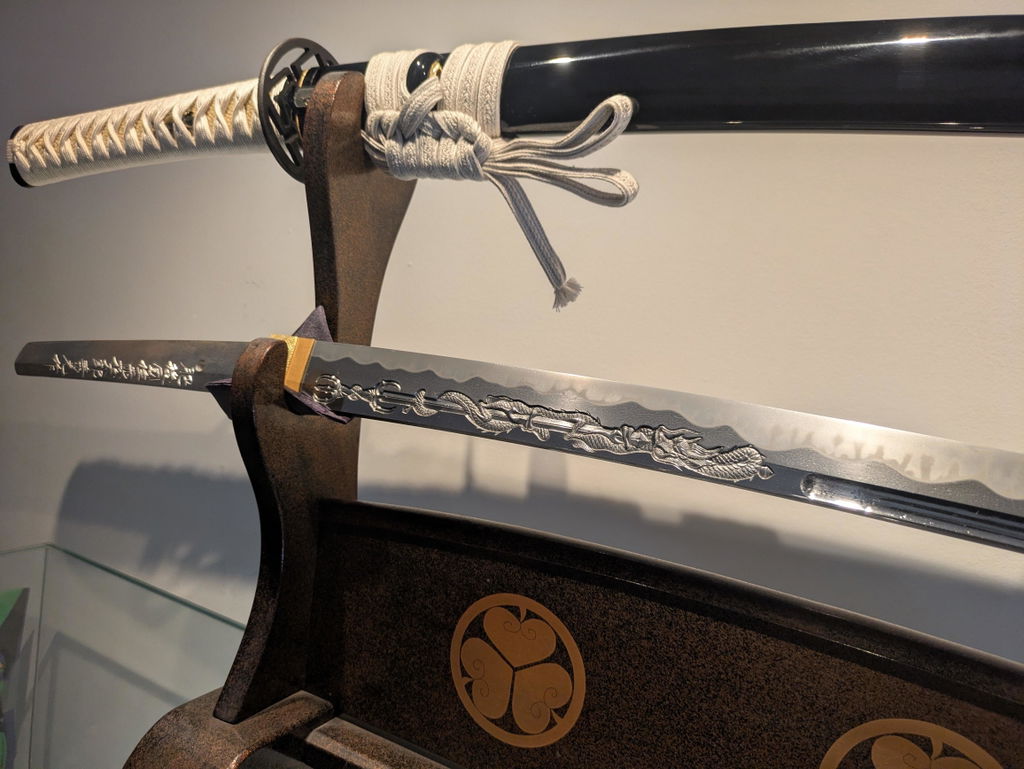
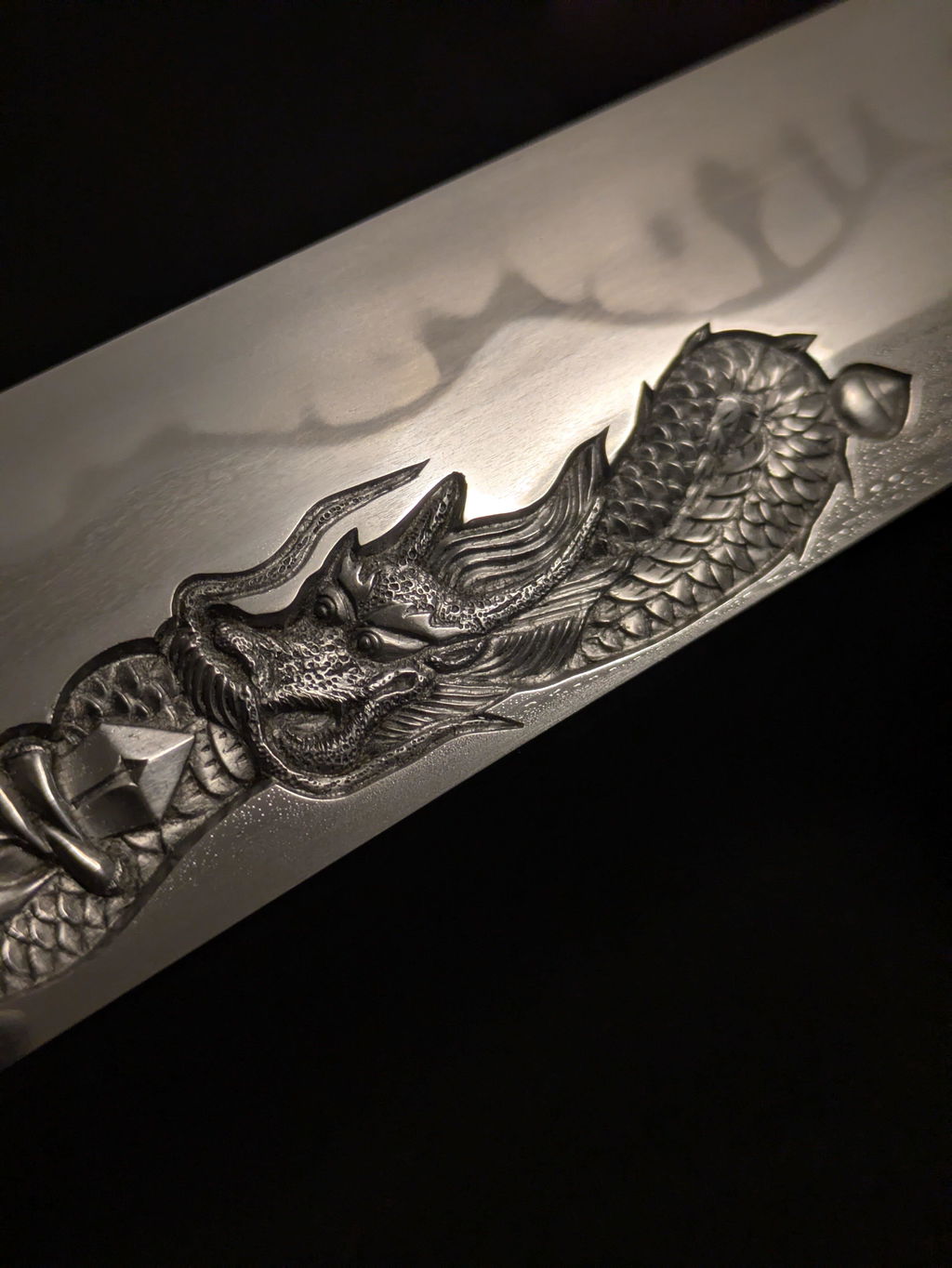
Katana (Osaka 8649) — Bizen tradition: The jigane is an itame delicately mixed with mokume, with fine ji-nie, forming the rich, powerful surface in which Naotane excelled. The hamon is a gentle ko-notare harmonized with gunome and ko-midare, giving full voice to the essence and refinement of the Bizen tradition from a smith who had mastered all five. Bright, clear ko-nie line the habuchi, and soft ashi and yō work within the temper — the serene maturity of his very last years expressed in both ji and ha.
Wakizashi (Tokyo 12720) — Sōshū tradition, matsukawa-hada: The wakizashi speaks eloquently of Naotane's command of the Sōshū tradition as well. Its jigane is a large itame (ō-itame) mixed with mokume that swells in bold undulations, with chikei threading through it like a net, vividly producing a dimensional, deep matsukawa-hada ("pine-bark grain"). Matsukawa-hada is the signature steel of Norishige of Etchū, one of the fathers of the Sōshū tradition — a sophisticated forging in which the surface heaves like the bark of a pine — and the ability to reproduce it at will is itself proof of Naotane's exceptional mastery of the Gokaden. Thick ji-nie, abundant chikei and kinsuji enliven a bright, clear ji and ha, full of the power and the nie-rich beauty of the Sōshū tradition. The Bizen katana and the Sōshū wakizashi form a complementary pair — a rare chance to enjoy the full breadth of Naotane's art in a single set.
Katana: A dignified shinogi-zukuri of moderate curvature and finely balanced motohaba and sakihaba, with a crisply gathered chū-kissaki — an upright presence that fuses practical beauty with artistry in the late-Edo shinshintō manner. The nakago is ubu (as originally made), boldly and clearly signed "Seventy-five-year-old man, Shōji Chikuzen-daisuke Fujiwara Naotane" with his distinctive kaō, and dated "Kaei 3" on the reverse — a blade of the highest documentary value.
Wakizashi: A well-proportioned hira-zukuri of firm width and thickness and a beautiful curve, drawing a flawless, flowing outline all the way to the point. The nakago is ubu with a ha-agari kurijiri and intact yasurime; it is signed "Mino Naotane" with kaō and a stamp (kokuin) on the front, and dated "a day in the 8th month of Kaei 4" on the reverse.
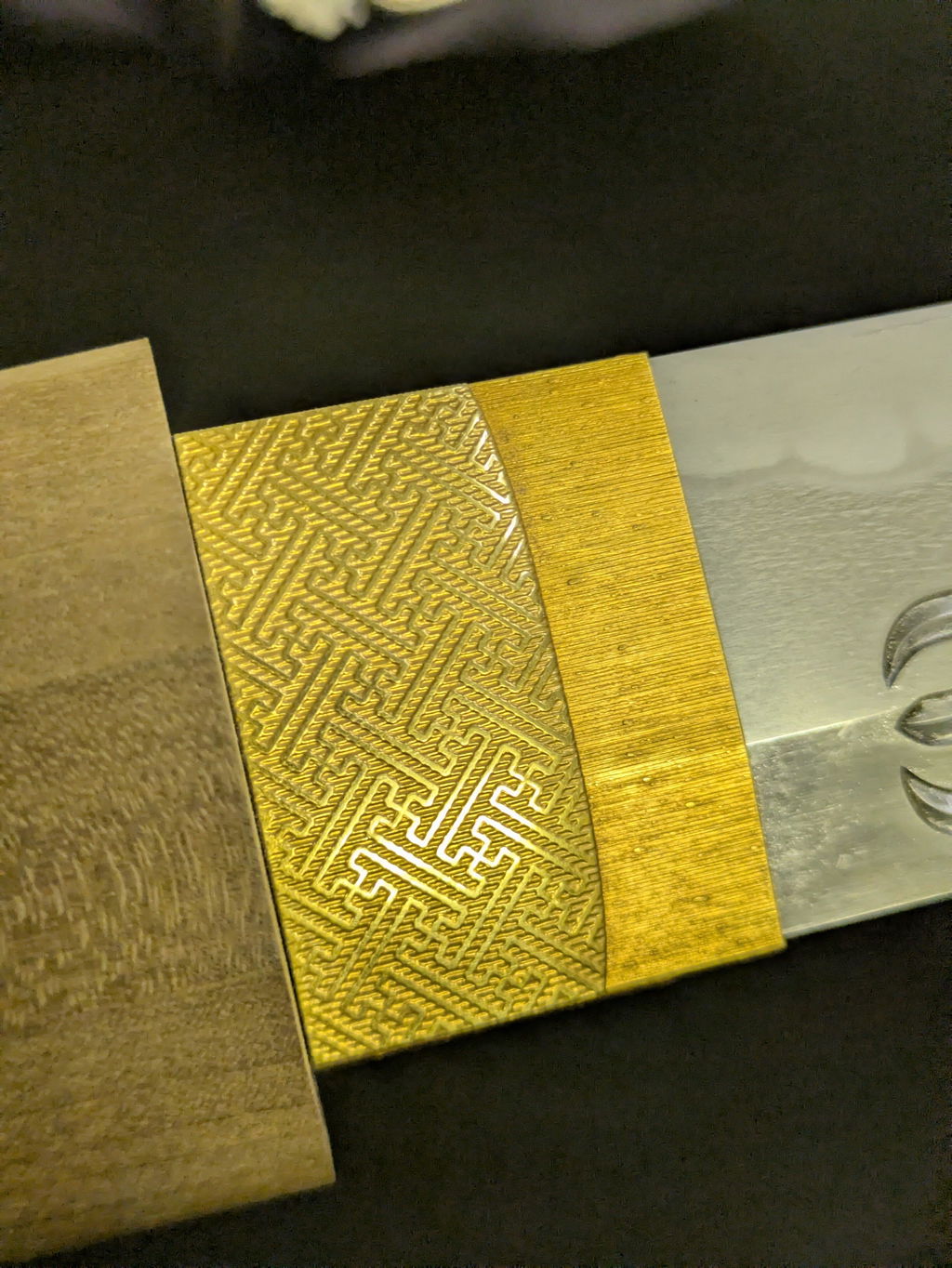
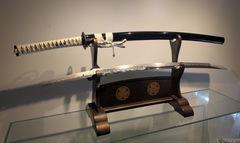
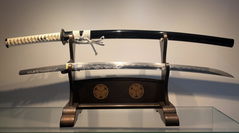
The set comes in a period daishō koshirae whose fittings are unified by the hands of two masters — the tsuba by the fine Edo metalworker Ōmori Eiichi and the fuchigashira by Hirata Harunari of the Hirata school. On both the long and short sword, the tsuba bears the Ōmori school's signature "Ōmori waves" — three-dimensional wave crests with flecks of gold scattering off the spray — while the fuchigashira show Harunari's sure technique and signature, at once serene and brilliant. The hilts are lavishly appointed: both are finished in the finest full-same wrap (sō-same) set with a large "oyatsubu" center-nodule — the single great grain that can be taken only sparingly from one ray-skin — whose orderly white pearling and splendid nodule lend a stately presence and great strength. The menuki are "bow, arrows, and arms with flowers" on the katana (emblems of martial fortune and refinement) and a "biwa (gagaku lute)" on the wakizashi (the samurai's command of both arts and letters); the wakizashi's kozuka and kōgai further carry a spirited "Genpei battle" scene in high relief with gold and silver inlay. Together with a deep, quietly lustrous black-lacquer saya, this is a daishō mounting of cultural-property, museum-class quality — a match for the dignity of the blades themselves.
Forged by the supreme shinshintō master Shōji Naotane in the golden last years when his skill and spirit had reached their height, this is a miraculous same-smith daishō. As the consecutive dates of Kaei 3 and 4 make plain, it is no later assemblage but a true pair forged in close succession by one hand. Both blades are certified NBTHK Tokubetsu Hozon Tōken, flawless and healthy, offering the Bizen tradition in the katana and the Sōshū tradition (matsukawa-hada) in the wakizashi within a single set. With the "seventy-five-year-old" inscription and the master's own kaō, the matched fittings of Ōmori Eiichi (tsuba) and Hirata Harunari (fuchigashira), and a complete daishō koshirae mounted in the most lavish full-same wrap, it is flawless on every count — blade ranking, context of manufacture, artistry of the mounting, and condition. A piece to be handed down with absolute confidence as a proud family heirloom and a sound asset — we invite you to experience the mature beauty left by this master of the late Edo age.
Katana (大刀)
Wakizashi (脇差)
Mounting (matched daishō koshirae)
¥1,100,000 ¥1,150,000

¥200,000 ¥240,000

¥400,000 ¥430,000

¥390,000 ¥410,000

¥270,000 ¥290,000

¥300,000 ¥330,000


Every blade reflects generations of knowledge, discipline, and precision passed down through traditional Japanese swordmaking. From the forging of steel to the final finishing touches, each piece is shaped with patience, mastery, and deep respect for heritage.

From carefully selected materials to the refined finishing of every surface, each sword is crafted and presented with uncompromising attention to detail. Our commitment to authenticity ensures every piece reflects true tradition, lasting quality, and enduring cultural value.

Designed with balance, simplicity, and purpose, our blades embody the harmony between refined form and skilled craftsmanship. Each sword represents a thoughtful union of strength, elegance, and the timeless discipline of Japanese artisans.