Antique Japanese Wakizashi Sword - Mumei, Shinto Era (36.6 cm)
¥200,000 ¥240,000

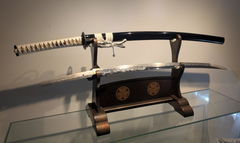
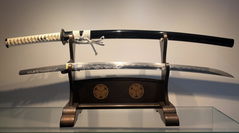
We are pleased to offer a katana signed "Norimitsu" (則光), the work of a Kaga (Kashū) smith working in the war-torn Hokuriku region during the Muromachi period (mid-to-late Muromachi). It is a signed (zaimei), unshortened (ubu) blade that has kept its original form and its two-character signature, and it comes complete with a handsome period handachi koshirae scattered with the unusual and elegant "maru-ni-gaku" (circle-and-votive-tablet) crest. The blade is certified by the NBTHK as a Hozon Tōken (Worthy of Preservation).
Norimitsu is one of the swordsmith names that worked in Kaga Province (present-day Ishikawa) through the Muromachi period, within the Kaga smith tradition (Kashū-tō) that would later be carried on into the Edo period. The Hokurikudō was a region torn by near-constant warfare, including the Ikkō-ikki uprisings, and Kaga blades are accordingly known for a sound, practical, no-nonsense character: tough and resistant to breaking, with excellent cutting ability in actual use. Work of the mid-to-late Muromachi period often combines that battlefield soundness with a graceful, deeply curved figure recalling the older tachi. That this blade has escaped the later shortening (suriage) so common to swords of this age — surviving ubu, with its full original form and two-character signature intact — is one of its real attractions.
The jigane is a ko-itame mixed with masame, showing the dark, richly aged steel characteristic of the Hokurikudō Kaga tradition. Here and there the surface shows forging marks that have come with age (kitae-me and faint hike); rather than detracting, these are the honest evidence of a blade that has lived through the turbulent Muromachi age, and they lend it a rugged, deeply flavorful "iron-bone" character. The hamon is based on a midare temper — a gunome of varying height mixed with pointed togari-ba — with ko-nie along the habuchi and a bright, clear finish. Within the temper, round, isolated "tama" float up charmingly, and bright kinsuji run like drawn lines, together with ashi and yō, making for a ji and ha rich in points of interest. For a Muromachi-period work the blade is in very good, freshly polished condition, and together with its deep curvature it conveys a strong breath of its age. It is on the strength of this period character and historical value that the NBTHK has designated it a Hozon Tōken.
The nagasa is 69.1 cm (2 shaku 2 sun 8 bu). Firm in both width and thickness, with a deep sori of 2.3 cm running from base toward the tip in a smooth, unbroken curve, it shows the traditional tachi-style figure of the early-to-mid Muromachi period. Both faces carry a cleanly cut bō-hi (single groove), running the length of the blade — lightening it and adding rigidity while setting the beauty of straight line against curve. The nakago is an unblemished ubu nakago, preserving its original form, with the two-character signature "Norimitsu" (則光) cut proudly in strong, confident strokes.
The sword comes with a handachi koshirae that eloquently expresses the dignity and bearing of the samurai. A handachi ("half-tachi") mounting combines the practicality of an uchigatana worn edge-up through the belt with the weighty metal fittings characteristic of a tachi (kabutogane, ishizuki, seme-gane and so on) — a high-ranking style that flourished during the transition from tachi to uchigatana from the late Muromachi into the Edo period, prized by senior samurai and daimyō households. The saya, fuchi and kojiri of this example are finely worked with the unusual and elegant "maru-ni-gaku" (circle-and-votive-tablet) crest — an uncommon device that gives the mounting a distinctive, individual character. The hilt is finished in a luxurious full-same wrap (sō-zame-maki), with the ray-skin showing beneath the binding across its whole surface; fine ray-skin set with large nodules, skillfully arranged in both white and black, unites practical grip with decorative beauty. The menuki are vigorous dragons in high relief with gold inlay — the dragon, a water deity and an emblem of victory and supreme authority, being among the most esteemed of motifs for sword fittings. The ensemble survives in excellent condition and carries an overwhelming presence even displayed as it is.
Having passed through repeated ages of war yet miraculously kept its original ubu nakago and its commanding figure, this Kashū Norimitsu is a characterful survivor of the Muromachi age. With the fine activity of tama and kinsuji floating in its dark steel, its deep and graceful curvature, and a period handachi koshirae set off by the auspicious "maru-ni-gaku" crest, it is a complete package. Certified by the NBTHK as a Hozon Tōken, its quality and historical value make it a proud centerpiece for a collection and a piece to hand down to the future.
¥200,000 ¥240,000

¥400,000 ¥430,000

¥390,000 ¥410,000

¥270,000 ¥290,000

¥300,000 ¥330,000


Every blade reflects generations of knowledge, discipline, and precision passed down through traditional Japanese swordmaking. From the forging of steel to the final finishing touches, each piece is shaped with patience, mastery, and deep respect for heritage.

From carefully selected materials to the refined finishing of every surface, each sword is crafted and presented with uncompromising attention to detail. Our commitment to authenticity ensures every piece reflects true tradition, lasting quality, and enduring cultural value.

Designed with balance, simplicity, and purpose, our blades embody the harmony between refined form and skilled craftsmanship. Each sword represents a thoughtful union of strength, elegance, and the timeless discipline of Japanese artisans.