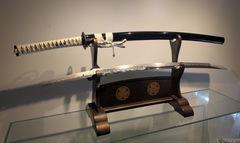
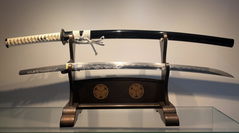
Antique Japanese Wakizashi Sword - Mumei, Shinto Era (36.6 cm)
¥200,000 ¥240,000

A supreme work in the finest ko-itame and the ultimate beauty of hiro-suguha (broad straight temper), left by a master at the pinnacle of half a century. We present a masterpiece katana by Ōmi Daijō Fujiwara Tadahiro, the second generation, a master representative of the early-Edo shintō (new-sword) period, designated a Jūyō Tōken (Important Sword) by the NBTHK (Nihon Bijutsu Tōken Hozon Kyōkai). Compared with kotō, a Jūyō designation for a shintō work is exceedingly rare — yet this blade passed the examination with ease, so sound and so free of the marks of age that it is fully deserving of the words "museum class" and "a treasure for a lifetime."
Given a superb polish, the blade is preserved in overwhelming condition — supremely healthy and without a single fault. The true essence of the second-generation Tadahiro lies in the beauty of a steel that admits no rival: a thoroughly refined ko-itame, finely and exquisitely packed, across which minute ji-nie are spread and glitter as though laid over the entire surface. The hamon is the smith's signature hiro-suguha, mixed with a shallow, large notare and set in a deep, rich nioi. Uniform ko-nie adorn the temper boundary; orderly ko-ashi run into the edge; and fine kinsuji and sunagashi harmonize beautifully — a faultless, serene quiet from which dignity overflows, a masterpiece that reaches the realm of fine art. The bōshi enters straight and returns gracefully in ko-maru. The blade keeps a spare, refined figure throughout, and the tang (nakago) retains crisp katte-sagari file marks, with the long signature Hizen no Kuni jū Ōmi Daijō Fujiwara Tadahiro cut deep and powerfully with the chisel.
Carefully protected and handed down over long years, this blade shows no loss from re-polishing, retaining the full width and thickness — and thus the imposing strength — it had when it was made. The nagasa is 72.2 cm. With a moderate sori, a refined carriage, and a chū-kissaki, it recalls the refined Kanbun-shintō shape of the early Edo period, while harmonizing beautifully with the graceful line peculiar to Hizen work.
The second-generation Tadahiro (1614–1693) was the natural son of the first-generation Tadayoshi, founder of the Hizen school. From his succession in Kan'ei 9 (1632), for more than half a century he reigned at the very head of the Hizen line of smiths and built its golden age — one of the foremost masters of the shintō era. In Kan'ei 18 (1641) he received the honorary title Ōmi Daijō, and his works thereafter were prized by daimyō houses as a status symbol in the Edo sword world. Among all his works, those designated Jūyō Tōken are exceedingly rare; this piece, made when his skill had fully matured, is truly deserving of being called the culmination of the second-generation Tadahiro.
This blade was designated a Jūyō Tōken (Important Sword) by the NBTHK in Shōwa 43 (1968). The original designation paper (Jūyō shitei-sho) has been lost in the course of the years; however, following the NBTHK's rigorous re-confirmation and examination procedures, a formal certificate of Importance (Jūyō shōmei-sho) was issued and granted in Heisei 12 (2000). Because the NBTHK officially guarantees this blade's designation history and authenticity, its rank as a Jūyō Tōken, and its artistic and asset value, are fully maintained without the slightest impairment — assuring firm, certain value through any change of ownership or future succession.
Even among the works of the second-generation Ōmi Daijō Tadahiro, a blade that combines this degree of soundness, so beautiful a straight temper, and the rank of Jūyō Tōken comes to market only very rarely. A piece of historical documentary value, overwhelming beauty, and assured asset quality — we recommend it with full confidence as the treasured sword of your house.
¥200,000 ¥240,000

¥400,000 ¥430,000

¥390,000 ¥410,000

¥270,000 ¥290,000

¥300,000 ¥330,000


Every blade reflects generations of knowledge, discipline, and precision passed down through traditional Japanese swordmaking. From the forging of steel to the final finishing touches, each piece is shaped with patience, mastery, and deep respect for heritage.

From carefully selected materials to the refined finishing of every surface, each sword is crafted and presented with uncompromising attention to detail. Our commitment to authenticity ensures every piece reflects true tradition, lasting quality, and enduring cultural value.

Designed with balance, simplicity, and purpose, our blades embody the harmony between refined form and skilled craftsmanship. Each sword represents a thoughtful union of strength, elegance, and the timeless discipline of Japanese artisans.