Even a casual conversation among Japanese students contains, without anyone noticing, multiple expressions rooted in the Japanese sword. Shinken ni kangaete — "think seriously." Sori ga awanai — "we don't get along." Tsubazeriai — "neck and neck." The sword has shaped the Japanese language so thoroughly that millions of people use these expressions daily without knowing where they come from. This article brings together thirty-six of them — from the well-known to the surprising — each with the sword's origin explained.
Here is what a typical Japanese student conversation sounds like — and how many sword idioms it contains:
A: "Oh boy, I was totally unprepared for that nukiuchi test. My answers are probably all ton-chin-kan."
B: "We should have listened more shinken in class. But somehow that teacher and I just sori ga awanai."
Four sword idioms in two sentences — and neither student thought about swords once.
All thirty-six idioms covered in this article:
元の鞘に収まるMoto no saya ni osamaru
反りが合わないSori ga awanai
とんちんかんTon-chin-kan
抜き打ちNukiuchi
地が出るJi ga deru
真剣勝負Shinken shobu
凌ぎを削るShinogi wo kezuru
鍔迫り合いTsubazeriai
土壇場Dotanba
相槌を打つAizuchi wo utsu
単刀直入Tanto-chokunyu
両刀使いRyoto-zukai
抜き差しならないNukisashi naranai
焼きを入れるYaki wo ireru
切羽詰まるSeppa tsumaru
身から出た錆Mi kara deta sabi
折り紙付きOrigami-tsuki
懐刀Futokoro-gatana
太刀打ちできないTachiuchi dekinai
急場凌ぎKyuba shinogi
付け焼き刃Tsukeyaki-ba
目抜き通りMenuki-dori
刃こぼれHakobore
諸刃の剣Moroha no tsurugi
焼きが回るYaki ga mawaru
助太刀Sukedachi
伝家の宝刀Denka no hoto
丸腰Marugoshi
自腹を切るJibara wo kiru
極め付きKiwame-tsuki
鞘当てSayaate
横槍を入れるYokoyari wo ireru
火花を散らすHibana wo chirasu
快刀乱麻を断つKaito ranma wo tatsu
一刀両断Itto ryodan
二刀流Nitoryu
Blade and scabbard — relationships and compatibility
元の鞘に収まる
Moto no saya ni osamaru
"To fit back into the original scabbard"
Modern meaning
Two people who have quarrelled are reconciled — or an estranged couple gets back together.
The sword origin: Every blade's scabbard is made to fit that specific blade's curvature precisely. A blade slid into a different sword's scabbard will not fit — or will fit badly and rattle. The original scabbard is the only one that fits perfectly. When enemies become friends again, they fit together as naturally as a blade returning to its own saya.
反りが合わない
Sori ga awanai
"The curve doesn't match"
Modern meaning
Two people who simply don't get along — a fundamental incompatibility of personalities or approaches.
The sword origin: Each sword has its own specific curve (sori), and the scabbard is shaped to match it exactly. A blade with the wrong curve won't fit the scabbard — and no amount of effort will make it fit naturally. When two people's personalities just don't align, they are like a blade and a mismatched scabbard.
At the forge — creation, sound, and combat training
とんちんかん
Ton-chin-kan
"Incoherent / off the mark"
Modern meaning
Something that is incoherent, misguided, or completely off the point.
The sword origin: When a master swordsmith and his apprentice forge a blade together, they alternate hammer strikes in a precise rhythm — ton-ten-kan. When things go wrong and the rhythm breaks down, the irregular sound becomes ton-chin-kan. The discordant hammering sound became a metaphor for anything that just doesn't add up.
相槌を打つ
Aizuchi wo utsu
"Hitting the hammer in tandem"
Modern meaning
To nod or respond in agreement during a conversation — the verbal and physical signals of attentive listening.
The sword origin: When forging a sword, master and apprentice face each other and strike the hammer alternately in coordinated rhythm — this is called aizuchi wo utsu. The image of two people responding to each other in perfect rhythm became the metaphor for attentive, agreeable listening.
Combat — tactics, battle, and confrontation
抜き打ち
Nukiuchi
"Draw and strike simultaneously"
Modern meaning
A surprise test or action given without advance notice.
The sword origin: Nukiuchi is a sword technique in which the blade is drawn from the scabbard and the strike is delivered in a single continuous motion — giving the opponent no time to react or prepare. A surprise exam that catches students completely unprepared is the modern equivalent.
真剣勝負
Shinken shobu
"Fighting with real swords"
Modern meaning
Doing something with one's utmost effort and full seriousness — giving everything.
The sword origin: Shinken (真剣) literally means "real sword" — as opposed to a wooden practice sword or bamboo training implement. A shinken shobu is a duel fought with live blades, where the slightest lapse in concentration can be fatal. Today, shinken alone means "seriously," and shinken shobu means approaching something with that same total commitment.
凌ぎを削る
Shinogi wo kezuru
"Shaving off the ridges"
Modern meaning
Fierce, neck-and-neck competition in which neither side gives ground.
The sword origin: The shinogi is the prominent ridge running along the upper portion of the blade, between the edge and the spine. In the most intense sword-to-sword clashes, the shinogi of both blades grind against each other, wearing away material. The phrase captures the image of blades locked together, both being worn down equally.
鍔迫り合い
Tsubazeriai
"Swordguards pressing together"
Modern meaning
A tough standoff or deadlock in which two evenly matched opponents neither advance nor retreat.
The sword origin: When two swords are locked together at close quarters, the tsuba (hand guards) of both blades press against each other — neither fighter able to strike or disengage cleanly. The image of two guards locked together, each fighter straining against the other, became the perfect metaphor for any evenly matched standoff.
単刀直入
Tanto-chokunyu
"A single sword straight in"
Modern meaning
Getting straight to the point — without long preambles, introductions, or indirect approaches.
The sword origin: The phrase describes a lone swordsman plunging straight into the enemy formation — no tactics, no flanking manoeuvre, just direct forward momentum. Applied to conversation, it means skipping all the circumlocution and going directly to what needs to be said.
太刀打ちできない
Tachiuchi dekinai
"Unable to fight with tachi"
Modern meaning
Unable to compete — the gap between one's own ability and the opponent's is simply too large to bridge.
The sword origin: The tachi was the long curved sword of the Heian and Kamakura-period mounted warrior — a powerful, demanding weapon. Tachiuchi referred to a swordfight with these large blades. If you cannot even fight with tachi — if the contest cannot even begin on level terms — the opponent is in a completely different class.
The blade's character — authenticity, condition, and hidden nature
地が出る
Ji ga deru
"The core comes out"
Modern meaning
Someone's true character — usually unflattering — shows through the surface they normally present.
The sword origin: A traditional Japanese sword is constructed with hard steel (hagane) on the outside encasing softer steel (shingane) at the core. As the blade is used and worn over time, the hard outer layer gradually wears away, revealing the softer inner steel. When someone's carefully maintained public persona wears thin and their true nature is exposed, they have let their ji come out.
折り紙付き
Origami-tsuki
"With the origami certificate"
Modern meaning
Guaranteed authentic — something or someone whose quality is fully verified and beyond doubt.
The sword origin: In this context, origami does not refer to paper folding — it refers to the certificate of authenticity (origami-sho) issued by the Hon'ami family, the hereditary sword appraisers to the Tokugawa shogunate, to swords they had examined and confirmed as genuine. A sword with an Hon'ami origami attached was, by definition, the real thing. Today, origami-tsuki means any person or thing whose authenticity or quality has been formally certified.
付け焼き刃
Tsukeyaki-ba
"A blade stuck on after hardening"
Modern meaning
Knowledge or skills hastily acquired without real depth — superficial learning that quickly loses its effect.
The sword origin: A tsukeyaki-ba is a disreputable repair technique in which a separately hardened steel edge is attached to a blade that has lost its sharpness — rather than having the blade properly re-tempered. Such a repair looks functional but fails quickly. Cramming for an exam the night before produces the same result: a temporarily sharp edge that won't hold.
刃こぼれ
Hakobore
"Chipping of the blade"
Modern meaning
A loss of sharpness or ability over time — declining effectiveness with age or overuse.
The sword origin: Hakobore refers to the notching or chipping of a blade's edge — damage that accumulates through use and reduces the sword's cutting ability. Applied to people, it describes the gradual dulling of a sharp mind or skill set with advancing age.
Hardening and heat — discipline, urgency, and consequences
焼きを入れる
Yaki wo ireru
"To put in the hardening"
Modern meaning
To discipline someone who has become lax or lost their edge — to put them through a rigorous corrective experience.
The sword origin: The differential hardening process (yakiire) is one of the most critical stages in sword-making — heating the blade to precise temperature and plunging it into water, which creates the hard cutting edge and the hamon. The process transforms soft, unhardened steel into something effective. Applying it to a person who needs to be toughened up preserves exactly this meaning.
焼きが回る
Yaki ga mawaru
"The hardening has gone around"
Modern meaning
To lose one's sharpness or good judgment — particularly through age. To become dull-witted.
The sword origin: During the yakiire process, if the hardening spreads unevenly — reaching the softer core of the blade — the blade becomes brittle rather than properly tempered. When the yakiire "goes around" incorrectly, the blade is ruined. When a person's mental sharpness "goes around" — spreading into areas it should not — their judgment becomes unreliable.
Difficult situations — being stuck, desperate, or cornered
土壇場
Dotanba
"The sand execution podium"
Modern meaning
The absolute last moment — a situation of extreme urgency where there is no longer any room to manoeuvre.
The sword origin: During the Edo period, executions took place on a raised podium of packed sand — the dotanba. These same grounds were also used to test new swords by cutting through bodies, with the results recorded by carving into the nakago. To be at the dotanba was to have no escape and no future. Today the phrase means any desperate, last-moment situation.
切羽詰まる
Seppa tsumaru
"The seppa is stuck"
Modern meaning
Being pressed into a corner with no way out — a desperate situation requiring an immediate decision.
The sword origin: The seppa is the thin elliptical metal collar on either side of the tsuba (hand guard), designed to stabilise the guard and ensure a tight, secure fit. If the seppa becomes jammed — stuck in place — the sword cannot be drawn cleanly from the scabbard. You cannot fight; you cannot run. The phrase captures that precise moment of total helplessness.
抜き差しならない
Nukisashi naranai
"Unable to pull out or push in"
Modern meaning
Stuck in a situation with no room to manoeuvre — impossible to exit or change.
The sword origin: When rust or moisture causes a blade to seize in its scabbard, neither drawing the sword nor re-sheathing it cleanly becomes possible. The blade is stuck — neither in nor out. This state of being neither free nor secured became the idiom for any situation with no exit.
急場凌ぎ
Kyuba shinogi
"Getting through with a broken blade"
Modern meaning
An improvised temporary solution — making do with what is available in a crisis rather than finding a proper fix.
The sword origin: Now written 急場凌ぎ (with the character for "place"), the original writing was 急刃凌ぎ — "getting through with the urgent blade." In battle, blades broke. You could not stop to find a new one; you had to manage with what you had. The phrase preserves that image of survival improvisation under pressure.
People and roles — trust, reliability, and social position
懐刀
Futokoro-gatana
"Pocket-sword"
Modern meaning
A trusted confidant or right-hand person — someone always by your side who can be counted on in a crisis.
The sword origin: The futokoro-gatana — also called kaiken — was a small blade carried hidden in the folds of clothing for self-defence. Unlike the katana left at the entrance when entering a building, this blade was always on the person. The loyal advisor who is always present, always ready to act when it matters, became the human equivalent of this ever-present blade.
両刀使い
Ryoto-zukai
"User of two swords"
Modern meaning
Someone skilled in two different areas — or, in current usage, someone attracted to both sexes.
The sword origin: The original meaning was a swordsman who fought with two blades — the two-sword style associated most famously with Miyamoto Musashi's Niten Ichi-ryu school. This developed into the meaning of someone with two distinct skills or interests. In contemporary Japanese, the phrase has acquired a further meaning referring to bisexuality, though the older sense of "accomplished in two fields" is preserved in the term nitoryu.
Structure and places — sword parts in the landscape
目抜き通り
Menuki-dori
"Menuki street"
Modern meaning
The main street or principal thoroughfare of a town — the most prominent and visible road.
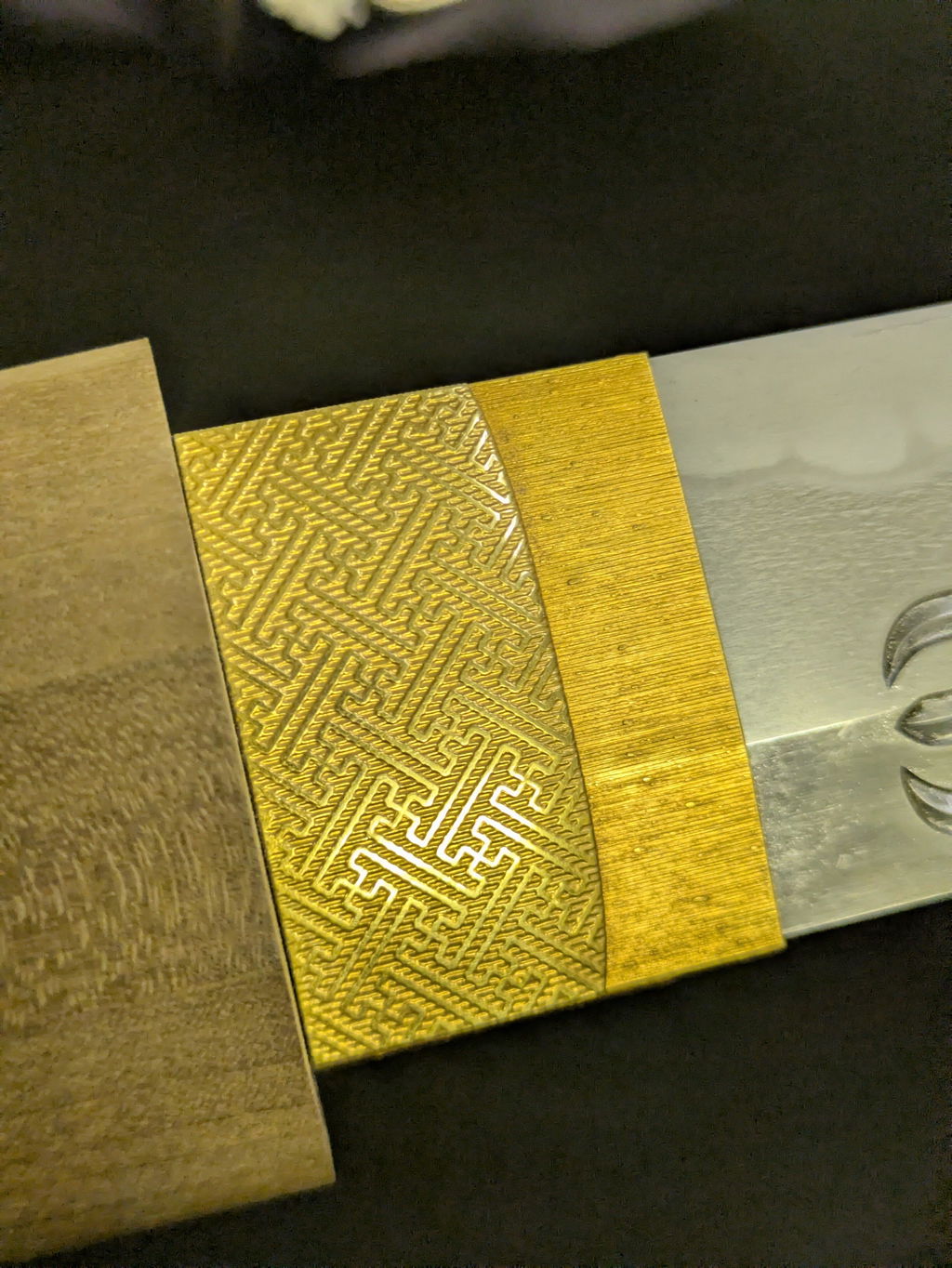
The sword origin: The correct original kanji is 目貫通り (menuki-dori) — from menuki (目貫), the small metal ornament fitted to the hilt of the sword. The menuki served originally as a structural element — covering and securing the mekugi (目釘), the bamboo or metal peg that locks the blade into the handle. Over time the menuki became primarily decorative, featuring elaborately worked designs of animals, crests, and mythological subjects. Being the most prominently visible and eye-catching fitting on the sword, menuki came to mean "prominent" or "conspicuous" — and 目貫通り became the name for any street that stood out as the centre of attention. In modern written Japanese the original 目貫 has been replaced by the phonetic substitute 目抜き, but the sword origin of the word is preserved in the original kanji.
Consequences and rust — self-inflicted problems
身から出た錆
Mi kara deta sabi
"Rust from one's own blade"
Modern meaning
Suffering that results from one's own negligence or bad behaviour — you have no one to blame but yourself.
The sword origin: A sword that is not maintained will rust. The rust comes from within the blade itself — from the iron, from moisture absorbed when the oil film breaks down. The rust is entirely the result of the owner's neglect. When someone's problems arise directly from their own failures and bad habits, they are suffering from rust of their own making.
Double-edged — the danger in what helps
諸刃の剣
Moroha no tsurugi
"A sword with two blades"
Modern meaning
Something that can both benefit and harm — a double-edged situation or tool whose advantages come with equal risks.
The sword origin: A moroha no tsurugi is a double-edged sword — sharp on both sides, able to cut in either direction. Unlike a standard Japanese sword, which has only one cutting edge, a double-edged blade can injure both the target and the user if handled carelessly. Any technology, policy, or advantage that carries equally significant risks is a double-edged sword in this sense.
一刀両断
Itto ryodan
"One sword, cut in two"
Modern meaning
To settle a matter decisively and without hesitation — cutting through argument or indecision with a single clear judgement.
The sword origin: Itto ryodan describes the act of cutting an object cleanly in two with a single sword stroke — the definitive demonstration of a blade's sharpness and a swordsman's technique. One strike; two pieces; no ambiguity. Applied to decisions and judgements, it means exactly the same thing: no deliberation, no compromise, no half-measures. A matter settled itto ryodan is settled completely and finally. While kaito ranma wo tatsu emphasises cutting through complexity, itto ryodan emphasises the finality and decisiveness of the cut itself.
二刀流
Nitoryu
"The two-sword style"
Modern meaning
Someone who excels simultaneously in two distinct fields — mastering both at the same time rather than choosing one over the other.
The sword origin: Nitoryu — the two-sword style — refers specifically to the fighting method developed and codified by Miyamoto Musashi (1584–1645), Japan's most celebrated swordsman. Where conventional swordsmanship used a single blade, Musashi's Niten Ichi-ryu school taught the simultaneous use of both the katana in the right hand and the wakizashi in the left — engaging the opponent with both weapons at once rather than keeping the shorter blade in reserve. Masashi described and explained his philosophy in The Book of Five Rings (Gorin no Sho), one of the most widely read works on strategy ever written.
In the modern world: The phrase received its most prominent contemporary application through Shohei Ohtani — the Japanese baseball player who, from his years in Japanese professional baseball through to his career in Major League Baseball, has performed as both a starting pitcher and a position player (batter) at elite level simultaneously. This dual mastery, considered essentially impossible at the professional level before Ohtani demonstrated it, was immediately and universally described in Japan as nitoryu. The phrase travelled with him into English-language sports media, where "two-way player" serves as its translation — but the original Japanese, with its direct line to Miyamoto Musashi, carries the deeper resonance. A tradition that began with a swordsman in 17th-century Japan now describes one of the most remarkable athletes in the world.
These thirty-six expressions span the full range of what a Japanese sword is: its construction, its use in combat, its maintenance, the social roles it represented, and the physical objects it comprised. That a single category of object could generate this many expressions still in daily use — centuries after swords ceased to be practical weapons — is itself a measure of how deeply the nihonto tradition shaped Japanese culture and thought.
The sword is still present in the Japanese language. It is present every time someone describes a situation as shinken (real sword — serious), every time two companies are said to be in tsubazeriai (guard-to-guard — a tight race), every time someone gets to the point with tanto-chokunyu (a single sword straight in). The tradition lives not only in museums and private collections — it lives in the words people use every day without noticing their origin.
The tradition behind the language
Explore authentic nihonto —
the objects that shaped these words
Tozando's collection brings together antique nihonto and modern fine art swords, selected for their craftsmanship, historical significance, and proven authenticity — shipped worldwide from Kyoto.


Leave a comment: