In the history of Japanese sword-making, there is a particular kind of distinction that is rarer and more telling than any prize or title: being described, by those who knew the work best, as having surpassed your teacher. Taikei Naotane (大慶直胤, 1778–1857) was the most celebrated direct student of Suishinshi Masahide — the father of the Shinshinto period — and the smith who, in the view of many subsequent scholars, took his teacher's vision further than Masahide himself was able to go. One of the江戸三作 — the Three Masters of Edo — Naotane's work in the Bizen-den tradition in particular is considered among the finest achievements of the entire Shinshinto period. The daisho set currently at Tozando's Shogoin gallery in Kyoto is the work of this smith — and this article tells the story of who he was.
50年
Active forging career — from his early independent work around 1801 until his death in 1857 at 79. One of the longest sustained careers in the Shinshinto period.
最上作
Saijo-saku — the highest ranking in sword quality classification. Naotane is ranked at this level for Shinshinto-period smiths — the same rank as his teacher Masahide.
天保打
Tenpo-uchi — blades made during the Tenpo era (1830–1844), considered Naotane's finest period. His Tenpo-period Bizen-den work is the most sought after of his entire output.
The Edo Sansaku — Where Naotane Stands
The term Edo Sansaku (江戸三作) — the Three Masters of Edo — refers to the three swordsmiths considered the greatest figures of the Shinshinto period working in Edo. It is one of the most significant groupings in the entire history of Japanese sword-making, and Naotane's place within it tells you immediately what kind of smith he was.
The founder — the argument
正秀
Suishinshi Masahide
1750–1825 · Naotane's teacher
The father of Shinshinto — who identified the decline of the Edo period tradition, wrote the theoretical framework for its recovery, and trained the generation of smiths who would implement it. The argument; not always its fullest realisation.
The practitioner — this article's subject
直胤
Taikei Naotane
1778–1857 · Masahide's finest student
The smith who, in many scholars' view, took Masahide's programme further than the master himself. Fifty years of active forging across multiple traditions — with his Tenpo-period Bizen-den work at the summit. The longest and most productive career of the three.
The independent genius
清麿
Minamoto Kiyomaro
1813–1854 · Soshu-den master
From a separate lineage — not Masahide's direct student but grouped with him and Naotane as the period's three greatest figures. Working primarily in Soshu-den, his nie-rich hamon commands the highest prices of any Shinshinto smith.
A Life at the Forge — Naotane's Journey
Taikei Naotane was born in 1778 in Yamagata domain, Dewa Province — the same region that had produced his future teacher, Suishinshi Masahide. His given name was Shoji Minobe (庄司箕兵衛), and he was the son of a sickle-maker — a background in metalworking that gave him the foundational skills he would redirect toward swords.
c.1798 — Apprenticeship
Moves to Edo to study under Suishinshi Masahide
Around the age of twenty, Naotane makes the journey from Yamagata to Edo and enters the forge of his fellow Dewa native Suishinshi Masahide. His talent was immediately apparent — he was given the smith name Naotane and the title Taikei (大慶, "great celebration") soon after entering the school, an honour rarely given to a new apprentice.
c.1801 — Independence
Establishes his own forge in Edo
Naotane becomes independent while maintaining his close relationship with Masahide. He lives initially in Nihonbashi, later moving to Kanda and then to Shitaya Okachimachi in what is now Ueno, where he would work for much of his career. His early work follows Masahide's toranba (large wave) style.
1812 — Domain service
Appointed to the Akimoto clan — the same patron as Masahide
Through Masahide's introduction, Naotane is appointed swordsmith to the Akimoto family of Yamagata domain — his teacher's patron and his own regional lord. This appointment gives him financial stability and social standing, freeing him to develop the research into Bizen-den techniques that would define his mature work.
1821–22 — Title
Receives the court title Chikuzen Daijo (筑前大掾)
The honorary court title — indicating official recognition of his standing — appears on his signatures from this period onward. His full formal signature becomes Shoji Chikuzen Daijo Fujiwara Naotane.
1830s–1840s — The Tenpo period
His finest work — the Tenpo-uchi blades
The Tenpo era (1830–1844) is when Naotane's Bizen-den work reached its peak. His blades from this period — known as Tenpo-uchi — show the choji hamon, the fine itame jihada with utsuri, and the overall character of Kamakura Bizen-den at its most fully realised in the modern era. These are the most sought of his entire output.
1848 — Late title
Title changes to Mino no Suke (美濃介); travels continue
In his seventies, Naotane continues to forge actively and to travel. His habit of stamping place names on the nakago as he worked across Japan — Shinano, Naniwa (Osaka), Ise, Kyoto — left a travel record built into the steel of his blades.
1857 — Death
Dies in Edo at 79, having forged for fifty years
Naotane died on the 27th of May, 1857, and was buried at Honnenji temple in Asakusa, Tokyo. He had forged for approximately fifty years, across multiple traditions, leaving a body of work that scholars consistently rank alongside the greatest achievements of the Shinshinto period.
The Two Traditions — Bizen-den and Soshu-den
Naotane's distinctive achievement within Masahide's fukko (復古, "restoration") programme was the breadth and depth of his technical range. Where many Shinshinto smiths concentrated on one tradition, Naotane worked fluently in multiple — with two traditions representing his highest achievements.
His greatest achievement
Bizen-den — the choji hamon master
Naotane's Bizen-den work — particularly from the Tenpo period — is considered by many specialists to be the finest Shinshinto expression of that tradition. His choji hamon shows the reversed, tipping character (sakagakari) typical of the great Fukuoka Ichimonji and Ko-Bizen masters. The jihada is a fine, well-packed ko-itame with utsuri (the mist-like reflection in the ji) visible in his finest pieces — a quality that even accomplished Shinshinto smiths rarely achieved. His Bizen-den pieces are ranked saijo-saku (the highest grade) and represent the summit of his output.
His second mastery
Soshu-den — the toranba and nie tradition
Naotane's early work in Soshu-den followed his teacher Masahide's characteristic toranba (large wave) hamon — a dramatic, sweeping pattern with abundant nie. His mature Soshu-den work shows deeper mastery of nie activity, with kinsuji and sunagashi present in his finest pieces. His Soshu-den blades rank jojo-saku (second highest grade) — exceptional in absolute terms, though considered by most specialists to be surpassed by his Bizen-den achievements.
The question scholars still debate — did Naotane surpass Masahide?
Several serious scholars of the Shinshinto period have written that Naotane's finest Bizen-den work goes beyond what Masahide himself achieved in the same tradition. The argument is specific: Masahide understood Bizen-den better than any smith since the Edo period's decline; Naotane implemented that understanding with a technical command that Masahide's own blades do not always match. This is not a criticism of Masahide — it is the highest possible tribute to Naotane, and a measure of how completely he absorbed and extended his teacher's programme.
"Masahide made the argument.
Naotane proved it —
in steel, across fifty years,
one blade at a time."
As seen on JCOM — 角田信朗のおっさんぽ (October 2026)
The daisho set by Taikei Naotane currently at Tozando's Shogoin gallery was featured in the October 2026 broadcast of Kakuda Nobuo no Ossanpo on JCOM — a programme in which the host visits Kyoto's distinctive cultural shops and institutions. Presenter Kakuda Nobuo, himself a committed nihonto enthusiast who has commissioned a wakizashi from the 26th-generation Kanefusa swordsmith in Seki, handled the blades directly during filming and responded with spontaneous admiration. The episode is currently available in rerun on JCOM; a second episode featuring Gallery Tozando is scheduled for broadcast.
Now available — Tozando's Shogoin Gallery, Kyoto
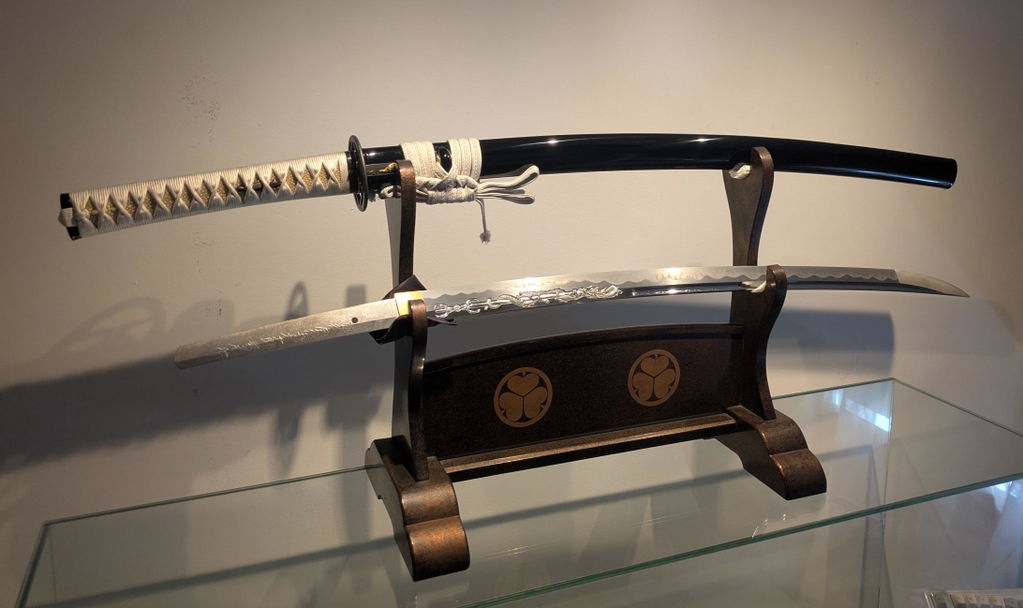
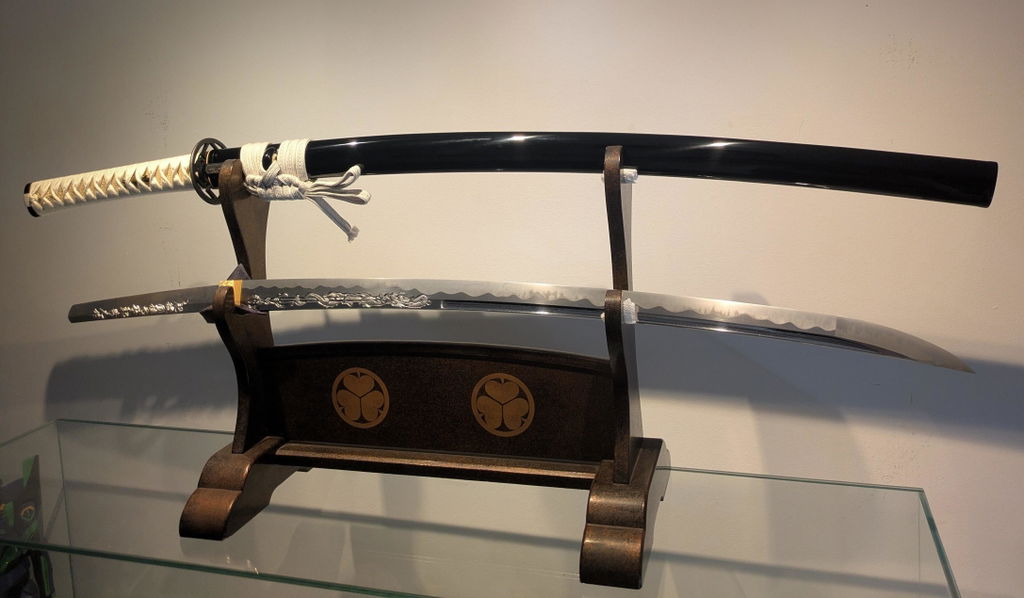
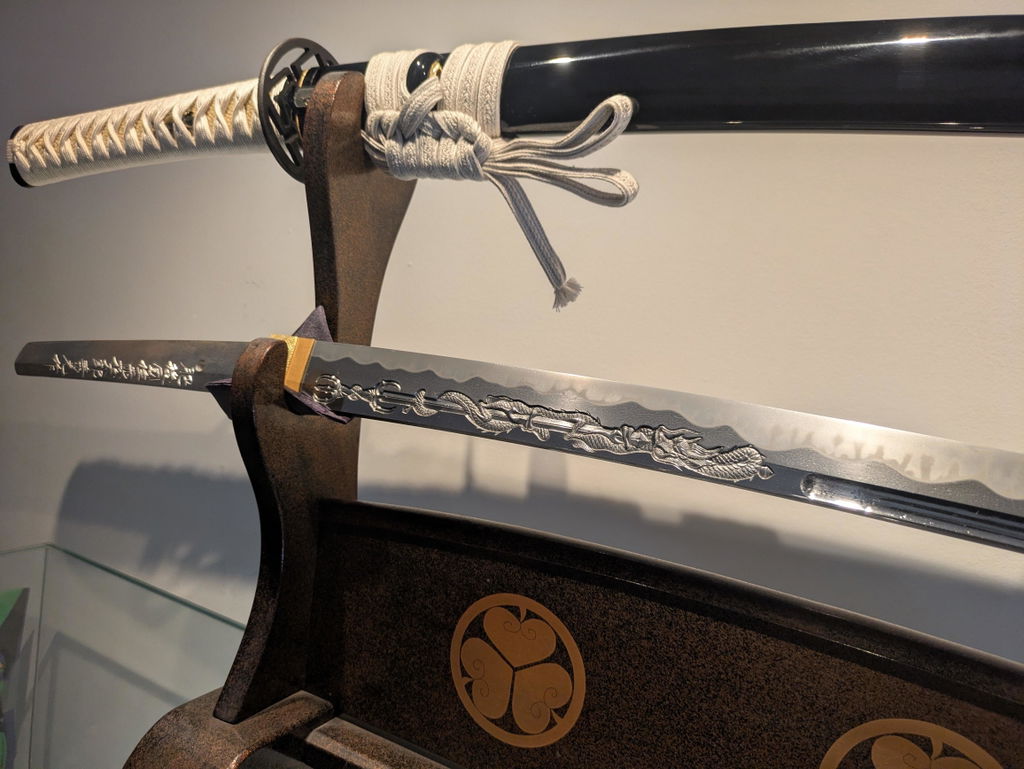
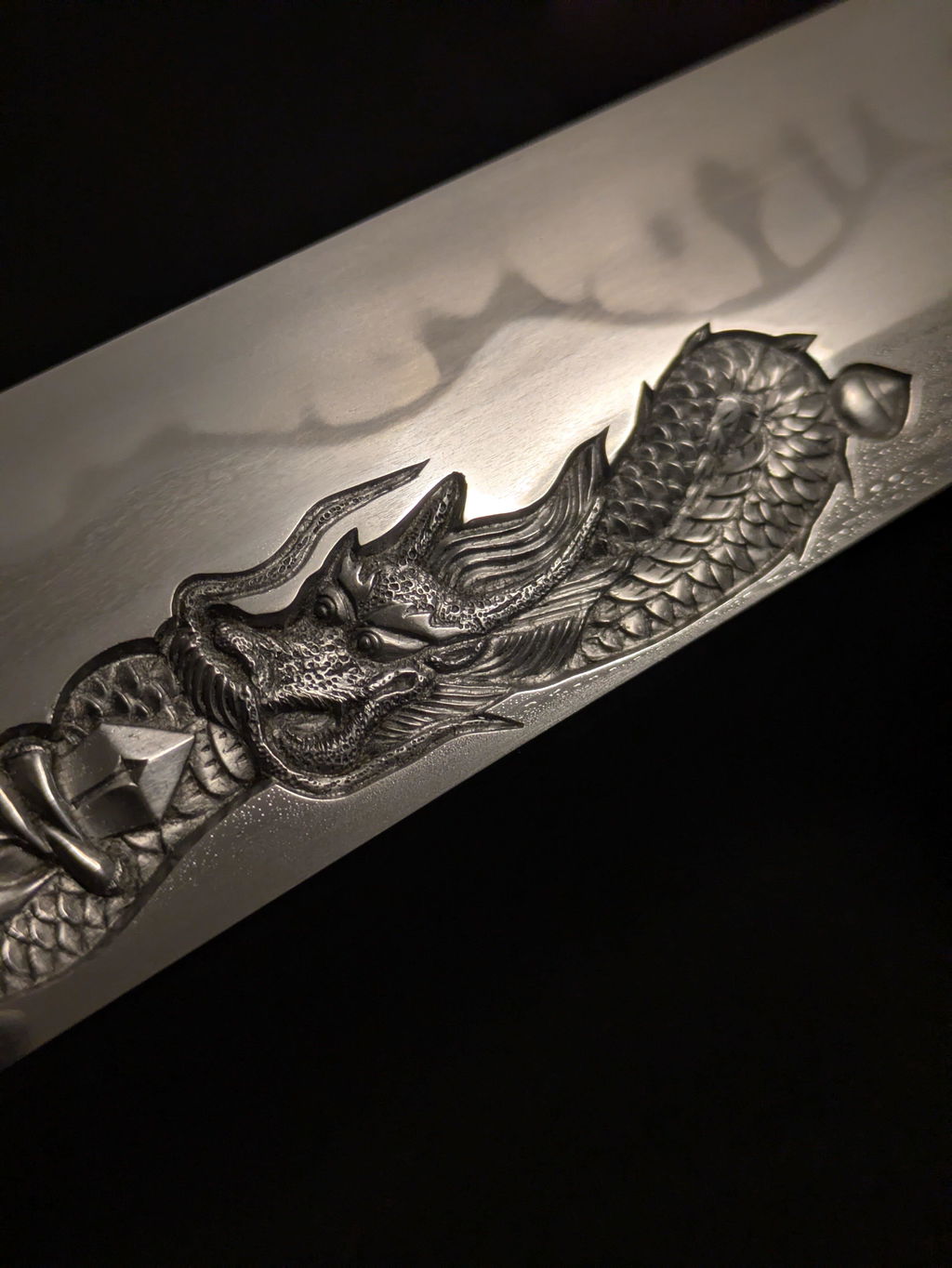
Daisho Set — Taikei Naotane
Katana and Wakizashi · NBTHK Tokubetsu Hozon (both blades)
荘司美濃介直胤 Shoji Minosuke Naotane · Shinshinto Era · Matched pair by the same smith · Shirasaya
A genuine daisho — katana and wakizashi by the same smith, produced as a matched pair — is among the rarest categories in the Shinshinto market. Naotane's total output, spread across fifty years of active forging, includes many individual blades; matched pairs from a single commission are far scarcer. The set currently at Tozando's Shogoin gallery represents exactly this: two blades by one of the Shinshinto period's three greatest smiths, produced together, preserved together, and available together.
The Shogoin gallery is Tozando's dedicated space for significant antique nihonto in central Kyoto — the same gallery that was featured in the JCOM broadcast. Visitors to Kyoto are welcome to contact us to arrange a viewing. International collectors may contact our specialists for detailed photographs, physical specifications, and full documentation of the set.
A daisho by Taikei Naotane does not appear on the market frequently. When one does, it represents an acquisition opportunity that is not simply twice a single Naotane blade — it is a different and rarer object, whose significance as a matched pair is distinct from the significance of its individual components.
A matched pair by one of the Shinshinto period's three masters
Taikei Naotane Daisho —
enquire through Tozando's specialists
This daisho set is held at Tozando's Shogoin gallery in Kyoto. Visitors to Kyoto are welcome to view it in person by appointment. International collectors may contact our specialists for full documentation, detailed photographs, and pricing information.
In Closing — The Smith Who Carried the Argument Forward
Suishinshi Masahide identified what needed to be done and wrote the theoretical case for doing it. Taikei Naotane spent fifty years doing it — working through the Bizen-den and Soshu-den traditions with a sustained technical commitment that produced, in his Tenpo-period best work, blades that many specialists consider the finest Shinshinto achievement in those traditions.
He was not simply a brilliant student who executed his teacher's programme. He was a smith who absorbed that programme and extended it — who took the argument Masahide had made and demonstrated, in steel, that it was correct. The fact that some scholars place his finest Bizen-den work above Masahide's own is not a diminishment of the teacher; it is evidence of how seriously and how completely the student took the lesson.
A matched daisho by Taikei Naotane is not simply two swords. It is a document of the Shinshinto tradition at its highest level — made by a smith who spent half a century proving that the classical tradition's greatest qualities could be recovered, and who proved it decisively.


Leave a comment: