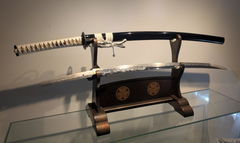
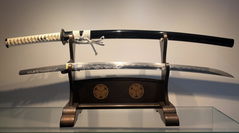
Antique Japanese Wakizashi Sword - Mumei, Shinto Era (36.6 cm)
¥200,000 ¥240,000

An exceptionally healthy and high-class unsigned (mumei) tantō, transmitting to the present day the skill of a master smith active in Musashi Province in the mid-to-late Edo period (around the Tenpō era). It is finely polished and preserved in condition essentially free of flaws or defects. The shirasaya bears a scabbard inscription (sayagaki) by Jirō Tarō Naokatsu (次郎太郎直勝), one of the representative Shinshintō masters of Musashi — his appraisal testifying to the high quality and dignity of the work.
Freshly polished, the blade is in superb, essentially flawless condition. The jigane is a finely and densely packed ko-itame (small wood-grain), so refined and clear that it appears almost grainless (muji-fū). The temper line is based on a clean, upright suguha (straight hamon) with a shallow notare (undulation), covered with fine nie so that the habuchi (temper edge) glows brightly. Its greatest highlight is the vivid yubashiri (drifting patches of nie) appearing within both the temper and the ground, creating a distinctive, shimmering charm and visual appeal.
The tantō has a clean, slender, and elegant figure with plenty of blade-flesh (ha-niku) retained — a powerful, well-made construction with no curvature (mu-sori). The excellence of the shape combined with the exquisite refinement of the steel and temper conveys, when taken in hand, the polished bearing characteristic of a Bakumatsu Edo smith.
The shirasaya bears a sayagaki by Jirō Tarō Naokatsu. Naokatsu was a master smith who — alongside Koyama Munetsugu and Kawai Hisayuki — took the Bakumatsu Musashi (Edo) sword world by storm during the Shinshintō era. This blade closely accords with Naokatsu's own style and technique, and attests to the high forging skill of Musashi Province around the Tenpō era. The blade is fitted with a simple wooden habaki (ki-habaki) that sits snugly against it — unobtrusive, and letting the charm of the blade shine through without disturbing the mood of appreciation.
The sayagaki of the Musashi master Jirō Tarō Naokatsu, and the enchanting yubashiri shimmering across a nie-laden ground and edge — a piece worthy of any collection, offering the refined technique and high dignity of a Bakumatsu Edo blade to the fullest.
¥200,000 ¥240,000

¥400,000 ¥430,000

¥390,000 ¥410,000

¥270,000 ¥290,000

¥300,000 ¥330,000


Every blade reflects generations of knowledge, discipline, and precision passed down through traditional Japanese swordmaking. From the forging of steel to the final finishing touches, each piece is shaped with patience, mastery, and deep respect for heritage.

From carefully selected materials to the refined finishing of every surface, each sword is crafted and presented with uncompromising attention to detail. Our commitment to authenticity ensures every piece reflects true tradition, lasting quality, and enduring cultural value.

Designed with balance, simplicity, and purpose, our blades embody the harmony between refined form and skilled craftsmanship. Each sword represents a thoughtful union of strength, elegance, and the timeless discipline of Japanese artisans.