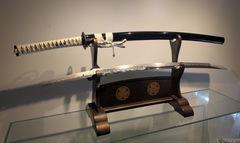
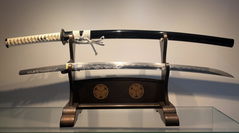
Antique Japanese Wakizashi Sword - Mumei, Shinto Era (36.6 cm)
¥200,000 ¥240,000

This blade has been acquired. Discover other exceptional swords currently available in our collection.


A master smith who cast a singular light on his age: Chikushi Nobukuni, active in Buzen province amid the unsettled winds of the Chōroku era in the mid-Muromachi period. Inheriting the bloodline of the illustrious Yamashiro school while honing his own aesthetic on Kyushu soil, his blades carry a dignity and crisp refinement that take the viewer's breath away. Signed Nobukuni and accompanied by an NBTHK (Nihon Bijutsu Tōken Hozon Kyōkai) Hozon Tōken certificate, it is a supreme piece that satisfies both the eye and the heart.
Freshly polished throughout, the blade is sound and in very fine state of preservation, without damage or major fault. The construction is shōbu-zukuri, uniting beauty with sharpness. The jigane is a densely forged itame, showing the moist, mellow skin characteristic of a kotō (old sword), with activity such as yubashiri ("splashes" of hardened steel) and chikei. The hamon is a hoso-suguha (narrow straight temper) with a bright, clear nioiguchi; ko-nie gather along it and delicate activity spreads within the edge — the high technical skill that is the true hallmark of the Nobukuni school is evident everywhere. The tang (nakago) is firmly cut with the two-character signature Nobukuni, speaking of its long history to the present day. It is preserved in a high-quality shirasaya.
Slightly slender and trim in mihaba, the blade shows to beautiful effect the crisp, keen silhouette that only shōbu-zukuri can give. The line of the mune-kado and the shinogi ridge, sweeping cleanly toward the back like the leaf of an iris (shōbu), is the distinctive form of the old-sword period, in which practicality and functional beauty were pursued to the very limit. The beauty of the shape and its tightly composed bearing are in exquisite balance — an enduring appeal that draws in whoever takes it up.
"Chikushi Nobukuni" refers to the group of smiths — and their leading master — who branched from the Yamashiro Nobukuni school of Yamashiro province (Kyoto) and migrated to and settled in Buzen province around the Chōroku era (1457–1460) of the mid-Muromachi period. Clearly distinguished from the main-line Yamashiro Nobukuni, they came to be called "Chikushi Nobukuni" and won renown as masters in Kyushu. Their refined old-period construction, combining excellent practicality with beauty, is highly esteemed and popular in the appreciation and collecting of swords to this day.
The blade is fitted with a fine gold (gilt) habaki that further sets off its dignity, and is carefully kept, in good order, in a plain wood shirasaya. It is precisely this spare, unadorned shirasaya presentation that lets one fully savor the beautiful lines of the shōbu-zukuri blade and the workmanship of its well-forged ground and edge.
A superb skin, a bright and lucid temper, and a refined shape pared of all excess — each time it is taken in hand it conveys the aesthetic sense of the samurai and the breath of history. A piece that unites value and dignity worthy of being handed down far into the future — an essential one for the enthusiast.
¥200,000 ¥240,000

¥400,000 ¥430,000

¥390,000 ¥410,000

¥270,000 ¥290,000

¥300,000 ¥330,000


Every blade reflects generations of knowledge, discipline, and precision passed down through traditional Japanese swordmaking. From the forging of steel to the final finishing touches, each piece is shaped with patience, mastery, and deep respect for heritage.

From carefully selected materials to the refined finishing of every surface, each sword is crafted and presented with uncompromising attention to detail. Our commitment to authenticity ensures every piece reflects true tradition, lasting quality, and enduring cultural value.

Designed with balance, simplicity, and purpose, our blades embody the harmony between refined form and skilled craftsmanship. Each sword represents a thoughtful union of strength, elegance, and the timeless discipline of Japanese artisans.