Antique Japanese Wakizashi Sword - Mumei, Shinto Era (36.6 cm)
¥200,000 ¥240,000

A signed uchigatana by Kanenobu (兼信) of Tsuyama in Mimasaka Province, a smith believed to belong to the Mino-descended Tsuyama smiths who brought the traditions of Seki to Tsuyama in the early years of the domain. The sayagaki on its shirasaya identifies the maker as "the 4th-generation Minamoto Kanenobu" of the Kan'ei era (1624–1644), and the blade, carrying the breath of the early Edo period, retains a balanced, clear form, with finely cut bō-hi (groove) on both faces lending it a dignified elegance.
On a refined jigane, a calm notare hamon is tempered, and the ubu tang, reflecting the weight of history, bears a powerfully cut long signature. It is accompanied by a han-dachi koshirae in which jet-black fittings engraved with auspicious karakusa (arabesque) harmonize with a vermilion saya showing the lacquer techniques of skilled craftsmen — a fine blade that conveys to the present day the bearing of the samurai house and prayers for longevity and prosperity.
The jigane is a well-packed ko-itame (small wood-grain pattern), showing a refined, clear surface. The hamon is a notare (gently undulating temper line) with a tight nioiguchi, bright and clear along the temper edge. The height of the temper is even, so that at first glance it appears as a calm hamon close to suguha (straight temper line), but a gentle, relaxed notare can be seen.
Freshly polished, the blade is in good overall condition. Within the bō-hi near the habaki, there is a small umegane (inserted steel plug) of about 4 mm. This is a traditional repair of a forging flaw; being located within the groove, it is inconspicuous and does not significantly detract from appreciation. The nakago (tang) shows black patina of age, mixed with a little red rust.
The blade is shinogi-zukuri (ridged construction) with a firm sori (curvature) of 2 cm, tapering gently in width to a chū-kissaki (medium point) — a well-balanced form typical of the Edo period. The kasane (thickness) is well preserved to the tip, and the blade remains sound. Bō-hi are cut on both faces; the grooves end in kaku-dome (squared ends) just above the habaki and run up to near the point. The grooves make the blade light and taut, giving it a neat, refined impression. The nakago has two mekugi-ana (peg holes), and the long signature "Sakushū Tsuyama jū Kanenobu" (作州津山住兼信) is cut on the front.
Tsuyama in Mimasaka Province (present-day northern Okayama Prefecture) became a sword-producing center in the early Edo period, when a group of Seki smiths from Mino Province followed Mori Tadamasa as he took up his fief there. At Tsuyama, smiths of the Kanekage and Kanesaki lines are known, leaving works that carry on the methods of their home province of Mino. Kanenobu, whose name also bears the character "Kane" (兼), is considered to be a smith belonging to this Mino-descended line of Tsuyama smiths. The sayagaki on the shirasaya records "the 4th-generation Minamoto Kanenobu" and "the Kan'ei era," and this work is believed to have been forged in the early Edo period, around the Kan'ei era (1624–1644), in the formative years of the Tsuyama smiths.
A signed blade by a Tsuyama smith with a refined jigane and neatly cut grooves, accompanied by a vermilion-lacquered koshirae with matching auspicious designs and a shirasaya — a well-accomplished blade, suited both to appreciation and to collection.
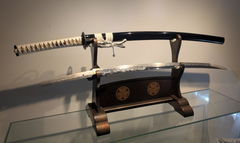
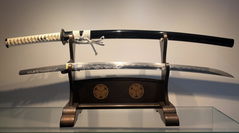
The koshirae is a han-dachi koshirae, which incorporates the fitting designs of a tachi mounting into the form of an uchigatana, worn thrust through the sash. While it has the construction of an uchigatana koshirae, with a kurikata (cord knob) and sageo (cord), the saya carries several band fittings in the manner of semegane, decorated with cloud shapes, and the kojiri (scabbard end) is covered long in metal like the ishizuki of a tachi. All fittings are unified with the same karakusa engraving and gold edging, forming a distinguished matching set.
The blade is housed in a vermilion-lacquered saya resembling cherry bark. Patterns of lines and dots representing the horizontal striations peculiar to tree bark and the fine lenticels (bark pores) are applied over the entire surface, and together with a deep reddish-brown tone as if aged over long years, it appears to have been meticulously rendered by hand using lacquer techniques. Unlike sakura-kawa-maki, in which actual bark is applied, rendering it in lacquer achieves a finish calculated down to the beauty of the whole saya's form and its harmony with the fittings. The gold-colored areas seen in various places on the saya are repairs of chips and scratches in the lacquer made with gold. These repair marks blend into the vermilion ground as a natural scenery, conveying the history of a koshirae that has long been used and cherished.
From the fuchi-kashira to the koiguchi, semegane, kurikata, and kojiri, the black-ground fittings are finely engraved in kebori (line engraving) with karakusa and edged with gold fukurin (rims). The kashira has a cloud-shaped window revealing the ray skin beneath. The endlessly extending karakusa is regarded as an auspicious pattern praying for the lasting prosperity and longevity of the family, by a play on words linking "man" (vine) to "ten thousand" and "tai" (band) to "generations," forming "bandai" (ten thousand generations). The menuki (hilt ornaments) beneath the tsuka-ito depict a "dragon," revered as the highest-ranking guardian deity that drives away evil and brings its owner fortune in contests and prosperity, adding a powerful accent to the hilt.
The tsuba (hand guard) has inome (heart-shaped openings) pierced above and below the nakago-ana, and warabite (bracken-shoot scrolls) to the left and right, with a wave pattern engraved in kebori on the ground. The heart-shaped inome has long been regarded as a talisman against evil and fire, and is also said to invite good fortune; it was used on the gable ornaments (gegyo) of shrines and temples, and is also said to express the ferocity of the wild boar, which charges fiercely when challenged. Warabite is a design that curls like the tip of a freshly sprouted bracken shoot, and has been loved in many crafts as a pattern evoking vitality and new growth.
The blade is also accompanied by a shirasaya (plain wood resting scabbard) bearing a sayagaki written in sumi ink.
A sound blade conveying the style of the early-Edo Tsuyama smiths, together with karakusa-engraved fittings praying for prosperity through ten thousand generations and a vermilion-lacquered han-dachi koshirae that has absorbed even its accumulated repairs as part of its scenery, further deepens the joy of ownership. We recommend it as a work full of the pleasure of collecting, in which you can savor not only the blade itself but also the history held in the designs and repairs of its koshirae.
¥200,000 ¥240,000

¥400,000 ¥430,000

¥390,000 ¥410,000

¥270,000 ¥290,000

¥300,000 ¥330,000


Every blade reflects generations of knowledge, discipline, and precision passed down through traditional Japanese swordmaking. From the forging of steel to the final finishing touches, each piece is shaped with patience, mastery, and deep respect for heritage.

From carefully selected materials to the refined finishing of every surface, each sword is crafted and presented with uncompromising attention to detail. Our commitment to authenticity ensures every piece reflects true tradition, lasting quality, and enduring cultural value.

Designed with balance, simplicity, and purpose, our blades embody the harmony between refined form and skilled craftsmanship. Each sword represents a thoughtful union of strength, elegance, and the timeless discipline of Japanese artisans.