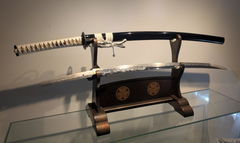
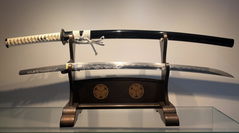
Antique Japanese Wakizashi Sword - Mumei, Shinto Era (36.6 cm)
¥200,000 ¥240,000

A signed sankaku yari (triangular-section spear) by the 5th-generation Tsunahiro of the distinguished Tsunahiro line, who wielded his brilliant skill in the land of Sagami in the early Edo period, around the Manji era, when the martial spirit was still strictly upheld. A Tokubetsu Hozon Tōken (Especially Worthy of Preservation) certificate from the NBTHK (Nihon Bijutsu Tōken Hozon Kyōkai) attests to its sure provenance, and its flawless appearance, retaining its original form from the time of its making, radiates a quiet dignity.
The construction of the sankaku yari, with its three sharp faces built with unerring precision, is functional beauty itself, rationally pursuing overwhelming penetrating power in actual combat. On a jigane of finely packed ko-itame-hada, a suguha with delicately intertwining ko-nie shines with dignified clarity. The graceful bō-hi (single groove) cut on the back, together with an extremely sound condition that shows no sign of later wear, conveys the tradition of the Sōshū smiths to the present day.
The jigane is a fine ko-itame-hada (small wood-grain pattern), beautifully and tightly packed, in which the refined techniques of the early Edo period live on while carrying on the tradition of the Sōshū school. Fine ji-nie adhere evenly and fine chikei (dark lines within the steel) intertwine as if flowing, showing a tight, dignified surface.
The hamon is based on a dignified ko-nie-deki suguha (straight temper line of small nie), and the temper edge is bright and clear. Freshly polished, it maintains a sound condition without any fatal defects.
It presents the construction of an authentic "sankaku yari" (triangular-section spear), with a superb point and three sharply joined cutting faces. It is a form full of dignity, in which high forging skill dwells within a functional beauty stripped of all excess. Furthermore, a graceful "bō-hi" (single groove) is cleanly cut on the back, improving the overall weight balance while adding a refined visual accent. The nakago (tang) is signed "Tsunahiro" (綱廣). The deeply flavored color of the old patina (ko-sabi) matured over long ages quietly tells of its long history.
The name "Tsunahiro" originates in the Sengoku period, when the founder of the line served the Gohōjō (Odawara Hōjō) clan and received the character "Tsuna" (綱) from Hōjō Ujitsuna, the clan's second head.
The Sōshū tradition, which flourished in Kamakura during the Kamakura period, entered the era known as "Sue-Sōshū" (late Sōshū) from the Muromachi period onward, when the center of smithing moved from Kamakura to Odawara. The Tsunahiro line is the representative school of this Sue-Sōshū era. After the fall of the Odawara Hōjō, the line is said to have been taken into the service of Tokugawa Ieyasu, and thereafter to have worked throughout the Edo period as swordsmiths in direct service to the Tokugawa (jikisan).
The 5th-generation Tsunahiro, active in the early Edo period and recipient of the title Ise Daijō in Manji 3 (1660), is a master smith praised as "the finest smith of the family" and "the most skilled of the Shintō Tsunahiro," and he is ranked as a Shintō jōsaku (superior smith) and his blades as wazamono for their cutting ability. Backed by its Tokubetsu Hozon Tōken appraisal, this work conveys in its purest form the outstanding skill of the 5th-generation Tsunahiro and the pride of the Sōshū smiths.
It is accompanied by a dedicated shirasaya (plain wood resting scabbard), suited to protecting and preserving the blade, and a short tsuka (handle) for appreciation and display.
The dignity of a suguha shining with ko-nie on a dense ko-itame-hada, and the overwhelming functional beauty unique to a sankaku yari. Its sure pedigree, proven by its Tokubetsu Hozon Tōken certificate, and its perfectly flawless soundness, undiminished even after several hundred years, speak of the true value of this work. Spears are a rare offering among our collection, which consists mostly of swords, and the last spear we listed — a different piece — sold immediately. We warmly invite you to take this opportunity to add this yari to your own collection.
¥200,000 ¥240,000

¥400,000 ¥430,000

¥390,000 ¥410,000

¥270,000 ¥290,000

¥300,000 ¥330,000


Every blade reflects generations of knowledge, discipline, and precision passed down through traditional Japanese swordmaking. From the forging of steel to the final finishing touches, each piece is shaped with patience, mastery, and deep respect for heritage.

From carefully selected materials to the refined finishing of every surface, each sword is crafted and presented with uncompromising attention to detail. Our commitment to authenticity ensures every piece reflects true tradition, lasting quality, and enduring cultural value.

Designed with balance, simplicity, and purpose, our blades embody the harmony between refined form and skilled craftsmanship. Each sword represents a thoughtful union of strength, elegance, and the timeless discipline of Japanese artisans.