Antique Japanese Wakizashi Sword - Mumei, Shinto Era (36.6 cm)
¥200,000 ¥240,000

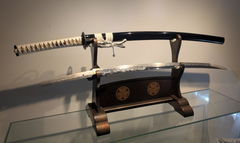
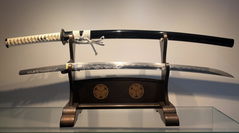
A blade bearing the name of a line descended from Masamune — a name so treasured that it was folded back to preserve it. This katana is signed "Kaneuji" (兼氏), the celebrated Mino smithing name that began with Shizu Saburō Kaneuji, counted among the "Masamune Juttetsu" (Ten Great Disciples of Masamune). The sayagaki on its shirasaya dates the blade to around the Ōei era (1394–1428) of the early Muromachi period. Its hamon, a notare (undulating temper line) mixed with gunome and togariba (pointed elements), combines expansiveness with sharpness, and a dignified bō-hi (groove) runs along the blade. Its tang, on which the signature was not cut away when the blade was shortened but instead folded back, bears witness to the deep respect that generations of samurai held for this sword. The koshirae is a first-class same-zaya koshirae, with a polished-out saya of kairagi ray skin that looks like plum blossoms in full bloom, and fittings unified in a cloud-and-dragon design.
The jigane is a well-forged, tightly packed itame (wood-grain pattern) with ji-nie, showing a moist, lustrous surface. The hamon is a generous midare based on a notare with a bright nioiguchi and mixed with gunome, its relaxed waves continuing powerfully from the base to the tip. Here and there, sharply pointed "togariba" appear, adding taut variation to the calm notare. This combination of notare, gunome, and togariba is also a characteristic seen in Kaneuji and the Mino smiths who followed his tradition — a rewarding temper pattern that unites expansiveness and sharpness. The bōshi (tip temper) undulates along the point and turns back in a ko-maru (small round).
The blade has been polished and remains sound in both ji and ha. The nakago (tang) shows a calm rust color that conveys its age.
The blade is shinogi-zukuri (ridged construction) with an iori-mune (peaked back), with an edge length of 67.3 cm (approx. 2 shaku 2 sun 2 bu) and a pleasing sori (curvature) of 2.1 cm. The width tapers from a motohaba of 28.4 mm to a sakihaba of 19.0 mm, ending in a chū-kissaki (medium point) — a well-balanced, beautiful form. The kasane (thickness) is 5.7 mm at the base and 4.1 mm at the tip. Bō-hi are cut on both faces, running down into the tang (kaki-nagashi). The blade weighs 510 g alone and 780 g in its mounting (without the scabbard). Helped by the grooves, it feels light and lively in the hand and is easy to handle.
The nakago has been greatly shortened (suriage) and has four mekugi-ana (peg holes), two of which are covered by the folded-back signature. Most noteworthy is that the signature is an "orikaeshi-mei" (folded-back signature). Many old tachi and katana were later shortened to suit the physique and fighting style of their users, and their signatures were often lost in the process. In this blade, the signed portion was not cut off but thinned and carefully folded back onto the reverse of the tang, preserving the maker's name to this day. This treatment, requiring considerable skill and effort, is evidence that successive owners held this sword in special esteem as "a work of Kaneuji" and were determined to preserve that name — a tang that tells a story, engraved with the respect of the samurai.
Kaneuji is a smithing name that laid the foundations of the Mino tradition. The first Kaneuji came from the Tegai school of his native Yamato Province, where he signed as "Kaneuji" (包氏). He later moved to Shizu in Mino Province, changed his name to Kaneuji (兼氏), and became known as "Shizu Saburō Kaneuji." He is further said to have studied under Masamune of Sagami, regarded as one of the greatest swordsmiths in Japanese history, and is counted among his foremost pupils, the "Masamune Juttetsu." His style, adding the brilliance of the Sōshū tradition to the steadiness of the Yamato tradition, became the source of the Mino tradition, which would later produce numerous master smiths, including "Seki no Magoroku."
After Kaneuji's death, his students moved to Naoe village in Mino Province and formed a school known as "Naoe Shizu," which flourished from the Nanboku-chō period into the Muromachi period. The Kaneuji name was carried on in later generations and long cherished by the smiths of Mino. This blade bears a name standing at the pivot of the great lineage of Japanese swordsmithing that runs from Masamune to the Mino tradition.
The other star of this sword is its koshirae, with a togidashi same-zaya (polished-out ray-skin scabbard) made of kairagi ray skin. Kairagi refers to the hard, granular nodules on the back of a species of ray; the name, written with characters meaning "plum-blossom skin," comes from the resemblance of its pattern to plum blossoms, and it has long been highly prized for decoration. By covering the saya with the ray skin, applying many layers of lacquer, and then polishing them back, each nodule emerges like a plum blossom. It is a luxurious technique that requires much time and great skill to complete. On this saya, a brilliant scene unfolds as if plum blossoms were in full bloom across its entire surface. Without major damage from age, it is a first-class piece conveying the appeal of the same-zaya koshirae, popular since its own time. A navy-and-white sageo (cord) tastefully sets off its splendor.
The tsuba, fuchi-kashira, and menuki are all unified in a dragon design. The round iron tsuba powerfully depicts, in nikubori (carved relief), a dragon writhing among the clouds, with gold inlay sparkling on the clouds and waves. The dragon has been revered as a sacred being governing water, bringing rain and abundance, and as a symbol of strength and protection. The "unryū" (cloud-and-dragon) motif, combining clouds and a dragon, expresses the momentum of ascending to the heavens and a mysterious power, with a heroic quality befitting a sword worn at a samurai's side.
The splendid plum-blossom scenery of the saya and the valiant dragon of the fittings — this koshirae, harmonizing elegance and strength superbly, condenses the aesthetic sense of the samurai and is worthy of appreciation in its own right. The habaki is a kinkise (gold-foil-covered) habaki with diagonal file marks, and a shirasaya (plain wood resting scabbard) for storage is also included, bearing a sayagaki written in sumi ink, which records the two-character orikaeshi-mei and dates the blade to around the Ōei era. With blade, koshirae, and shirasaya all present, this is a highly complete sword.
The signature of a name linking Masamune to the Mino tradition, a folded-back signature protected by generations of samurai, and a first-class koshirae woven from kairagi ray skin and cloud dragons — a sword full of story, in which both blade and koshirae take the leading role. We warmly invite you to welcome this sword, handed down across many ages, into your hands as its next owner.
¥200,000 ¥240,000

¥400,000 ¥430,000

¥390,000 ¥410,000

¥270,000 ¥290,000

¥300,000 ¥330,000


Every blade reflects generations of knowledge, discipline, and precision passed down through traditional Japanese swordmaking. From the forging of steel to the final finishing touches, each piece is shaped with patience, mastery, and deep respect for heritage.

From carefully selected materials to the refined finishing of every surface, each sword is crafted and presented with uncompromising attention to detail. Our commitment to authenticity ensures every piece reflects true tradition, lasting quality, and enduring cultural value.

Designed with balance, simplicity, and purpose, our blades embody the harmony between refined form and skilled craftsmanship. Each sword represents a thoughtful union of strength, elegance, and the timeless discipline of Japanese artisans.