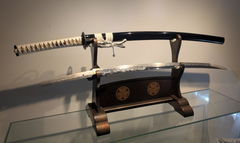
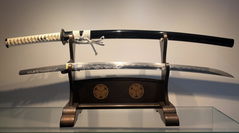
Antique Japanese Wakizashi Sword - Mumei, Shinto Era (36.6 cm)
¥200,000 ¥240,000

Born as a tachi and passed through the hands of samurai for six hundred years — a blade by the smith who stands at the source of Seki's distinguished lineage. This is a signed katana by Kaneyoshi (兼吉), renowned as the founder of the Zenjō school, the largest of the Seki Shichiryū (Seven Schools of Seki) of Mino. It is accompanied by a Hozon Tōken (Worthy of Preservation) certificate from the NBTHK (Nihon Bijutsu Tōken Hozon Kyōkai). Forged in the early Muromachi period, around the Ōei to Eikyō eras, this blade is thought to have originally been a long tachi worn slung at a samurai's waist. Although it was later shortened (suriage) for use as an uchigatana and its form was changed, it still retains a length of over 2 shaku 3 sun and carries the lingering elegance of a tachi to this day.
Even after six hundred years, this blade has not lost its fresh, moist luster. The jigane is an itame (wood-grain pattern) mixed with mokume (burl-grain), a well-forged, tightly packed, and refined steel, covered throughout with fine ji-nie, showing a moist surface of great depth. Masame (straight grain) characteristic of Mino blades flows in the shinogi-ji, and a faint shirake-gokoro utsuri (whitish reflection) rises toward the edge, conveying the depth unique to kotō (old swords). The hamon is a suguha (straight temper line) with a crisply tight nioiguchi. The temper, of even width and running bright and clear in a single line from the base to the point, could only be achieved by a smith of sure skill. It is a dignified style characteristic of Kaneyoshi, who carried the blood of the Yamato tradition, captivating not through flamboyance but through the beauty of the ji and ha themselves. The bōshi (tip temper) follows the point and turns back elegantly in a round manner.
The blade has been polished, and there are no conspicuous flaws or rust in either ji or ha; it is in nearly flawless, very sound condition. Old blades often show polish-wear or fatigue (tsukare) over the long years, but this blade splendidly retains its moist jigane and brilliant edge. The nakago (tang) is covered with a calm rust color that tells of its history.
The blade is shinogi-zukuri (ridged construction) with an iori-mune (peaked back), with an edge length of 2 shaku 3 sun 4 bu (approx. 70.9 cm) and a sori (curvature) of 5 bu 5 rin (approx. 1.67 cm). The width tapers markedly from a motohaba of 29.1 mm to a sakihaba of 17.4 mm, ending in a ko-kissaki (small point) — the very elegant form seen in tachi of the early Muromachi period around the Ōei era. The kasane (thickness) is 7.4 mm at the base and 5.3 mm at the tip, remaining solid all the way to the point, and the blade keeps a sound construction with little polish-wear. The blade alone weighs 730 g, conveying a pleasant weight in the hand.
The nakago has been shortened with machi-okuri (moving the notches), and has three mekugi-ana (peg holes), one of which is plugged. Kotō tachi were often shortened in later periods for use as uchigatana, and their signatures were frequently lost in the process. This blade, however, firmly retains the two-character signature "Kaneyoshi" near the end of the tang. Furthermore, since it still keeps a length of over 2 shaku 3 sun even after shortening, it can be inferred that it was originally an exceptionally long and imposing tachi. A blade that conveys the weight of history, passing on to the present the name of its maker and the lingering elegance of a tachi, even as its form was changed in the hands of samurai.
Kaneyoshi was one of the smiths who laid the foundations of Seki, the capital of swordsmithing. He is known as the founder of the Zenjō school, the largest of the "Seki Shichiryū," the groups of smiths that flourished in Seki. His native province was Yamato, and he is said to have been the same person as, or the son of, Kaneyoshi (包吉) of the Tegai school. His given name was Seijirō and his Buddhist name was Zenjō, which became the name of the school itself. His works are recorded from Kōō 1 (1389), at the end of the Nanboku-chō period, through the Ōei era of the early Muromachi period, and he is regarded as one of the finest smiths of Mino Province.
Kaneyoshi's works follow the Yamato tradition and excel in suguha. His style is characterized by a well-forged jigane and an elegant temper, strongly retaining the character of Yamato. The name Kaneyoshi was carried on by several generations, and the Zenjō school produced numerous master smiths, including Magoroku Kanemoto, famed as "Seki no Magoroku," and Kanefusa. Kaneyoshi, in other words, is a smith who stands at the source of the distinguished lineage of Mino blades that would later win great renown.
The blade is housed in a shirasaya (plain wood resting scabbard) for safe storage, bearing a sayagaki written in sumi ink. The habaki is a single-layer copper habaki. The registration certificate was issued by the Gifu Prefectural Board of Education on March 31, 1951 (Shōwa 26). This places the blade among the swords registered at the very beginning of the sword registration system, so-called "daimyō tōroku" (early registration), which speaks to a long history of careful preservation.
From the age when it was worn as a tachi to the age when it was carried as an uchigatana, this blade has passed through the hands of many samurai while preserving its maker's name and its brilliant edge. The signature of Kaneyoshi, founder of the Zenjō school; a Hozon Tōken certificate; and an early "daimyō tōroku" registration — a signed kotō blade carrying six hundred years of history, with a sure maker, a sure appraisal, and a sure provenance. We invite you to feel in your own hands the weight of a blade to which samurai entrusted their lives.
¥200,000 ¥240,000

¥400,000 ¥430,000

¥390,000 ¥410,000

¥270,000 ¥290,000

¥300,000 ¥330,000


Every blade reflects generations of knowledge, discipline, and precision passed down through traditional Japanese swordmaking. From the forging of steel to the final finishing touches, each piece is shaped with patience, mastery, and deep respect for heritage.

From carefully selected materials to the refined finishing of every surface, each sword is crafted and presented with uncompromising attention to detail. Our commitment to authenticity ensures every piece reflects true tradition, lasting quality, and enduring cultural value.

Designed with balance, simplicity, and purpose, our blades embody the harmony between refined form and skilled craftsmanship. Each sword represents a thoughtful union of strength, elegance, and the timeless discipline of Japanese artisans.