Antique Japanese Wakizashi Sword - Mumei, Shinto Era (36.6 cm)
¥200,000 ¥240,000

A masterpiece wakizashi conveying the lineage of Minamoto Shigetane, a master smith representative of the Shinshintō period, in which the battle-readiness demanded by the age and a highly refined aesthetic sense are fused at a high level. A kanteisho (certificate of appraisal) by Tokunō Kazuo attests to its sure pedigree, and the bearing of its tang, which strongly retains its original form from the time of its making, radiates a quiet dignity.
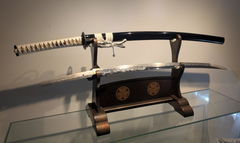
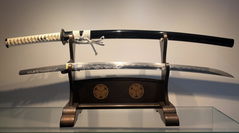
Its hira-zukuri (flat, ridgeless) form, with an overwhelming kasane (thickness) of about 9 mm relative to its mihaba (width), embodies the weighty power and toughness characteristic of a custom-order blade. On the blade, a graceful bō-hi with soe-bi (groove with a companion groove) is cut on one face, and a Bonji (Sanskrit character) with a suken (straight sword) on the other as a sacred carving, while a gunome-midare hamon with ko-nie shines brilliantly on a moist ko-itame-hada. Together with a period koshirae bringing together designs of waves, a dragon, and a dragonfly, it is a supreme collector's piece conveying the romance of history and the spirit of the samurai house.
The jigane is a finely packed ko-itame-hada (small wood-grain pattern) that flows beautifully throughout, gently mixed here and there with larger grain (ō-hada) and mokume (burl-grain). Fine ji-nie adhere thickly to it and fine chikei (dark lines within the steel) intertwine gracefully, presenting a superb, dark, tight, and moist texture.
The hamon is based on ko-nie-deki (small nie), tempered as a "gunome-midare" (irregular clove-shaped pattern) drawing waves of varied height, and the temper edge is bright and clear. Within the hamon, ashi, yō, and fine kinsuji run through, displaying rich variation and movement. The bōshi (tip temper) undulates toward the point and presents the appearance of a distinctive "jizō bōshi," in which the head swells out roundly before turning back deeply. Freshly polished, it maintains a very sound condition without any fatal defects.
While taking the dimensions of a wakizashi, this blade presents a weighty "hira-zukuri" (flat, ridgeless) form with a remarkable kasane of about 9 mm relative to its mihaba. This is a finish characteristic of a "custom-order blade" (chūmon-uchi), specially commissioned by its owner of the time in pursuit of battle-readiness and robustness, and with its full hiraniku (convex surface), it radiates an overwhelming sense of volume with a satisfying feel in the hand. The nakago (tang) is ubu mumei (unaltered and unsigned), and its deeply flavored old patina (ko-sabi), matured over long ages, quietly tells of its long history.
The late Edo period was a turbulent age leading from the Shintō to the Shinshintō period and on to the Bakumatsu. In Musashi Province, the center of politics and the martial arts, skilled swordsmiths gathered from all over the country and competed in their sword-making to meet the pressing demands of the times.
In that Shinshintō period, Minamoto Shigetane (重胤) entered the school of the Edo master Taikei Naotane (大慶直胤) and was highly regarded as "the finest master" among his many senior pupils. Originally a samurai of the Shirakawa domain in Ōshū, he had an unusual background; coming to Edo, he mastered under Naotane outstanding forging methods and the techniques of utsushi (interpretations) of kotō blades. While possessing a rare ability to recreate kotō and a versatile style inherited from his master (such as gunome-midare and suguha), few of his works survive, and he is known as an extremely rare presence on the market.
Attributed in the appraisal by Tokunō Kazuo as rightfully carrying on the lineage of this master smith, this work truly embodies, in the finest form, the high craftsmanship of Shigetane.
Furthermore, a finely detailed carving showing the outstanding skill of the craftsman has been cut into the lower part of the blade in shizumebori (incised carving): a "suken" (straight sword), symbolizing the sword of Fudō Myōō that shatters worldly desires and evil intentions, together with the shuji (Bonji) "Kān" representing Fudō Myōō, powerfully carved above it. This sacred carving, embodying divine protection and powerful evil-shattering force, raises to the utmost both the deep faith of the samurai praying for safety in actual combat and the rare artistic highlights of the blade. On the other face, a graceful bō-hi with soe-bi (groove with a companion groove) is cut.
The period koshirae housing this blade is a luxurious finish in which advanced metalworking techniques and the deep prayers of the samurai house dwell down to the finest details. The saya (scabbard) is colored in a beautiful two-tone contrast, with fine kizami (ribbed carving) and patterns applied near the hand and the koiguchi (scabbard mouth). It is an excellent mounting that combines practical durability with refined beauty at the waist.
The fuchi-kashira express a pattern of "waves" powerfully overcoming rough seas. The ceaselessly breaking waves are symbols of "overcoming hardship" and "the prosperity of the family," and carry the meaning of warding off evil, always keeping the owner's heart pure.
The kojiri (scabbard end fitting), which protects the bottom of the saya, is powerfully carved with a "dragon," the mightiest sacred beast that races through the heavens and grasps the sacred jewel, together with swirling clouds. The dragon has been revered as the highest-ranking guardian deity and as an auspicious emblem that drives away evil and brings the owner boundless fortune in contests and prosperity.
The tsuba (hand guard), which protects the hand, depicts a "dragonfly," known since ancient times as the "kachimushi" (victory insect) and a symbol of the samurai spirit, which never retreats and only advances. A strong prayer for unyielding fighting spirit and for drawing victory reaches into every corner of this blade.
The kanteisho (certificate of appraisal) accompanying this blade was issued by Tokunō Kazuo (1933–2002), a sword researcher and connoisseur. It is a personal appraisal by Mr. Tokunō and is distinct from the certificates issued by the NBTHK (Nihon Bijutsu Tōken Hozon Kyōkai).
Born in Toyama Prefecture, Tokunō came to Tokyo as a young man with the aim of devoting himself to the study of swords. After learning the fundamentals of sword appraisal under Kondō Kakudō, he continued to refine his expertise at study groups throughout Japan. In 1972 (Shōwa 47), he founded and led the Tōken Kenkyū Rengōkai (Sword Research Federation, known as "Tōren"), and he served in positions including registration examiner for the Agency for Cultural Affairs and representative of the Dentō Tōsō Kōgeikai (Traditional Sword Fittings Crafts Association). His books — beginning with Tōkō Taikan, a comprehensive directory of swordsmiths' signatures and careers, as well as Nihontō Zukan and Tōkensho Jiten — remain widely used as fundamental references by sword enthusiasts and researchers today.
This blade, though unsigned, was attributed to Minamoto Shigetane by Mr. Tokunō, drawing on his wealth of connoisseurship experience.
The unique presence radiated by a gunome-midare shining with ko-nie on a richly moist jigane and a weighty hira-zukuri form. The lineage of a master smith, backed by the certificate of Tokunō Kazuo, and a spirit handed down across the ages are condensed in this single blade. Together with the aesthetic sense dwelling in its period koshirae, please savor in your own hands the deep romance of history.
¥200,000 ¥240,000

¥400,000 ¥430,000

¥390,000 ¥410,000

¥270,000 ¥290,000

¥300,000 ¥330,000


Every blade reflects generations of knowledge, discipline, and precision passed down through traditional Japanese swordmaking. From the forging of steel to the final finishing touches, each piece is shaped with patience, mastery, and deep respect for heritage.

From carefully selected materials to the refined finishing of every surface, each sword is crafted and presented with uncompromising attention to detail. Our commitment to authenticity ensures every piece reflects true tradition, lasting quality, and enduring cultural value.

Designed with balance, simplicity, and purpose, our blades embody the harmony between refined form and skilled craftsmanship. Each sword represents a thoughtful union of strength, elegance, and the timeless discipline of Japanese artisans.