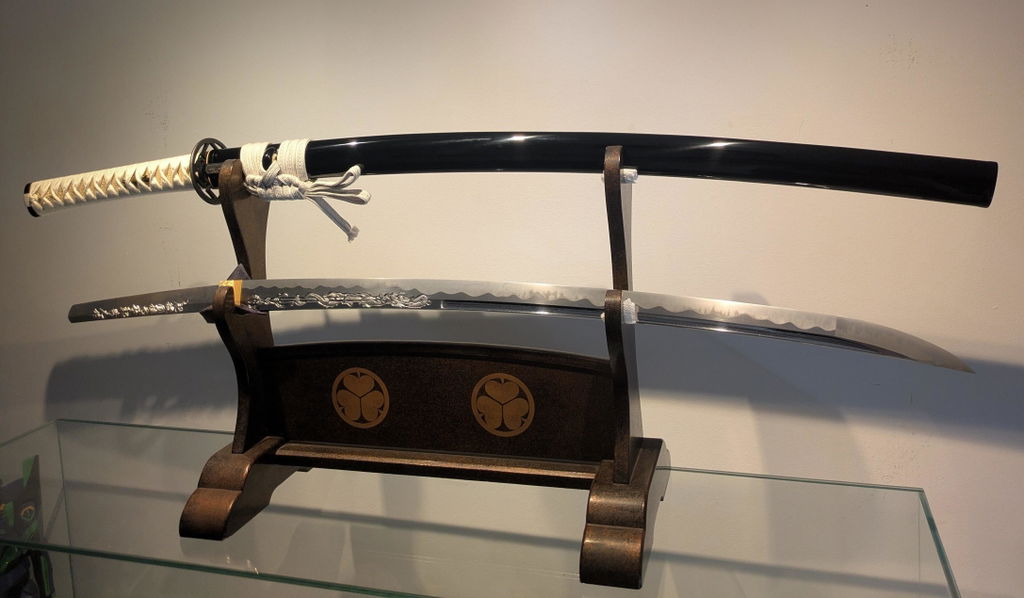
Antique Japanese Katana Sword - Mumei, Shinshinto Era - NBTHK Hozon Token(73.2 cm)
¥1,100,000 ¥1,150,000

We are proud to offer a katana by Suishinshi Masahide (水心子正秀) — the first-generation master, working under his own name Kawabe Gihachirō (川部儀八郎) — who is revered as the founder (kaiso) of the shinshintō ("new-new sword") era. Alongside his pupil Taikei Naotane and the later genius Minamoto Kiyomaro, Masahide is counted among the "Edo San-saku" (江戸三作), the three greatest swordsmiths of Edo; a landmark exhibition marking the 200th anniversary of his death was held at the Japanese Sword Museum in 2025. This blade is signed in full and dated to Bunka 12 (1815), the height of his powers, and the tang preserves both his cursive monogram (kaō) and his stamp (kokuin) with exceptional clarity. It has been certified by the NBTHK as a Tokubetsu Hozon Tōken (Especially Worthy of Preservation).
"Kawabe Gihachirō Fujiwara Masahide" is the full formal signature of the first-generation Suishinshi Masahide, whose name resounds through sword history as the founder of the shinshintō movement. Serving the Akimoto daimyō family, he came to believe that the swords of his own day had drifted into showy, impractical decoration, and he called for a return to the sound, functional craftsmanship of the old kotō masters of the Kamakura and Nanbokuchō periods — the fukkotō ("sword revival") theory. He not only preached it but wrote treatises on smithing and trained a huge school said to number more than a hundred pupils, forging robust, healthy, genuinely serviceable blades of the highest order. The year of this work, Bunka 12 (1815), falls in the mature period when his revival theory and technique had come to full fruition and his influence over the sword world was at its peak.
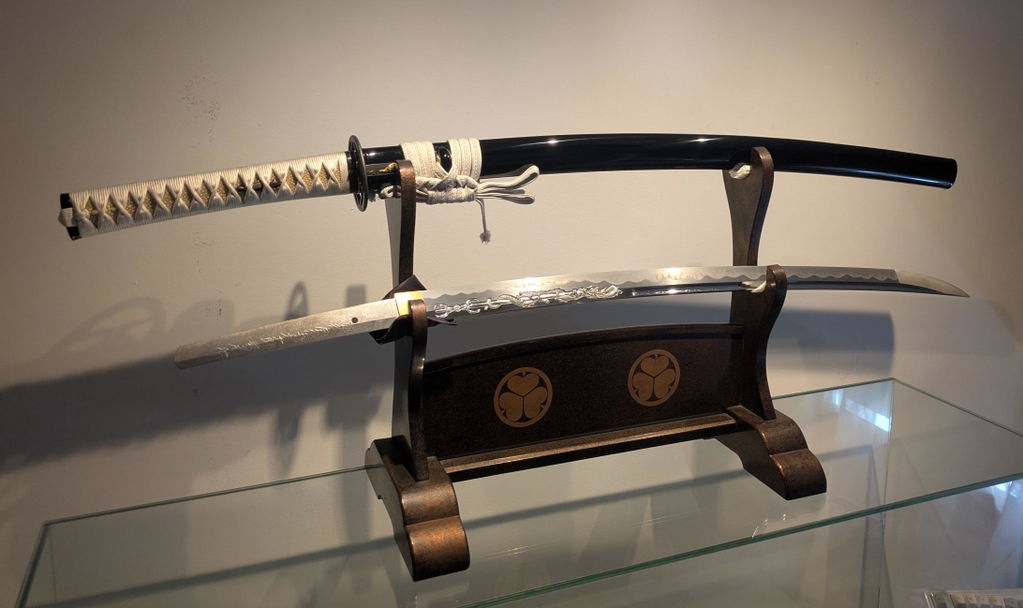
The blade is in excellent polish, and the clarity of both ji and ha can be enjoyed to the full. The jigane is a finely, densely packed ko-nuka-hada (fine "rice-bran" grain), with minute ji-nie laid evenly across the surface, giving the transparent, crystalline brightness that is the hallmark of the best shinshintō work. The hamon is a ko-gunome mixed with ko-chōji and carrying a gentle notare undulation, its ko-nie forming neatly and finely along a bright habuchi. The balance of a luminous temper line and delicate, orderly activity makes for a serene, dignified result worthy of a master's hand.
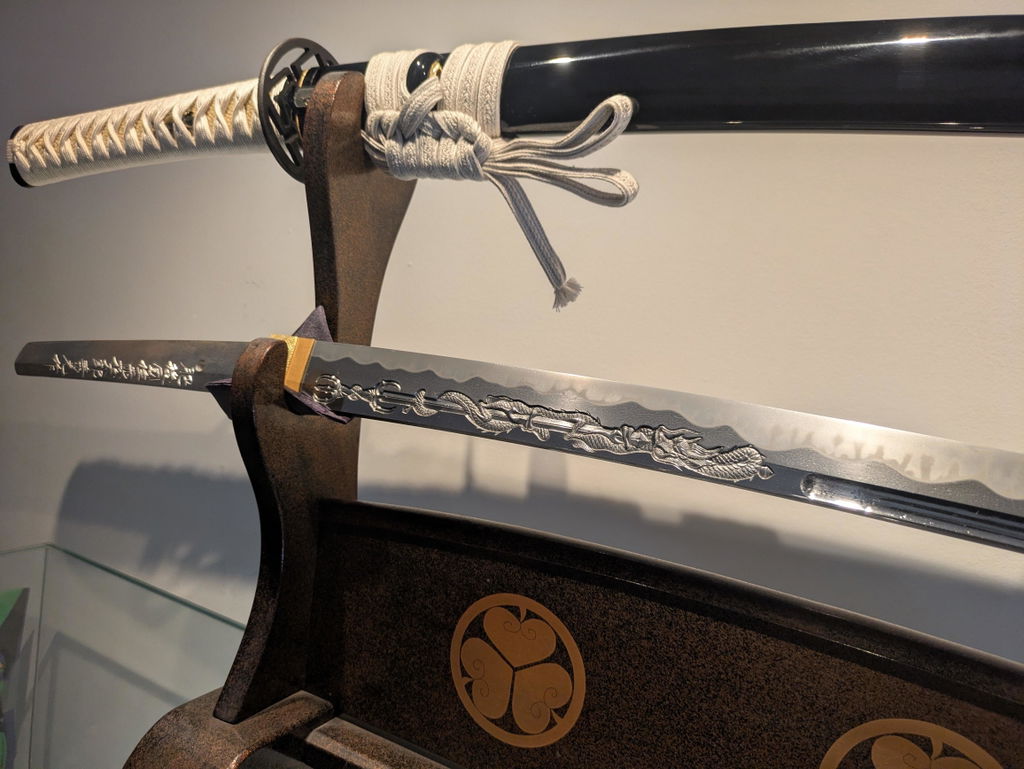
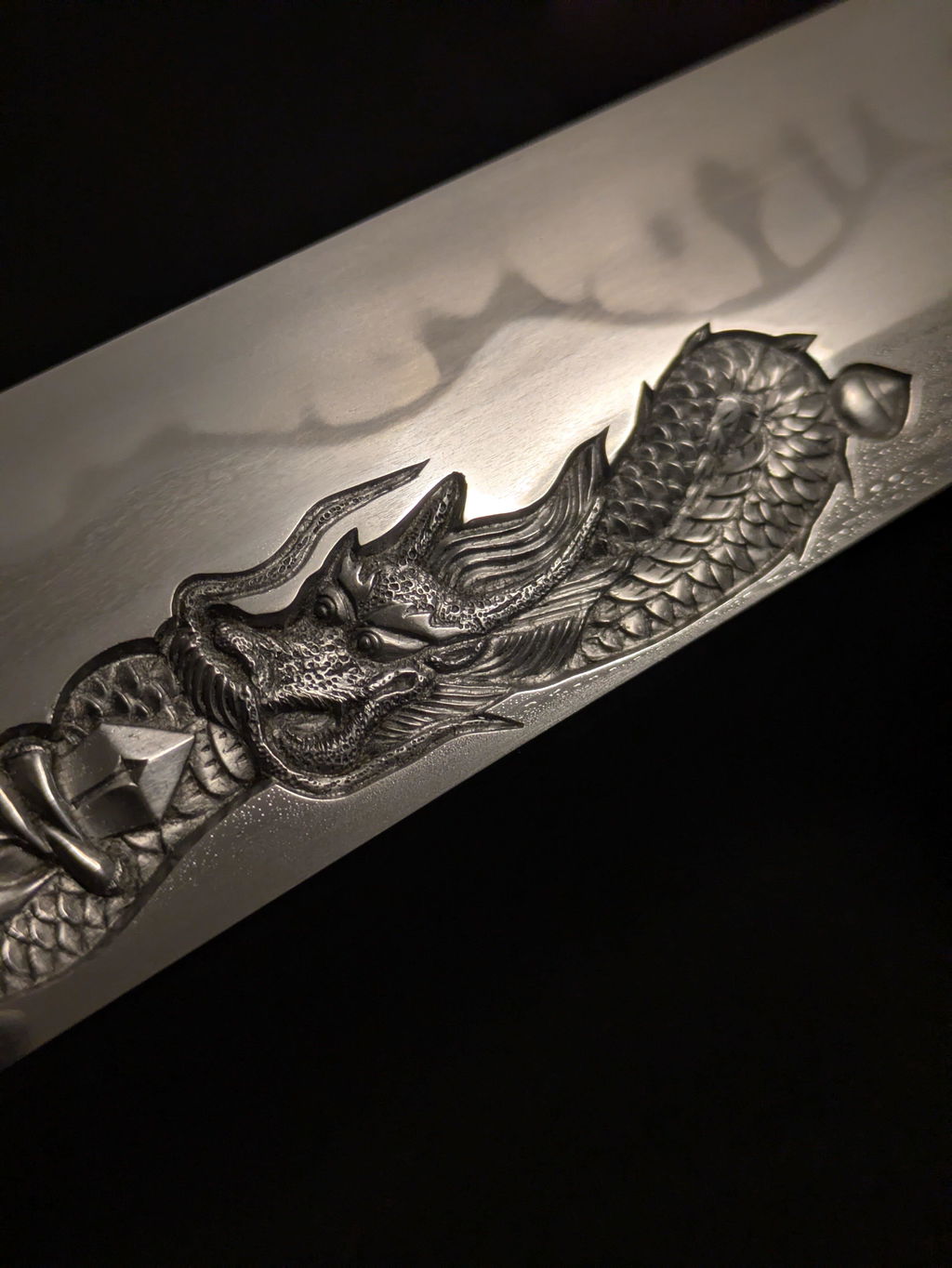
This is a shinogi-zukuri katana of moderate curvature and a strong, upright presence. A handsome, powerful bōhi (single groove) is cut and kaki-nagashi on both faces of the blade; run deep and cleanly, it lends the sword crisp definition and heightens both its sculptural beauty and its air of quality. The nakago retains the signature "Kawabe Gihachirō Fujiwara Masahide," accompanied by the kaō and stamp standing out sharply — a decisive document of the smith's own hand. The nagasa is 65.6 cm (about 25.83 inches, or 2 shaku 1 sun 6 bu 5 rin) with a sori of 1.67 cm (about 0.66 inch). Motohaba is a robust 33.5 mm with a thick motokasane of 9.7 mm; sakihaba 23.0 mm and sakikasane 7.3 mm. The blade alone weighs 810 g.
The sword is preserved in a shirasaya (plain wood storage scabbard) in excellent condition. Stripped of any superfluous ornament, the shirasaya is made to protect and display a blade's health and beauty in their finest state — the ideal way to safeguard an important sword and pass it down to future generations.
Suishinshi Masahide overturned the very idea of what a Japanese sword should be and opened a new age. This is a Tokubetsu Hozon-certified work carrying his skill, his philosophy, and the weight of that history — a bright, clear jigane, a temper of quiet distinction, and the crisp kaō and stamp that are the maker's own proof. For the serious collector, a signed and dated blade by the founder of the shinshintō school stands among the most desirable of acquisitions.
¥1,100,000 ¥1,150,000

¥200,000 ¥240,000

¥400,000 ¥430,000

¥390,000 ¥410,000

¥270,000 ¥290,000

¥300,000 ¥330,000


Every blade reflects generations of knowledge, discipline, and precision passed down through traditional Japanese swordmaking. From the forging of steel to the final finishing touches, each piece is shaped with patience, mastery, and deep respect for heritage.

From carefully selected materials to the refined finishing of every surface, each sword is crafted and presented with uncompromising attention to detail. Our commitment to authenticity ensures every piece reflects true tradition, lasting quality, and enduring cultural value.

Designed with balance, simplicity, and purpose, our blades embody the harmony between refined form and skilled craftsmanship. Each sword represents a thoughtful union of strength, elegance, and the timeless discipline of Japanese artisans.