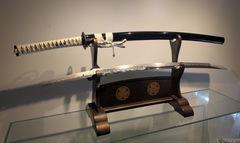
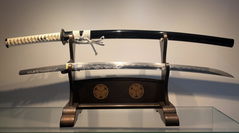
Antique Japanese Wakizashi Sword - Mumei, Shinto Era (36.6 cm)
¥200,000 ¥240,000

We are honored to present a masterwork by Ōsumi Toshihira (大隅俊平), designated a Living National Treasure (holder of the Important Intangible Cultural Property "Japanese sword forging") and one of the supreme swordsmiths of the Shōwa and Heisei eras. This is a commanding long tachi — a nagasa of a little over 2 shaku 6 sun (about 78.9 cm) with a generous curvature of roughly one sun (about 3.0 cm) — in the magnificent form of an old Kamakura tachi. It carries an NBTHK Tokubetsu Hozon Tōken (Especially Worthy of Preservation) certificate, objective confirmation of its outstanding beauty and health. In it lives the very essence of the "suguha" (straight temper) that Ōsumi pursued for his entire life, breathing the refinement of the great old blades.
Ōsumi Toshihira (1932–2009) was a swordsmith from Ōta in Gunma Prefecture and a Living National Treasure — holder of the Important Intangible Cultural Property for Japanese sword forging. In 1952 he entered the forge of the master smith Miyairi Akihira (later renamed Yukihira), himself a Living National Treasure. In 1958, aged twenty-six, he entered the NBTHK's forging-technique exhibition for the first time and won an Award of Excellence, making his name known as a leading talent of the Miyairi school. Returning home to establish his own forge, he won the top prize (tokushō) at the Shinsaku Meitō-ten for six years running from 1967, and went on to take the exhibition's highest honor, the Masamune Prize, three times (1974, 1976, 1978) — a brilliant record that established him as one of the very finest swordsmiths of the modern age. He was later awarded the Medal with Purple Ribbon (1999) and the Order of the Rising Sun, Gold Rays with Neck Ribbon (2005), and was designated a Living National Treasure in 1997. Setting himself apart from his teacher's flamboyant style, he devoted his life to the most demanding discipline of all — suguha. His re-creation and refinement of the "robust, upright beauty" of the Kamakura-period Bitchū Aoe school and the classical Yamato and Yamashiro (Rai) traditions earned him the acclaim "Ōsumi of the suguha."
Learn more: The Six Living National Treasures of Japanese Swordsmithing →
Having deeply studied the old masterpieces of the Kamakura-period Bitchū Aoe school and the Rai and Yamato traditions, the Living National Treasure Ōsumi Toshihira pursued the essence of suguha across his whole career. His supreme achievement lies in suguha — the one temper in which nothing can be hidden — where he brought into harmony a "taut, bright, crystal-clear habuchi of rigorous precision" and "an extremely dense, utterly clear jigane." His aesthetic, which relies not on flamboyant irregular temper but on the pure clarity of the steel and the dignity of a single straight line, was praised as "Ōsumi of the suguha" and remains without rival in the modern sword world. In this blade, too, within the overwhelming presence of its 2-shaku-6-sun length and its trim grooves, the pure, dignified technique and refinement that Ōsumi attained are given full and faultless expression.
As its NBTHK Tokubetsu Hozon certification attests, the blade is thoroughly healthy and in excellent polish, so that the character of ji and ha can be appreciated with great clarity. The jigane is a ko-itame packed extremely densely, with not a trace of murkiness — a refined, utterly clear surface, with fine ji-nie evenly applied, expressing the pure, powerful steel that is Ōsumi's hallmark. The hamon is the heart of Ōsumi's straight temper: a chū-suguha that sends out a single, dignified line of light. The nioiguchi is tight and controlled yet bright and clear, with delicate ko-nie gathering along the habuchi and soft, minute ashi entering the temper. Rather than adorning the blade with a showy pattern, it captivates through the clarity of the line and the beauty of the nioiguchi alone — the resolute, serene beauty that only Ōsumi Toshihira could achieve.
For all the overwhelming impact of its 2-shaku-6-sun length, the blade tapers elegantly from motohaba to sakihaba, and the beautiful one-sun curvature lends a supple dignity to the whole. The chū-kissaki is crisply gathered, showing a splendid balance reminiscent of the Aoe school and of Kamakura tachi. Both faces carry a handsome bō-hi (single groove), deep and trim with a sharply defined end, which tightens the long blade and lends a special, dignified tension. The nakago is ubu (as originally made) and unblemished, with intact yasurime, and is signed in tachi-mei with "Ōsumi Toshihira saku" (大隅俊平作) in orderly, powerful strokes.
The sword comes in a custom shirasaya, ideal for protecting and cherishing a blade of this length. Both scabbard and hilt are made of fine, straight-grained plain wood with a smooth, beautiful finish and trim lines. The habaki is a top-class gold-foil double habaki (kin-kise nijū habaki) befitting the dignity of a fine blade, its delicate, hand-cut-style file marks giving off a beautiful luster that further sets off the quality of the sword. Both shirasaya and habaki are made to the highest precision — a perfect storage mounting in which to pass this master's masterpiece down to future generations.
The "beauty of suguha" that the Living National Treasure Ōsumi Toshihira pursued throughout his life reaches, in this blade, what may be called its ultimate expression. Relying on no showy irregular temper, captivating through a single tight, bright line of nioiguchi and a jigane clear to its very depths, it is the pure spirit of the master made visible. With its NBTHK Tokubetsu Hozon designation vouching for its objective value as well, this is a masterwork to delight the eye and reward its owner — and a cultural treasure representing the summit reached by Japanese sword-forging, to be handed down with family pride for generations to come.
¥200,000 ¥240,000

¥400,000 ¥430,000

¥390,000 ¥410,000

¥270,000 ¥290,000

¥300,000 ¥330,000


Every blade reflects generations of knowledge, discipline, and precision passed down through traditional Japanese swordmaking. From the forging of steel to the final finishing touches, each piece is shaped with patience, mastery, and deep respect for heritage.

From carefully selected materials to the refined finishing of every surface, each sword is crafted and presented with uncompromising attention to detail. Our commitment to authenticity ensures every piece reflects true tradition, lasting quality, and enduring cultural value.

Designed with balance, simplicity, and purpose, our blades embody the harmony between refined form and skilled craftsmanship. Each sword represents a thoughtful union of strength, elegance, and the timeless discipline of Japanese artisans.