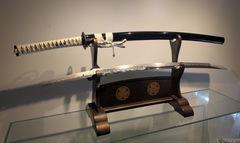
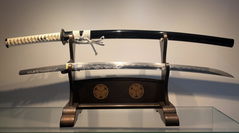
Antique Japanese Wakizashi Sword - Mumei, Shinto Era (36.6 cm)
¥200,000 ¥240,000

We are honored to present a katana by Sumitani Masamine (隅谷正峯), designated a Living National Treasure (holder of the Important Intangible Cultural Property for Japanese sword forging). Though Sumitani is best loved for his flamboyant "Sumitani chōji," this blade shows the opposite pole of his art: a calm, classical Bizen temper of great dignity. Signed and dated February Shōwa 48 (1973), from the prime of his career about eight years before his designation, it pairs a clear, well-forged ji with a quietly beautiful midare in a bright nioiguchi. It carries an NBTHK Tokubetsu Hozon Tōken (Especially Worthy of Preservation) certificate and — the heart of its appeal — a custom paulownia box bearing a box-inscription in the smith's own hand. A work by a Living National Treasure that descends with the maker's own brush inscription appears only very rarely on the market, making this an exceptional find for the collector who already knows his chōji and seeks a different, quieter facet of the master.
Sumitani Masamine (1921–1998) opened his forge, the "Sanryūtei," in Matto in Ishikawa Prefecture (present-day Hakusan City), and devoted his life to the study and forging of the great old blades, centered on the Bizen tradition. Pouring himself into the pursuit of steel — including making his own tamahagane — he reigned at the summit of the modern sword world, winning the highest honor, the Masamune Prize, three times, and in 1981 was designated a Living National Treasure. He established the refined, dignified elegance and fresh, lustrous steel that approach the old masterpieces, together with his signature flamboyant "Sumitani chōji," and stands as one of the supreme masters representing the modern Japanese sword world. He is also known for a number of commissions connected with the Imperial house and the great shrines (such as sacred swords for Ise Jingū), and his works are highly valued as treasures of the present age, in both dignity and artistic merit.
Learn more: The Six Living National Treasures of Japanese Swordsmithing →
Sumitani Masamine is best known for pursuing the Kamakura-period Bizen Ichimonji and Nagamitsu to their very limits and establishing his celebrated "Sumitani chōji" — a gorgeous, resplendent clustered chōji carrying a weighty dignity. This katana is the counterpoint to that fame: a serene, classical face of the Bizen tradition that is seen far less often among his works on the market. A calm temper is, in truth, the most unforgiving test of a smith — there is no flamboyant pattern to hide behind, and the result must stand on the clarity of the steel and the quality of a quiet, bright nioiguchi alone. Here that restraint is carried off with the sureness of a Living National Treasure, within a stretched and graceful shape that recalls the fine tachi of the Kamakura period. For the collector who already owns, or knows well, his exuberant chōji, this offers a different and quieter facet of the master — made in his prime, and, rarest of all, inscribed, dated and attested in his own hand on the box that accompanies it.
This is a superb piece, designated NBTHK Tokubetsu Hozon Tōken. The jigane is a ko-itame forged with fine precision, with fine ji-nie, showing a bright, moist, clear surface with the quiet refinement of the Bizen tradition. The hamon is a gentle notare mixed with gunome and chōji, worked with soft undulations rather than tall, flamboyant heads. The nioiguchi is bright and clear, with ashi and yō entering within the temper, and the bōshi tumbles into a midare-komi and turns back in a neat ko-maru — a serene, dignified finish that shows the care and quality of the master's hand.
The blade is a powerful yet graceful tachi-style shape, well balanced between motohaba and sakihaba, with a high koshizori and firm taper, its slightly inokubi-leaning kissaki lending an overwhelming dignity. The nakago is a healthy ubu nakago retaining its original form, with beautifully applied katte-sagari yasurime, boldly and clearly signed "Kaga-jū Ryōzanshi Sumitani Masamine kore o tsukuru" (加賀住両山子隅谷正峯作之) on the front and dated "a day in the 2nd month of Shōwa 48" (昭和四十八年二月日 = 1973) on the reverse — the "four" of the year written in its archaic four-stroke form — the unshakable confidence of the master evident in every stroke. The blade was registered in Ishikawa Prefecture the same year, in Shōwa 48 (1973), as is normal for a newly forged sword.
The shirasaya that protects and preserves this blade is a fine piece of work, the beauty of its wood grain matched by extremely precise joinery; it fits the curvature of the blade without the slightest play and keeps the sword in excellent condition even over long storage. The sword is fitted with a dignified gold double habaki (kin nijū habaki) that further sets off the elegance of this fine blade. Most notably of all, there is a custom paulownia box (kiri-bako) made for this sword, bearing a box-inscription (hakogaki) in the smith's own hand. On the inner lid, Sumitani Masamine himself took up the brush to write "Made in the Bizen tradition; a spring day, Shōwa 48 [1973]; Sumitani Masamine (Ryōzanshi), resident of Kaga Province" (備前傳作之 昭和四十八年春日 加賀國住両山子隅谷正峯), with his vivid kaō. This is a box inscription rather than a sayagaki (an inscription written on the shirasaya scabbard itself), but it carries the same kind of weight: it is the smith's own attestation of his work, identifying the tradition he worked in and dating the blade in his own hand. Among the works of Living National Treasures, those accompanied by such a hand-written attestation by the maker are limited in number, and this adds real value — speaking to the pedigree and authenticity of the blade, and making its worth as a holding all the more certain.
A prime-period katana that shows the care and devotion of the Living National Treasure Sumitani Masamine, who revived the aesthetics of the great old Kamakura blades for the modern age. Beyond the dignity of its Tokubetsu Hozon rank, the master's own box inscription will continue to attest to the work's authenticity and lineage for all time. To hold a work by a master who reigns at the summit of modern art swords, complete with his own box inscription, is itself a pride, and a way of passing a precious cultural inheritance down to future generations. Do not let this rare encounter slip by — treasure it as a lifelong possession for years to come.
¥200,000 ¥240,000

¥400,000 ¥430,000

¥390,000 ¥410,000

¥270,000 ¥290,000

¥300,000 ¥330,000


Every blade reflects generations of knowledge, discipline, and precision passed down through traditional Japanese swordmaking. From the forging of steel to the final finishing touches, each piece is shaped with patience, mastery, and deep respect for heritage.

From carefully selected materials to the refined finishing of every surface, each sword is crafted and presented with uncompromising attention to detail. Our commitment to authenticity ensures every piece reflects true tradition, lasting quality, and enduring cultural value.

Designed with balance, simplicity, and purpose, our blades embody the harmony between refined form and skilled craftsmanship. Each sword represents a thoughtful union of strength, elegance, and the timeless discipline of Japanese artisans.