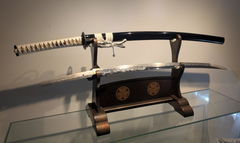
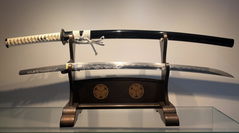
Antique Japanese Wakizashi Sword - Mumei, Shinto Era (36.6 cm)
¥200,000 ¥240,000

Sō Masachika is one of Kyūshū's foremost swordsmiths and the second generation of a family of mukansa (exhibition-exempt) masters. Trained in metallurgy at Kyūshū University and at Hitachi Metals before taking up the hammer under his father, he brings a scientist's understanding of steel to a centuries-old craft. His Takamatsu-no-miya Prize-winning utsushi (faithful re-creation) of a blade by Tsuda Echizen-no-kami Sukehiro, with its surging tōran-ba (billowing-wave hamon), led to his promotion to mukansa in 2006. A katana commissioned through Tozando is forged to order by the smith himself and priced as set by the All Japan Swordsmith Association (全日本刀匠会).
Masachika was born in 1958 in Fukuoka City, the son of the swordsmith Sō Tsutomu (宗勉), who was himself promoted to mukansa in 1990. His real name is 宗正敏. Rather than entering the forge straight from school, he studied metallurgy in the Faculty of Engineering at Kyūshū University and then worked in metals research at Hitachi Metals, a company closely connected with traditional Japanese steelmaking.
In 1983, at the age of twenty-five, he left industry to train full time under his father. Sō Tsutomu taught that "a sword is decided by its jigane" (刀は地鉄で決まる), and Masachika made the quality of the steel the foundation of his work. He works at the family forge in Hakata, Fukuoka, and signs his blades Chikushū-jū Sō Masachika (筑州住宗昌親, "Sō Masachika, resident of Chikuzen Province").
Masachika made his debut at the Shinsaku Meitō-ten (New Sword Exhibition) in 1990, winning the Newcomer's Prize. In 1997 he received a special prize from the All Japan Swordsmith Association, and in the years that followed he won the Nihon Bijutsu Tōken Hozon Kyōkai (NBTHK) Honorary Chairman's Prize and Chairman's Prize, the Agency for Cultural Affairs Commissioner's Prize, and the Takamatsu-no-miya Prize.
In 2005 he won the Takamatsu-no-miya Prize, the exhibition's highest honor, for an utsushi of a blade by Tsuda Echizen-no-kami Sukehiro (津田越前守助廣), the seventeenth-century Osaka master who created the tōran-ba. The following year, 2006, he was promoted to mukansa, joining his father in that rank and establishing the Sō family as a two-generation line of exhibition-exempt masters.
Masachika's work begins with the jigane (surface steel). Drawing on his training as a metallurgist, he pursues a dense, well-forged ko-itame (small wood-grain) that is both beautiful and sound. On this foundation he is best known for the tōran-ba (濤乱刃), a hamon of large, rolling waves that seem to crash against the shore, created in the Edo period by Sukehiro and admired ever since as one of the most dramatic patterns in Japanese swordmaking.
His tōran-ba and related gunome-midare (irregular rounded) hamon are rich in nie, with plentiful ashi (legs running toward the edge) and bright activity such as kinsuji (shining lines of nie) within the temper. Several of his blades are signed in homage to his model, for example Shinobu Sukehiro (偲助廣, "in remembrance of Sukehiro"), a sign of how closely he has studied the Osaka shintō masters.
A commissioned katana by Sō Masachika unites a metallurgist's command of steel with one of the most celebrated hamon in the history of the Japanese sword. It is a blade made for one owner, to be handed down as a family treasure. Please contact us to discuss specifications and lead time.
¥200,000 ¥240,000

¥400,000 ¥430,000

¥390,000 ¥410,000

¥270,000 ¥290,000

¥300,000 ¥330,000


Every blade reflects generations of knowledge, discipline, and precision passed down through traditional Japanese swordmaking. From the forging of steel to the final finishing touches, each piece is shaped with patience, mastery, and deep respect for heritage.

From carefully selected materials to the refined finishing of every surface, each sword is crafted and presented with uncompromising attention to detail. Our commitment to authenticity ensures every piece reflects true tradition, lasting quality, and enduring cultural value.

Designed with balance, simplicity, and purpose, our blades embody the harmony between refined form and skilled craftsmanship. Each sword represents a thoughtful union of strength, elegance, and the timeless discipline of Japanese artisans.