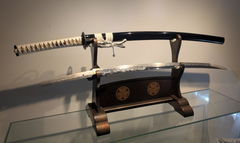
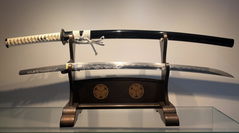
Antique Japanese Wakizashi Sword - Mumei, Shinto Era (36.6 cm)
¥200,000 ¥240,000

Mikami Sadanao is one of the leading swordsmiths of western Japan. A pupil of the Living National Treasure Gassan Sadakazu II (二代 月山貞一), he has won the Takamatsu-no-miya Prize twice at the Shinsaku Meitō-ten (New Sword Exhibition), was promoted to mukansa (exhibition-exempt) rank in 1995, and is a holder of Hiroshima Prefecture's Intangible Cultural Property for Japanese swordmaking. His specialty is Sōden-Bizen, the Bizen tradition enriched by Sōshū influence in the manner of Osafune Chōgi. A katana commissioned through Tozando is forged to order by the smith himself and priced as set by the All Japan Swordsmith Association (全日本刀匠会).
Sadanao was born in 1955 in Mizuho Town, Ōchi District, Shimane Prefecture (now Ōnan Town). His real name is 三上孝徳. In his final year of high school he became fascinated by Japanese swords, and in 1974 he entered the forge of the second-generation Gassan Sadakazu in Nara, one of the most respected smiths of the twentieth century. His smith name follows the custom of the Gassan school: the character sada (貞) is passed down from the Gassan masters, joined here with nao (直).
He received his swordsmith's license from the Agency for Cultural Affairs in 1980 and in the same year founded the Mikami Sadanao Nihontō Tanren Dōjō (三上貞直日本刀鍛錬道場) in Kitahiroshima Town, Yamagata District, Hiroshima Prefecture, where he works to this day. His blades are typically signed Aki no Kuni Mikami Sadanao saku kore (安藝国三上貞直作之, "made by Mikami Sadanao in Aki Province"), Aki being the old name for western Hiroshima.
Sadanao first exhibited at the Shinsaku Meitō-ten in 1981. Over the following years he received the exhibition's highest honor, the Takamatsu-no-miya Prize, twice, along with two Agency for Cultural Affairs Commissioner's Prizes, the Mainichi Shimbun Prize, two Kunzan Prizes, the Excellence Prize, and three Effort Prizes. This record led to his promotion to mukansa in 1995, the rank at which a smith's work is exhibited without judging.
In 2006 Hiroshima Prefecture recognized him as a holder of its Intangible Cultural Property for Japanese swordmaking technique (日本刀製作技術). In 2013 he succeeded Yoshihara Kuniie (吉原國家) as the seventh chairman of the All Japan Swordsmith Association, the body of working licensed smiths in Japan.
Over a career of more than four decades, Sadanao has taken on restoration and reproduction work for shrines in his home region, including the treasured mounted tachi and koshigatana (錦包籐巻太刀・腰刀) of Itsukushima Shrine. He has also demonstrated traditional forging abroad, including at an exhibition of Japanese swords in Poland, and has trained a new generation of smiths at his Hiroshima forge.
Sadanao's chosen field is Sōden-Bizen (相伝備前), a style that arose in the Nanbokuchō period when Osafune smiths such as Chōgi (長義) absorbed the bold nie-based work of Masamune's Sōshū school. Many of his blades follow Chōgi's methods: a broad, powerful sugata (overall shape), a well-forged, tough jigane (surface steel) in the tradition of his Gassan training, and a hamon full of nie activity, often a wide notare (undulating) or midare (irregular) pattern.
The result combines the brilliance of Bizen tempering with the strength and depth of Sōshū steel, a combination that suits both full-length katana and grand tachi in the Nanbokuchō manner.
A commissioned katana by Mikami Sadanao offers the work of a mukansa master whose training reaches back through the Gassan line and whose own forge has served Hiroshima's shrines and swordsmiths for over forty years. It is a blade made for one owner, to be handed down as a family treasure. Please contact us to discuss specifications and lead time.
¥200,000 ¥240,000

¥400,000 ¥430,000

¥390,000 ¥410,000

¥270,000 ¥290,000

¥300,000 ¥330,000


Every blade reflects generations of knowledge, discipline, and precision passed down through traditional Japanese swordmaking. From the forging of steel to the final finishing touches, each piece is shaped with patience, mastery, and deep respect for heritage.

From carefully selected materials to the refined finishing of every surface, each sword is crafted and presented with uncompromising attention to detail. Our commitment to authenticity ensures every piece reflects true tradition, lasting quality, and enduring cultural value.

Designed with balance, simplicity, and purpose, our blades embody the harmony between refined form and skilled craftsmanship. Each sword represents a thoughtful union of strength, elegance, and the timeless discipline of Japanese artisans.