

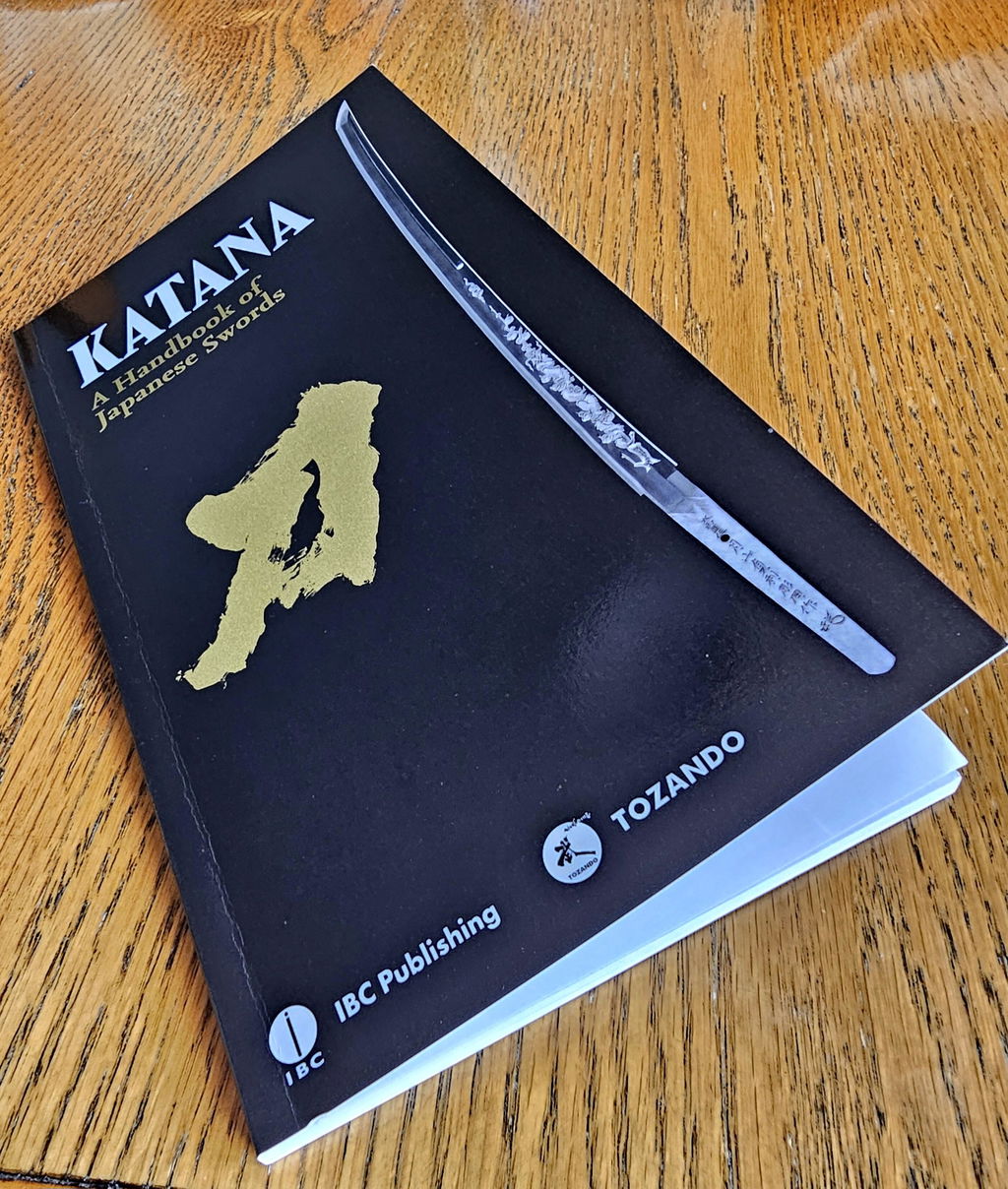
Every year, millions of people around the world encounter objects described as "authentic Japanese swords" — on online marketplaces, in souvenir shops, at martial arts suppliers — and have no reliable way of knowing whether what they are looking at is genuine. The problem is not a lack of interest; it is a lack of accessible knowledge. Most English-language information about nihonto assumes existing expertise, is scattered across specialist publications, or is written to serve the collector market rather than the complete newcomer. KATANA: A Handbook of Japanese Swords was written to address this gap — an accessible, authoritative introduction to what a Japanese sword actually is, published by Tozando and written for the international reader encountering the subject for the first time.
A Handbook of
Japanese Swords
Why This Book Was Written
The Japanese sword market has a problem that has grown more acute with the rise of international e-commerce: the proliferation of mass-produced swords from China and Southeast Asia that are described, marketed, and sold as authentic Japanese swords. These objects — made from industrial steel, outside Japan, by processes that have nothing to do with the tamahagane and traditional techniques that define genuine nihonto — are often indistinguishable to a new collector from the real thing, at least from a photograph and a confident description.
The solution to this problem is not more warnings or more disclaimers. It is knowledge. A collector who understands what a genuine Japanese sword actually is — what tamahagane is, what the jihada represents, why the hamon looks the way it does, what the nakago tells you about a blade's history — is a collector who cannot be deceived by a convincing-looking fake. KATANA: A Handbook of Japanese Swords was written to give that knowledge to anyone, anywhere in the world, who encounters the subject for the first time and wants to understand it properly.
The book draws on Yamamoto Yasumasa's more than thirty years of experience as a nihonto specialist at Tozando — as the person responsible for the authentication, selection, description, and international sale of Japanese swords to collectors in over seventy countries. It is written in the same spirit as Tozando's English-language specialist support: treating the reader as someone capable of genuine understanding, and providing the knowledge they need to exercise that understanding independently.
"The allure of the Japanese sword lies in the fact that it is far more than a weapon; it is a masterpiece of art that condenses centuries of craftsmen's spirit, refined technique, and the spiritual culture of Japan. Its elegant curves, the ethereal harmony of the steel grain, the tempered line emerging from the steel, and the breath of the swordsmith infused into every blade can truly be described as a symphony woven of fire and iron.
This book serves as an accessible guide for international readers encountering the world of Japanese swords for the first time, conveying their profound charm in an easy-to-understand explanation. It is a thoughtfully compiled volume that covers history, manufacturing methods, aesthetic beauty, and the significance of the sword within Japanese culture.
It is my sincere hope that this book will inspire many readers to take their first step into the magnificent world of Japanese sword artistry."
— Kubo Yoshihiro, President, All Japan Swordsmith Association (全日本刀匠会 会長)What the Book Covers — Five Chapters
From the Book — Two Excerpts
"Beyond its function as a weapon, the Japanese sword has been deeply rooted in Japan's history and culture for over a millennium. It has served as an object of worship and a symbol of authority. Often called the 'soul of the samurai,' the sword embodies the very spirit of Bushido.
Because these blades have been carefully preserved for over a thousand years, they play a vital role in Japan's heritage. Today many of them retain the brilliance they gained on the day they were forged, making them cultural treasures unlike any other in the world. To appreciate the beauty of a Japanese sword is, in essence, to experience the depth of Japanese culture."
"From the late Heian period through the Kamakura period, the Japanese sword dramatically evolved into the tachi by adding a curve to the blade. This curve was developed as an ideal shape for use in mounted combat.
When striking at an enemy from horseback, a straight sword made it difficult to transfer sufficient force, and it was also inconvenient to draw it from its sheath. However, a curved sword allowed for a natural thrust — a technique in which the sword is drawn from the sheath and simultaneously strikes the enemy — dramatically increasing the power of the strike. This necessity in combat led to a unique development unparalleled anywhere in the world, resulting in the beautiful curvature unique to the Japanese sword."
it is far more than a weapon;
it is a masterpiece of art that condenses centuries
of craftsmen's spirit, refined technique,
and the spiritual culture of Japan." — Kubo Yoshihiro, President, All Japan Swordsmith Association · Foreword to KATANA: A Handbook of Japanese Swords
Why Tozando — The Authority Behind the Book
KATANA: A Handbook of Japanese Swords was not written by an academic or a journalist. It was written by Tozando's editorial team, drawing on more than thirty years of daily engagement with nihonto — authenticating blades, describing them to international collectors, facilitating their export, and fielding the questions that collectors in seventy countries ask when they are trying to understand what they are looking at.
That experience gives the book a quality that purely academic treatments of the subject often lack: practical utility. The descriptions of blade anatomy in Chapter 1 use exactly the vocabulary that appears in NBTHK certificates and dealer listings. The explanation of the production process in Chapter 4 addresses precisely the question — why can't this be done industrially? — that distinguishes a genuine nihonto from a mass-produced fake. The appreciation guide in Chapter 5 tells the reader what to actually look for when they are standing in front of a blade.
Tozando has been shipping Japanese swords to collectors in more than seventy countries since 1989. The most common barrier those collectors face is not access to swords — it is knowledge of how to evaluate what they are looking at. KATANA: A Handbook of Japanese Swords was written to lower that barrier, permanently, for anyone who reads it.
available now at japanesesword.net
72 pages. Five chapters. Everything a first-time collector needs to understand what a genuine Japanese sword is, how it is made, how to read it, and how to distinguish it from the mass-produced alternatives that dominate the international market. Written by Tozando's Managing Director, with a foreword by the President of the All Japan Swordsmith Association.
In Closing — Knowledge as the Foundation of Collecting
The Japanese sword market will always contain objects that are not what they claim to be. No amount of regulation, certification, or market intervention will eliminate the incentive to produce convincing-looking alternatives to the genuine article when the genuine article commands significant prices and the market for it is international and largely non-specialist.
The effective response to this situation is not suspicion — it is knowledge. A collector who understands what tamahagane is, what the jihada reveals about a blade's authenticity, and what the difference between a genuine hamon and a chemically etched pattern looks like is a collector who is not vulnerable to the most common forms of misrepresentation. That knowledge is not difficult to acquire; it requires only a reliable guide written by someone with the expertise and the motivation to convey it accurately.
KATANA: A Handbook of Japanese Swords was written to be that guide — for the reader anywhere in the world who wants to understand what they are looking at when they encounter a Japanese sword, and to do so reliably, from the beginning. We hope it serves that purpose for every reader who picks it up.

Leave a comment: