The image is one of the most recognisable in Japanese visual culture: a samurai with two swords thrust through the belt, the longer blade angled to the left, the shorter one beside it. This is the daisho (大小) — literally "large and small" — the paired long and short swords that, from the mid-Edo period onward, became the defining mark of samurai status. But the daisho is more than an iconic silhouette. It is a statement of identity, a legal designation, a practical system, and — for collectors today — one of the most challenging and rewarding categories of nihonto acquisition. This article explains what the daisho is, why it developed, what it meant to the people who wore it, and what distinguishes a genuine matched pair from two swords that happen to be displayed together.
大小
Daisho — "large and small." The paired swords of the samurai class — katana (or tachi) and wakizashi, worn together as the visible mark of samurai status from the Edo period onward.
1629
Approximate date of the Edo shogunate's formal codification of daisho wearing as a samurai prerogative — establishing in law what had become customary practice in the preceding decades.
1876
Year of the Haitōrei edict — which prohibited the wearing of swords in public, effectively ending the daisho's practical function after more than two centuries as Japan's most visible status symbol.
The Two Swords — What Each One Is
The long sword — daito
刀
Katana (or Tachi)
かたな · Blade over 2 shaku (60.6cm)
The primary weapon — worn edge-upward through the belt (obi) as a katana, or edge-downward suspended from the belt as a tachi in earlier periods. The katana form became standard from the Muromachi period onward, suited to the faster draw required in close-quarters combat. In the Edo period's peaceful conditions, the katana became primarily a status object — its practical function largely symbolic, its aesthetic qualities increasingly important.
The short sword — shoto
脇差
Wakizashi
わきざし · Blade 1–2 shaku (30–60cm)
The companion sword — worn alongside the katana at all times, including indoors where the longer blade was required to be left at the entrance. The wakizashi's shorter length made it practical in confined spaces and gave the samurai a secondary weapon if the primary was lost or inaccessible. It also carried a specific ritual function: seppuku (ritual suicide) was performed with the wakizashi, not the katana — a distinction that gave the shorter blade a gravity beyond its practical utility.
Why Two Swords — The Practical and the Symbolic
The daisho was not always the standard. Earlier periods saw samurai carry single swords, or combinations of swords and other weapons. The specific pairing of katana and wakizashi as a matched set — worn together, treated as a unit, eventually made legally exclusive to the samurai class — developed gradually through the Muromachi and Sengoku periods and crystallised into formal practice during the early Edo period.
The practical logic was straightforward. The longer katana was the primary combat weapon — effective at distance, capable of powerful cutting strokes, suited to the open encounters of samurai combat. But the katana had limitations in confined spaces: narrow corridors, rooms, the interior of buildings. The wakizashi addressed these limitations. A samurai entering a building was required by etiquette to leave the katana at the entrance — but the wakizashi remained on the body at all times. The shorter blade was never left behind. The pair worked as a system, covering the situations that each sword alone could not.
The symbolic logic ran deeper. By the Edo period, Japan had entered an era of enforced peace under the Tokugawa shogunate. The practical necessity of combat weapons was dramatically reduced. What remained — and what the shogunate formalised into law — was the sword's function as a marker of social identity. Wearing the daisho was not merely a right of the samurai class; it was, legally and visually, what made a samurai recognisable as a samurai. The merchant could not wear it. The farmer could not wear it. The artisan could not wear it. Two swords at the belt announced, without words, a person's position in the Edo period's rigidly stratified social order.
How the Daisho Developed — A Historical Timeline
Heian — early Kamakura period
Single sword, or tachi with tanto
The dominant sword form for mounted warriors was the tachi — a longer, more curved blade worn edge-downward suspended from the belt. It was typically paired with a tanto (short blade) rather than a wakizashi. The concept of a specifically matched pair did not yet exist; the combination was practical rather than symbolic.
Muromachi period (1336–1573)
The katana replaces the tachi; the wakizashi emerges
The shift from mounted to infantry combat produced the katana — worn edge-upward, allowing a faster draw. Alongside it, the wakizashi developed as a distinct sword form between the tanto and the katana in length. Samurai began pairing the two, but the combination was not yet formalised or exclusive to any class. The aesthetic idea of a matched pair — blades made by the same smith, in the same style, presented together — began to develop during this period.
Sengoku period (1467–1615)
Practical pairing becomes common; Toyotomi Hideyoshi's sword hunt
The katana-wakizashi combination became standard practice among samurai during the Sengoku period's continuous warfare. In 1588, Toyotomi Hideyoshi issued the Katanagari (刀狩令) — the "sword hunt" edict — which confiscated weapons from non-samurai classes and began the formal process of restricting sword-wearing to the warrior class. This was a critical step toward the daisho's eventual formalisation as a class marker.
Early Edo period (1603–c.1650)
Formalisation — the daisho becomes law
The Tokugawa shogunate formalised the daisho as the exclusive prerogative of the samurai class. Wearing two swords in public became legally defined as a samurai privilege — and effectively a samurai obligation. The daisho shifted from being a practical military combination to being a legal identity marker, a visible declaration of class status that carried both privilege and responsibility. Merchants of sufficient wealth occasionally received special permission to wear a single sword; the full daisho remained samurai territory.
Mid-to-late Edo period (c.1650–1868)
The aesthetic daisho — matched pairs as art objects
In the peaceful Edo period, with actual combat extremely rare, the daisho's aesthetic dimension became primary. Great smiths were commissioned to produce matched pairs — katana and wakizashi with coordinated sugata, matching hamon character, and koshirae designed and executed as a unified artistic statement. The production of a genuine daisho — two blades by the same smith, in the same tradition, presented in matching mounts — became one of the most demanding and prestigious commissions available. The surviving Edo-period daisho sets in major collections represent some of the most significant achievements in the nihonto tradition.
1876 — Haitōrei
The edict that ended two centuries of daisho wearing
The Meiji government's Haitōrei (廃刀令) edict prohibited the wearing of swords in public — ending the daisho's practical function overnight. Former samurai were required to surrender the visible symbol of their class identity. The transition was experienced as a profound humiliation by many; it was also the moment that transformed the daisho from a living social institution into a historical and collectible object.
"Two swords at the belt said everything
that needed to be said — without a single word.
In the Edo period, the daisho was not a weapon.
It was a declaration."
Two Swords vs. a Matched Pair — The Critical Distinction for Collectors
This is where the collector's understanding of the daisho becomes most important — and where the most significant differences in value and significance arise. There is a fundamental difference between two swords that happen to be displayed together and a genuine daisho — a matched pair produced as a unit, by design, with the specific intention of the blades functioning together as a coherent aesthetic and martial statement.
Same smith — the strongest form of matching
Most significant
The most definitive daisho is one where both blades were forged by the same smith — ideally documented as a commission for the same patron, at the same time, with matching signatures and dates on both nakago. Where this documentation survives intact, the pair is among the most historically and aesthetically significant categories of nihonto. A documented same-smith, same-commission daisho by a major Edo-period smith represents the rarest and most complete form of the tradition. NBTHK certification of both blades, noting their relationship, is the authentication standard for such pairs.
Same school, same period — complementary matching
Significant
Where both blades come from the same school tradition and period — even if not by the same individual smith — the pair has genuine coherence. A katana and wakizashi both from the Hizen tradition of the Edo period, both showing the characteristic fine itame jihada and tight nioiguchi of that school, present as a aesthetically unified pair even without being products of a single hand. The jihada character, hamon style, and overall sugata of the two blades should complement each other naturally — not match exactly, but speak the same aesthetic language.
Matching koshirae — the mounted pair
Visual unity
Even where the blades themselves are from different smiths or different periods, a daisho can achieve visual and historical unity through its koshirae — the complete decorative mounting. Where both swords are mounted in coordinated koshirae by the same fittings makers, with matching lacquer, tsuba, fuchi-kashira, and menuki, the pair presents as a designed object regardless of the blades' individual histories. Some of the most visually spectacular daisho in major collections achieved their unity through koshirae rather than through the blades themselves. The fittings can be the unifying element when the blades are not.
Two swords displayed together — not a daisho
Important distinction
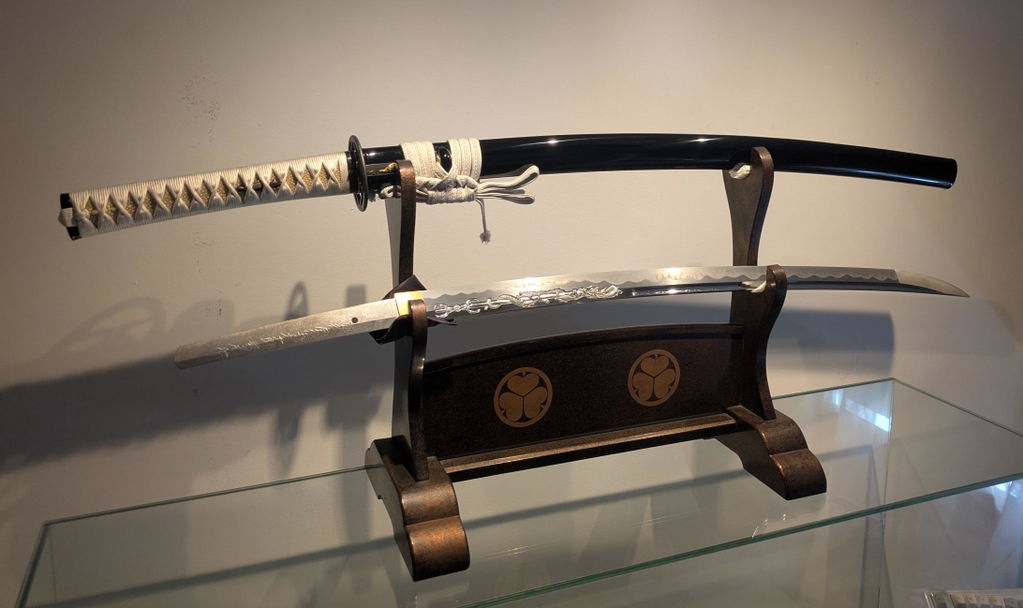
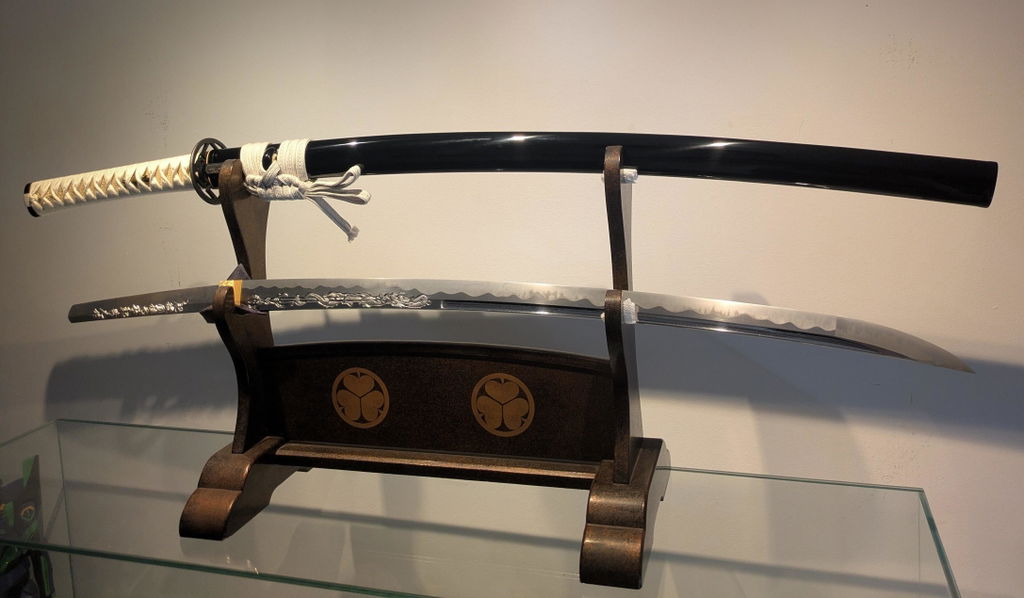
A katana and a wakizashi placed on the same stand, or offered together by a seller as a "daisho," are not necessarily a matched pair in any meaningful sense. Two swords from different smiths, different periods, different schools, and different original owners, displayed together for convenience or commercial presentation, carry none of the historical and aesthetic significance of a genuine daisho. When evaluating any daisho offered on the market, the first questions are always: what connects these two blades? Were they made together? Were they mounted together? Is there documentation of their original pairing? Without satisfactory answers, the pair is simply two swords.
The wakizashi as an independent collectible
The wakizashi deserves specific mention as a collecting category in its own right, independent of the daisho context. Because wakizashi are shorter than katana, their entire technical repertoire — jihada, hamon, nakago — is compressed into a smaller canvas, which in the hands of a great smith produces extraordinary concentration of quality. Some of the most remarkable hamon in the nihonto tradition appear on wakizashi rather than on the longer blades that typically receive more attention. A fine wakizashi by a major smith — certified at Tokubetsu Hozon or Juyo level — often represents exceptional value relative to a katana of equivalent quality, precisely because it is less conspicuously sought. Collectors who come to nihonto through the daisho concept frequently discover that the wakizashi is the more compelling of the two pieces.
The Daisho for Collectors Today
A genuine matched daisho — documented same-smith, or at minimum same-school with coordinated koshirae — is among the most demanding acquisitions in the nihonto market. The challenge is not simply finding two high-quality swords; it is finding two swords whose relationship to each other is documented, coherent, and historically meaningful.
This rarity drives significant value. A daisho by a major Edo-period smith, both blades certified and their pairing documented, commands a premium over what the individual blades would fetch separately — because the pair, as a unit, is a different and rarer object than its components. When a genuine matched daisho appears on the market, it represents something that is not simply twice a single sword; it is a surviving instance of the tradition as it was actually practised, which is a different and more significant thing.
For collectors building toward a daisho, the more common approach is sequential: acquiring a katana first, then seeking a wakizashi from the same tradition whose character complements the longer blade. This is not a matched pair in the strictest sense, but it can be a coherent collection that represents the daisho concept meaningfully. Tozando's specialists can advise on complementary pairing — identifying wakizashi whose jihada, hamon, and period are consistent with a katana already in a collection.
The tradition of the paired sword — in Tozando's collection
Browse katana and wakizashi —
or ask about complementary pairing
Tozando's antique collection includes both katana and wakizashi across all major school traditions and periods. If you are building toward a daisho — or if you are looking for a wakizashi that complements a blade you already own — our specialists can identify pieces whose tradition, period, and character make them natural companions. Contact us with details of what you are looking for.
In Closing — Two Swords, One Statement
The daisho was, for more than two centuries, the most visible social statement available to a person in Japan. Two swords at the belt announced class, identity, and the rights and obligations that came with them — instantly, without words, to everyone who saw it. No other object in Japanese material culture carried so much social information in so compact and recognisable a form.
What survives of the daisho tradition — the matched pairs in museum collections, the individual blades whose original pairing can sometimes be reconstructed from documentation, the Edo-period koshirae sets whose coordinated design speaks of a single artistic vision — carries that weight forward into the present. These are not merely two swords. They are evidence of a social institution, an aesthetic tradition, and a craft practice that produced some of the most significant objects in Japanese cultural history.
For a collector, understanding the daisho means understanding not just what the individual blades are, but what their relationship to each other was intended to be — and whether that relationship survives in the pair being considered. Two swords can always be found. A genuine daisho, where the connection between the two blades is real and documented, is something rarer and more significant. That distinction is worth understanding before any acquisition in this category.


Leave a comment: