

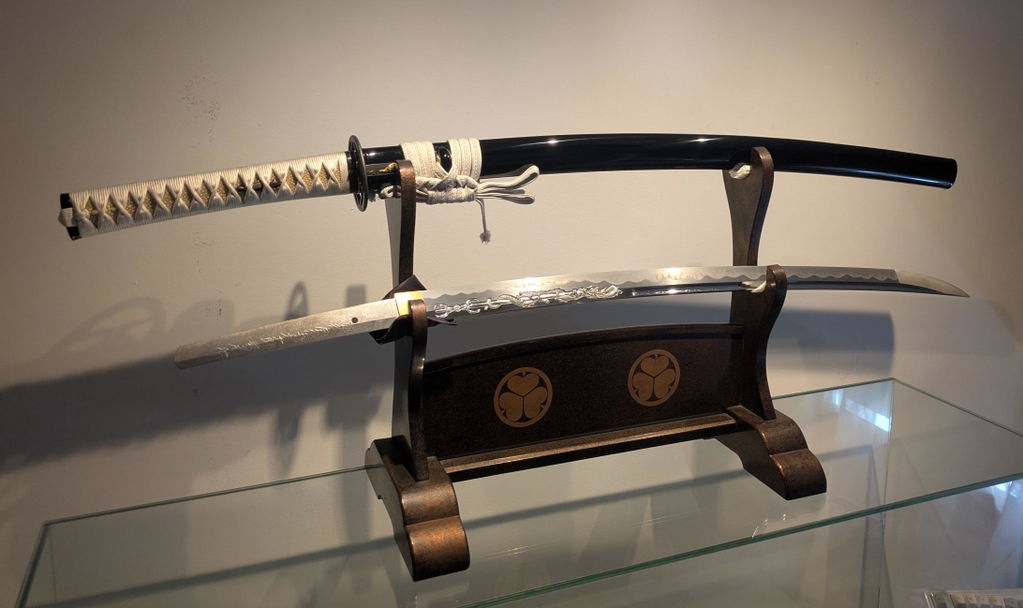
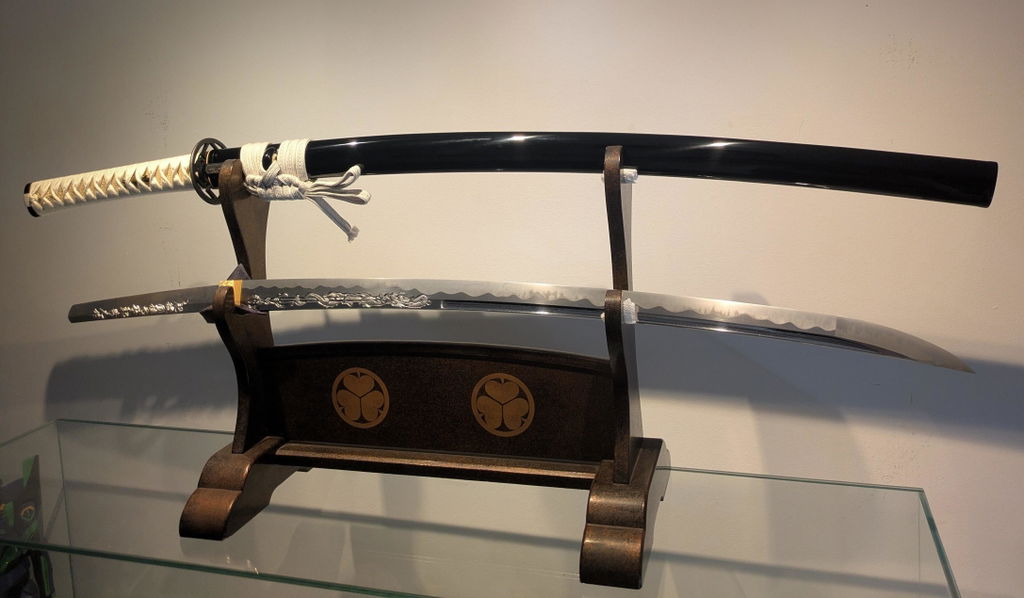
In the hierarchy of the Hizen tradition — the school that produced some of the finest Shinto-period swords in Japan — three names stand above all others: the first-generation Tadayoshi, who founded the school; the second-generation Tadahiro, known as Omi Daijo, who carried it to its greatest breadth and productivity; and the third-generation Mutsu no Kami Tadayoshi, whose work represents its technical peak. Of these three, Omi Daijo Tadahiro is the most prolific by a wide margin — he forged for more than sixty years, from the age of nineteen until his death at eighty, and left behind more surviving blades than any other smith of the Shinto period. That productivity means his blades appear in the market with some regularity — which makes the rarity of what Tozando currently carries all the more significant. This is a Juyo Token blade by Omi Daijo Tadahiro: a sword the NBTHK has designated as exceptionally important, in a category where, as Tozando's specialists can confirm from direct experience, Shinto-period blades almost never reach.
The Hizen Tradition — Japan's Greatest Shinto School
The Hizen tradition takes its name from Hizen Province — present-day Saga and Nagasaki Prefectures in Kyushu — where the school was established at the very beginning of the Edo period. Its founder, the first-generation Tadayoshi, had studied under Umetada Myoju in Kyoto, one of the greatest swordsmiths of the early Shinto period, and returned to Saga to establish a school that would produce more than a hundred smiths over the course of the Edo period.
What distinguished Hizen blades from the outset was a specific quality of steel — a uniquely fine, densely packed jihada that became so characteristic of the school that it received its own name: konuka-hada (小糠肌, "fine bran skin"). The konuka-hada is the identifying feature of Hizen steel — a jihada so fine and so tightly packed that it resembles the surface of polished rice bran. No other school produced jihada quite like it, and its achievement depended on specific tamahagane quality, specific forging technique, and the accumulation of knowledge within a tradition that had been refining this quality for generations.
The Three Great Masters — The Hizen Hierarchy
Omi Daijo Tadahiro — The Second Generation in Detail
Born in 1614, he was the first-generation Tadayoshi's son. When his father died in 1632, he inherited the school at the age of nineteen, and received the title of Omi Daijo in the eighteenth year of Kanei (1641). He died in the sixth year of Genroku (1693) at the age of eighty — never having adopted the Tadayoshi name, signing as Tadahiro throughout his career.
(cite index="51-1">His active forging career spanned more than sixty years, and among the smiths of the Hizen tradition he left the largest number of surviving works. This productivity is both his distinction and, in collector terms, the source of an important nuance. Because Tadahiro worked for so long and left so many blades, his work is more frequently encountered on the market than that of either his father or his son. A collector who wants a Hizen blade has more opportunities with Tadahiro than with the other two masters.
But quantity does not mean uniformity. Across sixty years of forging, Tadahiro's work shows significant variation — reflecting the development of his technique, the demands of different commissions, and the evolution of his aesthetic sensibility. The finest Tadahiro blades are not simply prolific examples; they are fully realised expressions of the Hizen aesthetic, as accomplished in their own terms as any work by the first or third generation. The NBTHK's Juyo Token designations among his work — and there are many — identify precisely these blades.
The Physical Qualities of Tadahiro's Finest Work
The NBTHK's Juyo Token designation requires exceptional historical and artistic significance — a blade that represents something genuinely important within the tradition's development. For Koto-period blades (pre-1596), the combination of age, historical significance, and the relative scarcity of well-preserved examples means that good Kamakura or Nanbokucho pieces can reach Juyo based on historical importance alone.
Shinto-period blades face a different standard. Because they were made in the Edo period's relatively peaceful conditions, and because they have had less time to deteriorate, the average Shinto blade is in better condition than the average Koto blade. This paradox of good preservation works against Juyo designation: the bar for artistic and historical significance is higher when good condition is the norm rather than the exception. Shinto blades that achieve Juyo have cleared a more demanding aesthetic threshold than many Koto pieces at the same level.
This is the significance of the blade Tozando currently carries: a Tadahiro blade that has cleared that threshold. The NBTHK panel assessed this specific piece — its jihada, its hamon, its physical character in every dimension — and determined that it met the Juyo standard. For a Shinto-period blade, that determination represents something the panel awards only to work of genuine exceptional quality.
is not given for survival — it is given for excellence.
The bar is higher precisely because
good condition is expected."
NBTHK Juyo Token Certificate
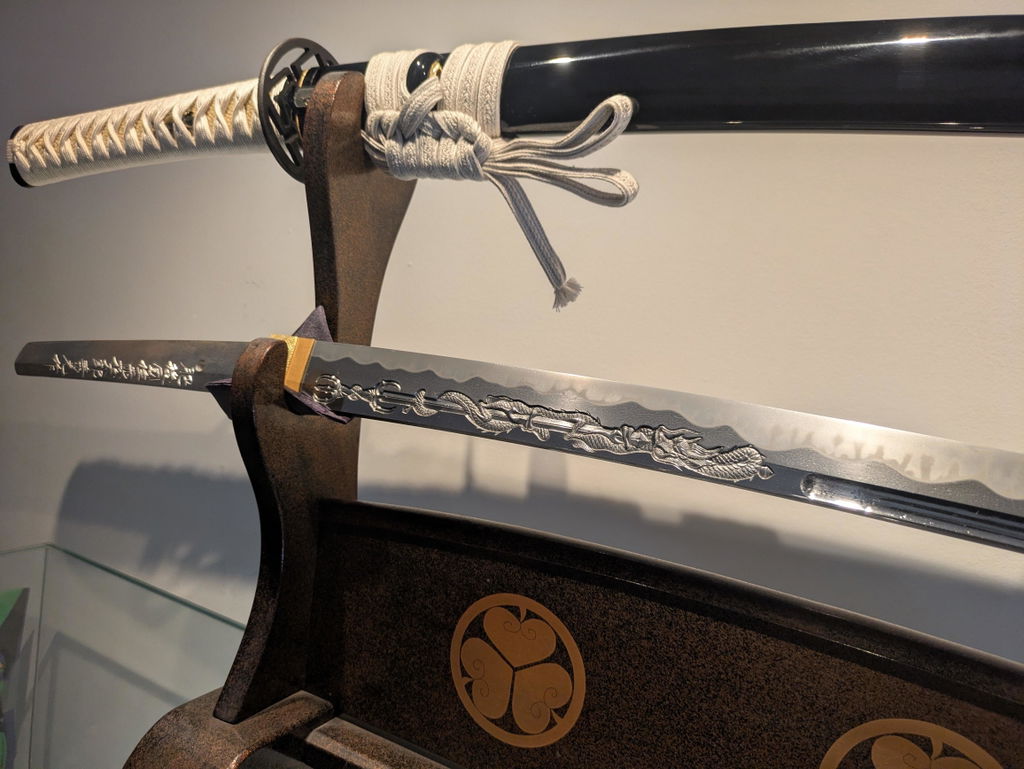
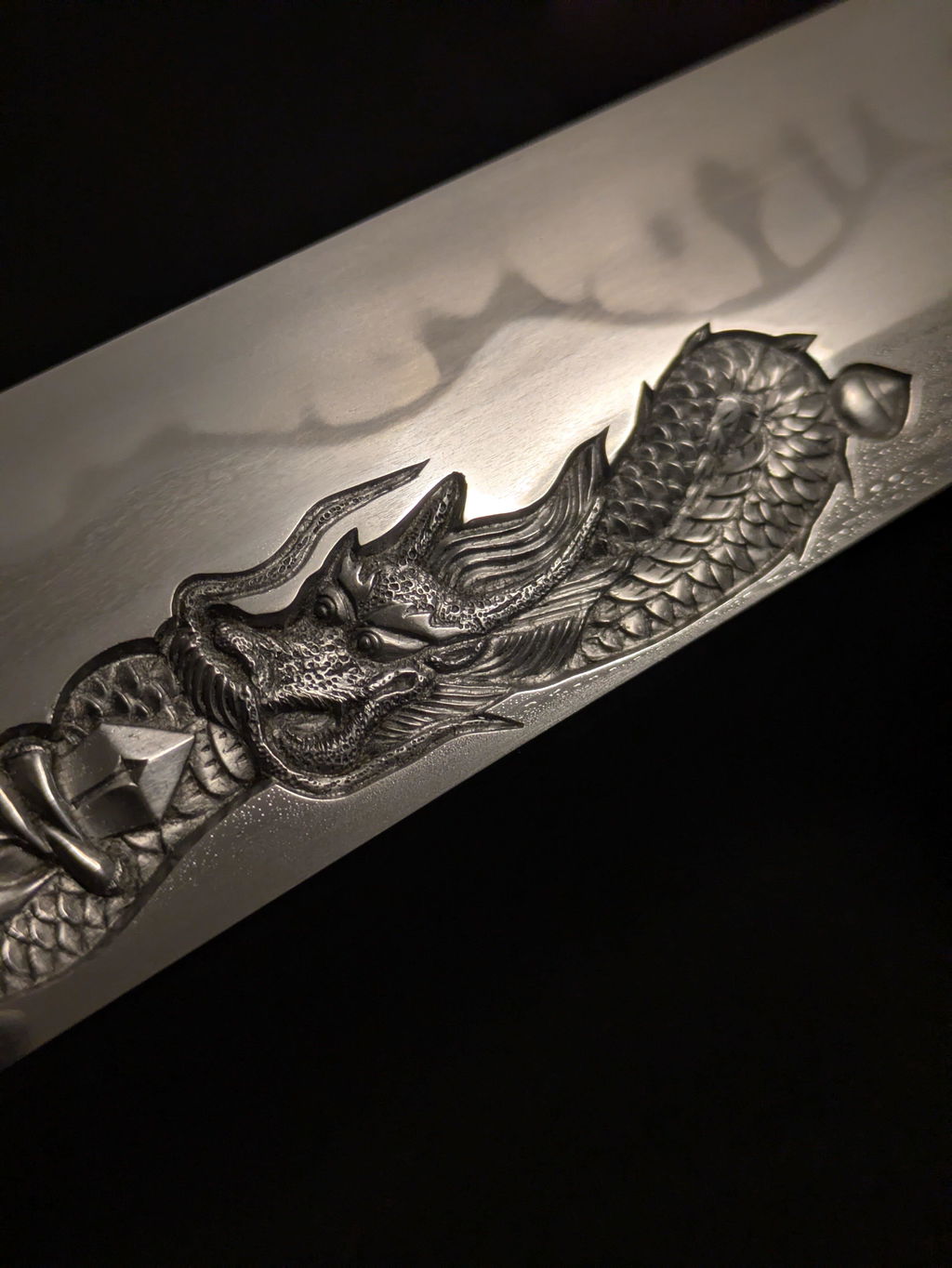
The blade's jihada shows the konuka-hada that defines the finest Hizen work — a finely packed, brilliantly bright itame in which jikei are visible under directional light. The hamon is suguha, with deep nioi and abundant nie — the kinsuji and sunagashi that Tadahiro's characteristic work shows at its best are present and active throughout the blade. An ubu nakago means the full physical record of the blade as Tadahiro left it is intact, including the complete Omi Daijo signature.
The condition that led to Juyo Token designation is exactly what Tozando's specialists observed on direct examination: a blade in extraordinary preservation for a Shinto-period piece, whose physical qualities — jihada, hamon, sugata — show Tadahiro's technique at its most fully realised. This is not a Tadahiro blade that happens to have survived well. It is a Tadahiro blade the NBTHK's panel identified as exemplary among his surviving work.
Among Tadahiro's hundreds of surviving blades, the number that have achieved Juyo Token designation represents a small fraction. Of those, the number currently available on the open market at any given time is smaller still. Tozando's specialists can provide the complete documentation, including the Juyo paper with its full panel assessment, to any serious enquirer.
available now in Tozando's collection
A Juyo Token Shinto blade by one of the Hizen tradition's three great masters — in ubu nakago condition, with the complete Juyo documentation. Contact Tozando's specialists for the full details, including the NBTHK's written assessment of this specific blade.
In Closing — What This Blade Represents
Omi Daijo Tadahiro worked for sixty years. In that time he produced more blades than any other Shinto-period smith and trained the next generation of Hizen masters — including the third-generation Mutsu no Kami Tadayoshi, whose work is considered the school's technical peak. His contribution to the Hizen tradition was not the founding inspiration of his father or the technical refinement of his son, but something equally important: the sustained, prolific practice that made the tradition a living and continuously developing school across the first half of the Edo period.
Of the hundreds of blades he left, the NBTHK has designated a fraction as Juyo Token — blades where his technique was operating at its highest level, and where that quality has been preserved intact across three centuries. The blade now in Tozando's collection is among this fraction. For a collector who understands what the Hizen tradition is, what Juyo Token designation means for a Shinto-period blade, and what it means to own a piece in ubu nakago condition with complete documentation — this is a genuinely significant acquisition opportunity.

Leave a comment: