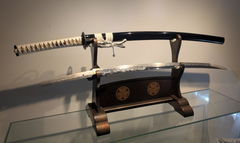
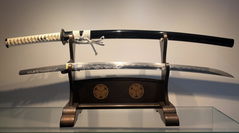
Antique Japanese Wakizashi Sword - Mumei, Shinto Era (36.6 cm)
¥200,000 ¥240,000

We are pleased to present an ubu, mumei (unaltered tang, unsigned) tantō believed to have been forged between the early and mid Edo period. Its generous kasane (thickness), which lends a satisfying, weighty heft to its plain and sturdy hira-zukuri (flat, ridgeless) form, gives it a robust, practical frame with something of the spirit of the battle-oriented yoroidōshi (armor-piercer). Freshly polished, it boasts a superb condition, "nearly flawless and sound," free of mi-kobore (chips) or any fatal defects. Furthermore, it is perfectly matched with a superb period koshirae (full mounting): a tsuka (hilt) tightly re-wrapped by an excellent contemporary tsuka-maki craftsman and finished with a durable lacquer coating, fuchi-kashira depicting thunderclouds with lightning roaring across the sky, and a superb kozuka (utility knife) on which tawara (straw bales), shells, and plum blossoms are brilliantly depicted in gold and silver inlay on a shakudō nanako (fish-roe-textured) ground — a rare treasure in both appreciation value and the satisfaction of ownership.
The jigane is an itame-hada (wood-grain pattern) tightly mixed with fine mokume (burl-grain) and nagare-hada (flowing grain), thickly covered with ji-nie, revealing the depth of iron character (tetsumi) matured over the ages and a refined, excellent texture.
The hamon is a dignified midareba (irregular temper line) based on ko-gunome (small gunome), with togariba (pointed elements) appearing in only a very few places. Bright, clear ko-nie gather deeply along the temper edge, fine ashi enter the hamon, and kinsuji and sunagashi run beautifully as if drawing lines — the blade is rich in activity in both ji and ha.
Freshly polished, it maintains a "nearly flawless and sound" condition, free of chips or fatal defects, allowing the brilliance of its clear temper edge and the profound depth of its iron character to be fully appreciated.
A hira-zukuri (flat, ridgeless construction) tantō form, excellent in usability. Particularly noteworthy is its solid kasane (thickness), with sturdy motokasane and sakikasane (thickness at base and tip). The mihaba (width) is also substantial, and the moment it is taken in hand, a pleasingly weighty heft is conveyed; it boasts a sturdy, practical frame with something of the yoroidōshi (armor-piercer) about it.
The nakago (tang) is ubu, preserving its appearance from the time of its making, softly covered with a rich, mellow ubu-sabi (original patina) nurtured over the ages.
An item of extremely high value for both appreciation and practical use, combining a high-quality period koshirae in very good condition with tsuka-maki (hilt wrapping) of the finest craftsmanship.
The fuchi-kashira are carved in takabori (high relief) with a design of raiun (thunderclouds), in which lightning races through gaps in jet-black clouds and thunder roars. Since ancient times, thunder and lightning have been revered as wielding the overwhelming energy of the heavens, and their fury was regarded as a symbol of "great military might" that defeats enemies. At the same time, thunder was also a sacred presence that brings the blessing of rain and promises a bountiful harvest of the five grains, and so it was revered as a powerful protective motif guarding the warrior.
The tsuka has been tightly re-wrapped, without the slightest deviation, by a skilled modern tsuka-maki craftsman, and carefully finished with a coating of urushi (lacquer). Lacquered tsuka-maki is a high-grade specification that gains dramatically improved durability and water resistance against sweat and wear, while providing a moist, deep luster and a superb grip that seems to cling to the hand.
The kozuka (utility knife) fitted at the side is a truly magnificent design, in which tawara (straw bales) colored in gold, countless shells, and a branch of plum blossoming with dignity are meticulously rendered in takabori with gold and silver inlay on a finely worked shakudō nanako ground. The "tawara" symbolize the wealth of the samurai house and a bountiful harvest of the five grains, while the "shells" symbolize good fortune (kai, a pun on "buying in" luck) and, with their hard shells, "protection of the body." By adding the "plum," which endures the winter and blossoms ahead of all other flowers, the piece expresses the deep prayer and aesthetic sense of the Edo samurai — "to dispel hardship and draw in abundance and fortune in arms" — making it a superb sword fitting brimming with refinement and auspiciousness.
The blade is fitted with a gold-colored habaki (blade collar). The lacquered saya (scabbard), metal fittings, and kozuka are all in very well-preserved condition, fully satisfying the sense of ownership when held in hand.
A supreme treasure to cherish, with a profound weight that resonates in the palm and the prayers of the samurai dwelling within. A dignified midareba of clear ko-nie-deki, with rich activity in ji and ha as kinsuji and sunagashi shine brilliantly as if drawing lines. And above all, the stately heft of its solid kasane, conveyed the instant it is taken in hand, together with the rich, mellow texture of its ubu-sabi, which carries the breath of the time of its making, deeply stirs the soul. Please savor this robust yet elegant blade, which still radiates a dazzling brilliance across the ages.
¥200,000 ¥240,000

¥400,000 ¥430,000

¥390,000 ¥410,000

¥270,000 ¥290,000

¥300,000 ¥330,000


Every blade reflects generations of knowledge, discipline, and precision passed down through traditional Japanese swordmaking. From the forging of steel to the final finishing touches, each piece is shaped with patience, mastery, and deep respect for heritage.

From carefully selected materials to the refined finishing of every surface, each sword is crafted and presented with uncompromising attention to detail. Our commitment to authenticity ensures every piece reflects true tradition, lasting quality, and enduring cultural value.

Designed with balance, simplicity, and purpose, our blades embody the harmony between refined form and skilled craftsmanship. Each sword represents a thoughtful union of strength, elegance, and the timeless discipline of Japanese artisans.